Foreign founders searching for China business setup fees almost always receive a single number that hides more than it reveals. The professional registration package is only one line. Registered capital is a five-year payment obligation, not a government charge. A representative office looks cheaper on paper until the cost-plus tax and the inability to issue fapiao are factored in. Joint ventures add partner negotiation time and shared control. This page separates the actual fees foreigners pay in 2026, compares WFOE, RO and JV on the numbers that matter, and flags the three overruns that still delay projects after the licence is issued.
The ranges below reflect current market practice for foreign-owned structures in major cities. They exclude salaries, operational rent beyond the registered address, and the capital injection itself. City, business scope and document quality still move the total by 15–30 percent.
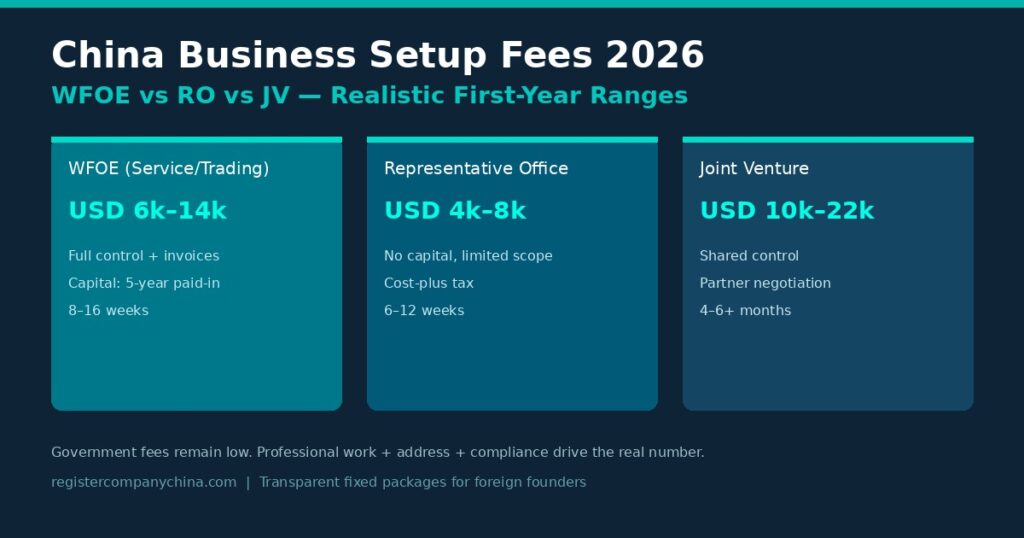
China Business Setup Fees 2026: Quick Comparison
| Entity | Typical all-in setup fees (USD) | Registered capital | Realistic timeline | Best for |
|---|---|---|---|---|
| Service / Trading WFOE | 6,000 – 14,000 | Yes (paid within 5 years) | 8–16 weeks | Operating business, invoices, hiring |
| Manufacturing WFOE | 18,000 – 30,000+ | Yes (higher expectation) | 4–6 months | Production, environmental licences |
| Representative Office (RO) | 4,000 – 8,000 | None | 6–12 weeks | Liaison, market research only |
| Joint Venture (JV) | 10,000 – 22,000 | Yes (shared) | 4–6+ months | Negative-list sectors or local partner needed |
Government filing fees themselves remain low — often RMB 0–1,000 for the business licence and basic chops in Shanghai, Shenzhen and Guangzhou. Almost all of the visible cost is professional work, document legalisation, a bank-acceptable address, and first-year compliance hand-over.
What Counts as a “Fee” vs What Does Not
Three categories are routinely mixed together in quotes. Separating them prevents budget shocks.
- True fees — government charges, agent/professional fees, notarisation + apostille + translation, company chops, tax and social-insurance registration, bank account opening support.
- Registered capital — money the foreign shareholder commits to the Chinese company and must pay in full within five years under the 2024 Company Law (Article 47). It is working capital, not a registration charge. SAMR and banks both review whether the declared amount is commercially reasonable for the scope.
- First-year running costs that start immediately — compliant registered address, monthly bookkeeping and tax filings, statutory audit, and any work-permit costs for foreign staff.
A realistic small service WFOE first-year cash outlay (excluding capital injection and staff salaries) therefore sits higher than the headline setup package. In Shanghai or Beijing the combined professional + address + basic compliance figure commonly lands between USD 12,000 and 25,000. Shenzhen, Guangzhou and many tier-2 cities are often 15–25 percent lower for the same scope.
WFOE Setup Fees in Practice (2026)
For a standard consulting or service WFOE owned by a foreign individual or overseas company, reputable full-service packages that include name pre-approval, articles, SAMR filing, chops, tax registration and basic bank coordination run USD 6,000–14,000. Trading WFOEs sit slightly higher because of customs and foreign-exchange preparation. Manufacturing files add environmental and production licences and regularly exceed USD 18,000–30,000.
Document legalisation is the most common extra. Since China joined the Apostille Convention, investors from member countries need only an apostille rather than full consular legalisation. Cost still ranges USD 800–2,500 depending on the number of documents and the home-country process. Incomplete or poorly translated packs remain one of the top reasons SAMR returns a file or banks delay KYC.
City practice differs. Shanghai and Beijing tend to sit at the upper end of fee ranges and expect more robust registered capital and address documentation. Shenzhen and Guangzhou often process faster for clean service and trading scopes and quote 10–20 percent lower professional fees for comparable work. Free-trade-zone options (Lingang, Qianhai, Hainan) can reduce corporate income tax to 15 percent for encouraged industries but do not eliminate the setup fees.
Representative Office Fees: Lower Setup, Higher Ongoing Friction
An RO has no registered capital requirement and a lower professional fee band (typically USD 4,000–8,000). Government charges are modest. The structure can be useful for pure liaison, market research or supplier coordination when the parent does not need to issue invoices or sign local contracts in its own name.
Two practical costs are frequently under-estimated. First, ROs are taxed on a cost-plus basis: the tax authority imputes a deemed profit (commonly at least 15 percent of expenses) and levies corporate income tax and VAT on that base. Rent, salaries (including offshore payments to the chief representative), and professional fees all feed the calculation. Second, an RO cannot issue fapiao. Any revenue-generating activity must still be booked through a WFOE or the overseas parent, which often forces an early conversion and double setup cost.
For most foreign founders who intend to sell, hire or invoice in China, the RO is therefore a temporary bridge rather than a permanent low-cost solution. The conversion cost later is real.
Joint Venture Fees and Extra Complexity
JV professional fees typically start higher (USD 10,000–22,000) because the process includes partner due diligence, joint articles, and often longer negotiation. Timeline regularly stretches to four to six months or more. Capital is shared according to the equity ratio and is still subject to the five-year paid-in rule. Negative-list sectors that still require Chinese participation remain the main reason to choose a JV; for open sectors a WFOE is usually cleaner and cheaper to control.
Three Common Cost Overruns That Still Stop Files
1. Registered address that banks reject. SAMR may accept a serviced-office or cluster address for the licence, but most mainland banks still require a commercial lease they can physically verify. Virtual addresses that fail bank KYC force a second address change and extra fees. Budget a compliant commercial address from day one (USD 1,500–6,000 per year in tier-1 cities for an acceptable solution).
2. Legal representative appearance for bank opening. Registration itself can often be completed remotely. Corporate bank account opening almost always requires the legal representative (or at least a director with authority) to appear in person for KYC. Travel, hotel and time away from the office add USD 2,000–6,000 that rarely appears in the original quote.
3. Under-declared or over-declared registered capital. Too low and the bank or tax bureau may question the commercial reality; too high and the five-year payment schedule becomes a binding cash commitment. Align the figure with realistic first- and second-year operating needs rather than marketing optics.
First-Year Budget Scenarios (Excluding Capital Injection)
Lean consulting WFOE (1–2 people, major city)
Professional package + legalisation + compliant address + basic bookkeeping/tax/audit: roughly USD 12,000–22,000.
Trading WFOE with small office and 3–5 staff
Higher professional fees, physical office, higher transaction volume for bookkeeping: USD 20,000–40,000 before salaries and inventory.
RO for pure liaison
Lower setup but ongoing cost-plus tax and no invoicing capacity: USD 8,000–15,000 first year before deciding whether to convert.
City choice still matters. Moving a clean service scope from Shanghai to Shenzhen or a tier-2 city can reduce both the professional fee and the annual address/compliance line without changing the legal capability of the entity.
How to Use These Numbers When Comparing Quotes
Ask every provider for an itemised list that separates:
- government and official charges,
- professional/agency fees and what is included (chops, tax registration, bank support),
- document legalisation and translation,
- registered address solution and whether it is bank-acceptable,
- first-year bookkeeping, tax filing and statutory audit,
- any expected travel for the legal representative.
Fixed-price packages that cover the full path from name pre-approval through bank account hand-over remove most of the surprise. Remote handling of the SAMR filing is now standard; the remaining in-person step is almost always the bank.
For a precise figure based on your city, scope and shareholder structure, the practical next step is a short scoping conversation rather than another generic range. Register Company China provides fixed packages for WFOE, RO and JV formation with transparent inclusions and remote process management. The goal is a number you can put into a board or investor budget without later amendments for address, bank or compliance items that should have been visible from the start.
Frequently Asked Questions
Are government fees for China company setup still low in 2026?
Yes. In most major cities the business licence itself carries little or no official charge. The visible cost is professional work, documents, address and post-licence compliance.
Is registered capital a setup fee?
No. It is the shareholder’s commitment to fund the company and must be paid in full within five years. It should match the commercial needs of the business scope.
Why do some quotes look much cheaper?
They often cover only the SAMR filing and basic chops, excluding legalisation, a bank-acceptable address, tax registration and first-year compliance. Those items still have to be paid.
Is an RO cheaper overall?
Setup fees are lower, but the cost-plus tax base and the inability to issue fapiao frequently make a later conversion necessary. For any revenue-generating plan a WFOE is usually the clearer long-term choice.
Do I need to travel to China for setup?
Registration filings can be handled remotely in most cases. Bank account opening for a foreign legal representative still normally requires an in-person appearance. Plan for that single trip.
If you already know your preferred city and business scope, a tailored quote that lists every line item is the fastest way to turn these ranges into a usable budget.