










How to Choose a Company Name in China as a Foreign Investor
How to Choose a Company Name in China as a Foreign Investor The name that matters is the Chinese name on the business licence. An English brand, a Hong Kong company name, or a domain does not register the company. For a wholly foreign-owned enterprise, that Chinese name is what banks, the tax bureau, customs, and counterparties will use on chops, contracts, and invoices. You can usually file it yourself through the local name-declaration system. The registrar keeps an accepted name for two months, or for one year if the company or a scope item needs pre-approval. During that hold the name cannot be used to trade. If the licence is not filed before the hold ends, the name drops back into the pool. What a China company name must contain Under the Enterprise Name Registration Provisions, in force since 1 March 2021, and the implementing measures issued by the State Administration for Market Regulation as Order No. 82, effective 1 October 2023, a company name is normally four parts in this order: Administrative division: the county-level or higher place where the company is domiciled. A district name is used together with its city, not alone. A zone or park name is used together with the administrative division, not by itself. Trade name, or zihao: at least two standard Chinese characters. A natural-person investor’s name may be used. Place names and industry words are allowed inside the trade name only if readers will not treat them as the location or the industry. Industry or business feature: tied to the main activity and, where possible, to the national industry classification. This is not the same text as the full business scope. Organisational form: a limited company uses 有限责任公司 or 有限公司. A company limited by shares uses the corresponding share-company wording. The form must match the real structure. Two layouts are common. The city can sit at the front: 上海启衡企业管理咨询有限公司. Or, where local practice allows, the city can sit in brackets after the trade name and before the form: 启衡(上海)企业管理咨询有限公司. The bracket form is a placement rule, not a different legal name type. SAMR’s Enterprise Name Declaration Guidelines (2025 edition), Announcement No. 59 of 2025, published on 4 January 2026, keep this four-part structure and spell out how foreign-invested enterprises, branches, and groups are named. The system still compares identical and similar trade names. A match with an existing name in the same industry, at the same registration authority, is blocked unless there is an investment relationship. Names of companies that were dissolved, revoked, or renamed stay in that comparison for one year. English names, parent brands, and the licence The licence name is in standard Chinese characters. If you translate it for contracts or a website, the translation must follow ordinary translation practice and must not break the naming rules. The English line is not a second registered name. Chops, bank accounts, and legal documents must use the name printed on the licence. A foreign parent’s English mark rarely maps one-to-one into two or three Chinese characters. Sound-alike characters, meaning-based characters, and a new Chinese trade name are all used. Pick the version you can actually register, then check it as a trademark. Company-name registration does not give you trademark rights, and a registered trademark does not by itself clear the company-name database. Wholly foreign-owned or foreign-controlled companies that use the foreign investor’s trade name may include (中国) in the name. If (中国) appears, the trade name must match the foreign investor’s name or the translation of that investor’s trade name. Putting 中国, 中华, 中央, 全国, or 国家 at the front of a name is a different and much harder route: SAMR reviews it strictly and the State Council must approve. Those words in the middle of a name are allowed only as an industry qualifier. What the declaration system rejects Names are self-declared. The national and local systems compare the proposal against banned-word lists and same-or-similar rules, then the applicant commits that a confusing name will be their legal problem. The registrar can still refuse the name at licence filing if it does not comply. Do not file

How to Set Up a Trading Company in China
How to Set Up a Trading Company in China A foreign investor can set up a trading company in China as a wholly foreign-owned limited company in most open wholesale and retail activities. The business licence is not the trading right. You can import and export in the company name only after the business scope includes import and export, customs registers the company as a consignor and consignee, and the bank and tax registrations that follow are in place. This guide covers the entity, the scope wording that customs actually reads, the registration sequence that replaced the old foreign trade operator filing, and the product licences and tax points that decide whether the first shipment clears. What a China trading company is In practice, most foreign investors use a wholly foreign-owned enterprise, still called a WFOE, structured as a foreign-invested commercial enterprise, or FICE. It is a Chinese limited liability company. The shareholder can be a foreign individual or an overseas company. Wholesale and retail distribution are generally outside the foreign investment negative list, so 100 percent foreign ownership is available for ordinary goods trading. Tobacco is the clear sector exception. Product rules still apply to food, cosmetics, medical devices, publications, and online sales of drugs and devices. A representative office is not a substitute. It cannot issue invoices, import in its own name, or hold import-export rights. A joint venture is relevant when a negative-list cap or a partner asset forces shared equity, not because trading itself requires a Chinese shareholder. If the shareholder documents, address, and apostille path are still open, start with what a WFOE is and the WFOE setup guide. Why business scope decides the trading right Business scope, jingying fanwei, is printed on the licence. Customs, the tax bureau, and the bank all read it. For a trading company it normally needs some combination of the following: Wholesale, if you sell to other businesses. Retail, if you will sell to consumers, including a later online store. Companies that draft only wholesale often have to amend before they can open a store. Import and export of goods, and of technology if that is part of the model. Commission agency, if the company will act for the group rather than buy and resell on its own account. Named product categories where the local office expects them, especially food, cosmetics, and medical devices. Without import and export in the scope, the company cannot register with customs as a consignor or consignee. Amending scope later means a change filing with the State Administration for Market Regulation, updated articles of association, and a wait before customs and tax records catch up. Include categories you can already see coming. Import-export rights in the current rules There is no separate foreign trade operator certificate to collect before customs. On 30 December 2022 the National People’s Congress deleted the filing requirement in the Foreign Trade Law, and local commerce departments stopped accepting those filings from the start of 2023. The revised Foreign Trade Law, adopted on 27 December 2025 and effective on 1 March 2026, did not bring the filing back. A company no longer needs that old commerce filing to apply for import or export licences, technology contract registration, or quota allocation. What remains is a sequence, not a single permit: A business licence whose scope includes import and export of goods or technology. Customs registration with the General Administration of Customs as a consignor and consignee of imported and exported goods. The customs code is tied to the unified social credit code. Declarations can then be filed in the company name. China Electronic Port enrollment and an account on the China International Trade Single Window. Most declarations run through these systems, and they usually follow customs registration. Foreign-exchange arrangements at the designated bank for import payments and export receipts. VAT general taxpayer status, then separate registration for export refunds if the company will export. Plan the first arrival against the customs code, not the licence date. Local processing times vary. Food, cosmetics, and medical devices add their own approvals and can stretch a file well past a plain trading

China Joint Venture Registration for Foreign Companies: When a JV Is Worth It
China entity choice China Joint Venture Registration for Foreign Companies: When a JV Is Worth It A China joint venture is worth registering only when a Chinese partner is legally required, or when that partner brings a licence, asset, or channel you cannot buy on contract. In open sectors, a wholly foreign-owned enterprise is usually faster, cleaner, and easier to control. As of 2026, most commercial activities sit outside the foreign-investment negative list. New joint ventures are limited liability companies under the Company Law, not the old equity or contractual joint-venture statutes. The registration filing can be handled remotely. Partner due diligence, the shareholders agreement, and the bank account usually cannot. Register Company China scopes both paths before filing. If a WFOE is available, that is the default recommendation. If a JV is actually required, the package covers name check, articles, joint-venture contract support, SAMR filing, chops, and a fixed-price handoff to banking and compliance. Request a fixed-price quote for your China entity. Start with the sector, not the partner pitch The first question is access, not chemistry. China Briefing’s guide to the 2024 Foreign Investment Negative List, still the edition cited in 2026 practice, counts 29 restricted or prohibited entries. Some require a Chinese equity share. Many manufacturing caps were removed in that edition. Sectors not on the list can generally be 100 percent foreign owned, subject to the separate market-access list and any industry licence. A local distributor offering a joint venture is not evidence that a joint venture is required. In consulting, software, trading, and most services, a WFOE can invoice, hire, and hold the bank accounts without sharing the board. Use a JV when one of these is true: The negative list, or a sector rule, caps foreign ownership or requires a Chinese partner. The partner contributes a licence, land-use right, factory, or distribution right that cannot be contracted cleanly. A specific project, often with a state-linked counterparty, will not proceed without shared equity. The Encouraged Foreign Investment Catalogue (2025 edition) took effect on 1 February 2026. It can improve incentives in listed industries. It does not force a joint-venture structure. WFOE or joint venture: the decision that changes the file Question WFOE Joint venture Ownership 100 percent foreign Shared with at least one Chinese investor Control Shareholder appoints directors and legal representative Reserved matters, board seats, and vetoes must be negotiated Revenue and fapiao Yes, inside the approved scope Yes, inside the approved scope Typical licence timeline once documents are complete Often 2 to 6 weeks in mature cities Similar filing time, but negotiation sits in front of it End-to-end before banking Commonly 8 to 16 weeks including apostille Commonly 3 to 6 months once partner work is real A representative office is a third option only for liaison work. It cannot invoice. If the goal is revenue, do not use an RO as a cheaper JV. Compare scope and cost on the WFOE registration cost breakdown before locking a partner term sheet. What China joint venture registration actually requires The AMR filing looks familiar if you have registered a WFOE. The extra work is the Chinese shareholder and the contract that governs them. Confirm the business scope against the negative list and any industry licence. A vague scope is a common reason files stall. Collect the foreign investor pack: certificate of incorporation, constitutional documents, shareholder chart to natural-person owners, and a board or shareholder resolution. These usually need apostille. Legalisation time in the home country is often two to four weeks. Collect the Chinese partner pack: business licence, articles, identity of the legal representative, and a resolution approving the investment. Check the licence on the national enterprise credit system, not from a PDF the partner sends. Agree registered capital, contribution form, and the five-year payment schedule. There is no general statutory minimum. Banks and the local AMR still expect a figure that matches the activity. In-kind contributions such as land or equipment need a defensible valuation. Sign articles of association and a shareholders agreement covering reserved matters, IP ownership, non-compete, deadlock, and exit. Do this before the name is filed. File for
China WFOE Single Shareholder and Legal Representative Bank Appearance Rules in 2026
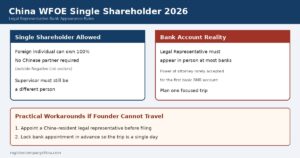
A foreign individual can now be the sole shareholder of a China WFOE in most open sectors. That change simplifies ownership structure, but it does not remove the practical bottleneck that still stops many remote founders: the legal representative almost always has to appear in person at a mainland bank to open the basic RMB account. This page covers what single-shareholder ownership actually allows in 2026, the remaining supervisor rule, why banks still insist on a face-to-face KYC interview, and the two workable options when the founder cannot travel. Single Shareholder WFOE: What Changed Under the revised Company Law, a limited liability company can have a single shareholder. Foreign natural persons are recognised as foreign investors under the Foreign Investment Law. In sectors not on the Negative List, one foreign passport holder can therefore own 100% of a WFOE. This removes the old practical need to invent a nominal second shareholder just to satisfy a headcount rule. The structure is cleaner on paper and faster to document. One constraint remains in most filings: the director (who is usually also the legal representative) and the supervisor must be different individuals. You cannot hold both roles yourself. Why the Legal Representative Still Has to Appear for Banking Company registration with SAMR can be completed with notarised and apostilled documents. Bank account opening is a separate process governed by bank KYC rules and the customer due diligence measures that took effect in 2026. In practice, almost every major mainland bank requires the legal representative to sit in the branch, present the original passport, answer questions about the business model, source of funds and expected transaction profile, and sign the account opening forms. Powers of attorney and video calls are rarely accepted for the first basic RMB account. A few foreign banks may allow video KYC when the group already has an existing relationship, but this should not be assumed when planning a first WFOE. The interview itself is short. The travel and scheduling around it are what extend the timeline. Two Practical Workarounds Appoint a China-resident legal representative before incorporation. A trusted local director or senior hire can hold the legal representative title. The foreign founder remains the sole shareholder and retains control through the articles of association and shareholder resolutions. This removes the need for the founder to travel for the bank appointment. Plan one focused trip after the licence is issued. Once the business licence is in hand, lock a specific bank branch appointment in advance. The trip then becomes a single, scheduled appointment rather than an open-ended wait. Choosing the legal representative is one of the highest-leverage decisions in the entire setup. The person controls a personal chop, appears on the business licence, and is the public face for banks, tax offices and counterparties. Additional 2026 Point for Individual Shareholders From 1 September 2026, dividends paid by a foreign-invested enterprise to a foreign individual shareholder are subject to 20% Chinese individual income tax (with possible treaty relief). Corporate shareholders may face different withholding treatment depending on the holding structure and applicable tax treaty. This tax change does not affect the ability to be a sole shareholder, but it does affect the long-term cost of taking profits out as an individual. Common Mistakes Assuming that because registration can be remote, banking can also be remote. Appointing the same person as both legal representative and supervisor. Declaring a high registered capital without a realistic five-year payment plan (the capital must still be paid in within five years). Choosing a cheap virtual address that later fails bank KYC or tax bureau inspection. Decision Checklist Before You File Is the sector fully open to 100% foreign ownership? Who will be the legal representative, and can that person appear at a bank in China? Who will serve as supervisor (must be a different person)? Is the registered address bankable and acceptable to the local SAMR? Have you modelled the five-year capital contribution schedule? Register Company China handles single-shareholder WFOE setups for foreign individuals and overseas companies, including the practical coordination of legal representative arrangements and bank account opening. If you are deciding between
How Americans Can Register a Company in China
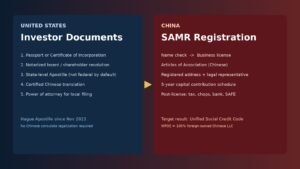
How Americans Can Register a Company in China Yes. A U.S. citizen or a U.S. company can register a Chinese limited liability company and own 100 percent of it in most open sectors. The usual vehicle is still called a WFOE in practice: a Chinese LLC owned only by foreign shareholders. The process is no longer a consular-legalization marathon. Since 7 November 2023, the United States and China both apply the Hague Apostille Convention, so U.S. public documents need a state (or, for federal papers, Department of State) apostille rather than Chinese embassy authentication. The harder work in 2026 is choosing the shareholder structure, drafting a defensible business scope, setting a realistic five-year capital schedule, and getting the U.S. document package right the first time. What “register a company in China” actually means for a U.S. founder You are not moving your Delaware or California entity into China. You are creating a new Chinese legal person. That company receives a business license from the local Administration for Market Regulation (AMR / SAMR), an 18-digit Unified Social Credit Code, company chops, a tax profile, and the right to open RMB and foreign-currency accounts. Three structures still appear in U.S. search results. Only one of them is a full operating company: WFOE (wholly foreign-owned LLC) — 100 percent foreign ownership, can invoice, hire, import, and sign contracts in its own name. Default choice when the sector is off the Negative List. Joint venture — needed only when the Foreign Investment Negative List still caps foreign equity or requires a Chinese partner. Representative office — cannot generate revenue or issue fapiao. Useful for liaison, not for selling. The 2024 edition of the Negative List (effective 1 November 2024) has 29 restricted items and removed remaining manufacturing-sector access caps. Wholesale, most professional services, and ordinary trading are open to 100 percent foreign ownership. Product-specific rules still apply (tobacco, certain publications, some online pharmaceutical sales). Individual American vs U.S. company as shareholder Either can be the investor. The choice changes the document chain more than the SAMR form. Investor Core U.S. documents Typical extra time When it is cleaner U.S. individual Passport (notarized + apostille in many cities), proof of address, appointment papers Shorter package Solo founder, consulting or light trading WFOE U.S. corporation or LLC Certificate of incorporation or good standing, parent articles or operating agreement, board or member resolution, signatory authority proof — each apostilled in the issuing state 1–3 extra weeks if several states are involved Group wants limited liability at the U.S. layer, or multiple founders A Delaware holding company with a resolution notarized in California and a passport copy notarized in Texas needs three separate apostilles. That mismatch is the most common U.S.-specific delay. U.S. apostille path (the step most guides still get wrong) Chinese consulates in the United States no longer legalize ordinary public documents destined for mainland company registration. The New York consulate published this change after 7 November 2023. Notarize private papers (board resolution, power of attorney, passport copy where a notary is required) in the state where the signer appears. Obtain the apostille from that state’s Secretary of State. A Delaware good-standing certificate is apostilled in Delaware. A California notarized resolution is apostilled in California. Federal documents (rare for WFOE setup) go to the U.S. Department of State, not a state office. Commission a certified Chinese translation of the apostilled bundle. SAMR files in Chinese. Do not send the package to a Chinese embassy “just in case.” Extra stamps do not help and can confuse the local AMR clerk. Documents China will actually file Local checklists vary by city, but the 2026 SAMR standardized materials for business-entity registration point to the same core set: Company registration application form (the 2026 version, in force from 1 May 2026, collects the capital-contribution timetable on the form itself) Articles of Association in Chinese, signed by all shareholders Investor qualification papers (apostilled U.S. corporate set or individual identity set) Appointment of the legal representative, director or executive director, and supervisor Registered-address proof: commercial lease plus the landlord’s property certificate Beneficial-owner declaration (PBOC/SAMR beneficial-owner information rules) Power of attorney
China WFOE Annual Audit and Tax Filing Cost for Foreign Companies
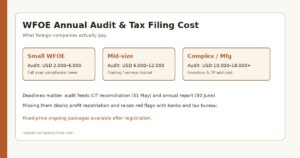
Once a WFOE is licensed and banked, the recurring cost that most foreign founders underestimate is the annual compliance cycle: statutory audit, corporate income tax reconciliation, and the SAMR annual report. These are not optional. Missing the deadlines blocks profit repatriation and can put the company on the abnormal operations list. This guide gives realistic cost ranges for foreign-invested companies, explains what drives the price, and shows how the filings connect. What Must Be Done Every Year Every WFOE must complete three linked pieces of work: Statutory annual audit by a Chinese-licensed CPA firm. The audit report is the foundation for the tax filing that follows. Corporate Income Tax (CIT) annual reconciliation, due by 31 May. Late filing attracts daily interest and potential penalties. Annual enterprise report (including foreign-investment information) filed with SAMR, generally by 30 June. The audit feeds the CIT reconciliation; the CIT clearance and audit report together support dividend remittances through the bank and SAFE. Cost Ranges That Foreign Companies Actually Pay Figures below are typical professional fees for the statutory audit itself (local or mid-tier firm). Bookkeeping and monthly tax filings are separate. Small, low-activity WFOE (few invoices, under roughly USD 1 million revenue, clean books): USD 2,000–6,000 Mid-size service or trading WFOE: USD 6,000–12,000 Manufacturing WFOE with inventory or more complex cost accounting: USD 10,000–18,000 Larger or multi-entity groups, or those needing transfer-pricing documentation: USD 15,000–35,000+ Big Four branding usually adds 30–50 percent and is rarely necessary for unlisted FIEs. Many small WFOEs combine monthly bookkeeping, tax filings and the annual audit into an outsourced package that can sit in the low thousands of US dollars per year when volume is modest. What Drives the Price Up or Down Transaction volume and number of fapiao, inventory counts, intercompany flows, payroll headcount, and whether transfer-pricing local files are required. First-year audits often take longer because accounting policies and opening balances need to be established. Clean monthly books throughout the year keep the year-end fee lower. Timeline in Practice Financial year ends 31 December. Bookkeeping should be finalised in January. Audit fieldwork typically runs February–March, with the report targeted for April so the CIT reconciliation can be filed by 31 May. The SAMR annual report window runs to 30 June. Profit repatriation is usually possible after both the audit and CIT are cleared. How Register Company China Supports Ongoing Compliance Register Company China provides fixed-price packages that cover registration and can continue into monthly bookkeeping, tax filings and coordination of the annual audit. The goal is predictable cost and clean hand-over so foreign shareholders are not surprised by year-end fees or missed deadlines. If your WFOE is already operating or you are about to file, request a fixed-price quote for the compliance scope that matches your transaction volume and city. View our services or request a quote. Related reading: Remote WFOE Registration, WFOE Registration Process, and Legal Representative Requirements. FAQ Is the annual audit required even if the company had no revenue? Yes. A dormant or zero-revenue WFOE still needs the audit and the annual report. The cost is lower, but the obligation remains. Can I skip the audit and only file the tax return? In practice no. The CIT reconciliation relies on audited figures in most cases, and banks and SAFE expect the audit before approving outward dividends. Who can sign the audit report? Only Chinese-registered CPAs. Foreign parent auditors cannot replace the local statutory audit. What happens if I miss the 31 May CIT deadline? Interest accrues daily on any unpaid tax, and repeated late filings raise the chance of a tax bureau review of prior years.
