China WFOE Annual Compliance and Tax Filing 2026
A Wholly Foreign-Owned Enterprise does not finish its obligations when the business licence is issued. From the first full year of operation, the company sits inside a fixed compliance calendar that covers bookkeeping, tax returns, a statutory audit, corporate income tax settlement, and public annual reporting. Missing the main deadlines is expensive and visible.
What annual compliance means for a WFOE
Annual compliance is the set of recurring filings and reviews that keep the company in good standing with the tax bureau, the State Administration for Market Regulation, and, where relevant, foreign-exchange and customs systems. It includes monthly or quarterly VAT and surcharge filings, individual income tax withholding if there are employees, quarterly corporate income tax prepayments, a year-end statutory audit, the corporate income tax annual reconciliation, and the enterprise annual report published through the National Enterprise Credit Information Publicity System.
Dormant companies are not exempt. A WFOE with no revenue still needs bookkeeping, nil tax filings where required, and the annual report. Treating inactivity as a pause is a common mistake and often ends with an abnormal-operations listing.
The core 2026 deadline chain
Most foreign finance teams work backward from three hard dates.
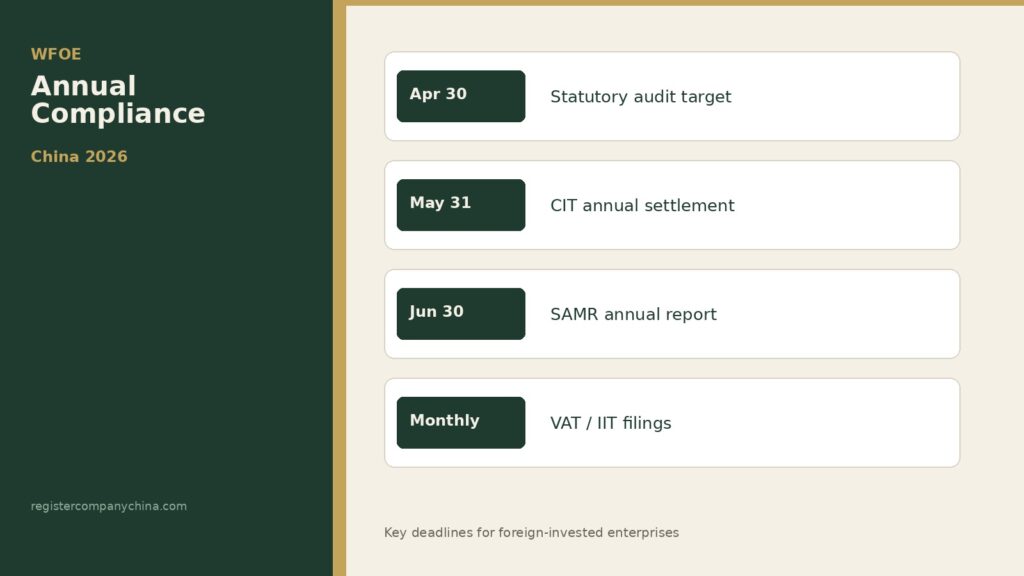
Statutory audit target: end of April. A Chinese-registered CPA firm issues audited financial statements. Many tax bureaus will not accept the annual corporate income tax return without this report.
Corporate income tax annual settlement: 31 May. This is the main tax deadline of the year. The company reconciles quarterly prepayments against final taxable profit, files the annual return, and pays any balance. Late payment attracts daily late fees.
SAMR annual report and related foreign-investment reporting: 30 June. The company submits operating and shareholder information through the national publicity system. Failure can place the entity on the abnormal operations list, which affects banking, government procedures, and future changes.
Alongside these annual items, VAT and individual income tax continue on a monthly or quarterly cycle, and corporate income tax is prepaid each quarter.
Documents the tax and audit teams usually need
Expect to prepare financial statements, bank reconciliations, fapiao and expense records, payroll and social insurance data if staff are on payroll, related-party transaction information where thresholds apply, and the signed audit report. R&D or preferential-rate claims need supporting project files; without them, deductions are often lost.
What happens if you miss a deadline
Late corporate income tax attracts daily late fees. Missed annual reporting can trigger listing on the abnormal operations registry, public credit impact, and friction with banks and regulators. Persistent non-compliance can complicate licence changes, profit repatriation, and eventual deregistration. Closing a WFOE already requires multi-year tax clearance; an unclean compliance history lengthens that process.
Practical way to run the year
Engage the CPA firm before year-end so fieldwork can start early in the new year. Keep bookkeeping current every month rather than reconstructing twelve months in April. Diary the 31 May and 30 June dates as non-negotiable. If the company is small or loss-making, file the annual tax return earlier in the window to leave room for bureau queries. Confirm local practice for audit timing and any city-level variations, especially for trading entities with customs obligations.
China WFOE annual compliance and tax filing in 2026 is mostly calendar discipline. The rules are predictable. The cost of ignoring them is not.
If your WFOE is approaching its first full compliance year, map the audit, May tax settlement, and June annual report together with ongoing monthly filings. That sequence is what keeps the company clear for banking, dividends, and future corporate changes.