China WFOE Registration Timeline and Cost for Foreigners in 2026
If you’re a foreign founder looking at China company setup in 2026, the official process looks neat on paper. Eight steps, business licence in a couple of weeks, done. Reality is messier. The licence part is usually quick. The bank account is where most people lose weeks or months.
Here’s the practical picture based on current rules and what actually happens on the ground.
Realistic Timeline: What Takes Time in 2026
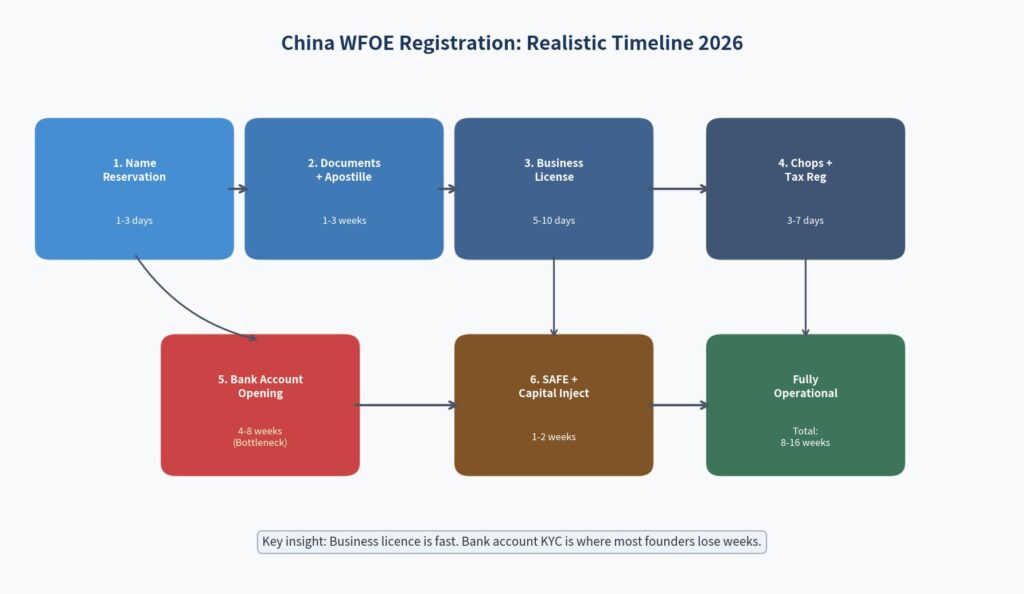
End-to-end for a clean consulting or trading WFOE usually lands between 8 and 16 weeks. Manufacturing or restricted-scope files run longer. The sequence itself has not changed much since the Foreign Investment Law, but two things still catch people:
- The 2024 Company Law five-year capital contribution rule (effective 1 July 2024)
- Tighter bank KYC that started biting harder in 2025–2026
Typical breakdown:
| Step | What happens | Typical time |
|---|---|---|
| 1. Name reservation | Submit Chinese name options to local SAMR | 1–3 working days |
| 2. Documents + Apostille | Shareholder docs, AoA, power of attorney | 1–3 weeks (depends on your country) |
| 3. Business licence | SAMR issues the unified licence + foreign investment report | 5–10 working days on a clean file |
| 4. Chops + tax registration | Public Security Bureau chops, tax bureau activation | 3–7 days |
| 5. Corporate bank account | RMB basic account + foreign currency capital account | 4–8 weeks (this is the real bottleneck) |
| 6. SAFE + first capital injection | Foreign exchange registration and initial capital arrival | 1–2 weeks after bank account is live |
Total realistic window: 8–16 weeks from kickoff to a company that can actually invoice and receive money. The business licence itself is rarely the long pole.
What It Actually Costs in 2026
Professional fees for a standard service or trading WFOE usually sit between USD 6,000 and 12,000 all-in (document prep, filings, chops, bank coordination). Manufacturing or more complex scopes run higher. Government licence fees themselves are effectively zero in most cities.
Registered capital is separate. There is still no statutory minimum for most activities, but the five-year paid-in rule means you have to set a number you can actually inject. Typical practical ranges we see:
- Consulting / services: RMB 100,000 – 500,000
- Trading: RMB 500,000 – 3,000,000
- Manufacturing: RMB 1,000,000+
Set it too low and some local offices or banks will push back. Set it unrealistically high and you create a future compliance headache.
Three Places Applications Commonly Get Stuck
1. Registered address
Virtual or pure shared addresses are under heavier scrutiny. Many cities now want a real commercial lease with the 25-digit property code. Banks check the address too. A cheap “virtual office” that looks fine for SAMR can still kill the bank application later.
2. Bank account KYC
This is the step that surprises people. Some banks still want the legal representative to appear in person or complete video verification. Ownership structure, source of funds, and business scope all get reviewed more carefully than in 2022–2023. Choosing the right bank branch early matters more than most founders expect.
3. Capital contribution schedule
Under the 2024 Company Law you must pay in the full subscribed capital within five years. The Articles of Association and the application form now capture the timeline. Vague or overly aggressive schedules get questioned.
Documents You Actually Need
For a foreign individual or overseas company shareholder:
- Passport (or corporate registration documents) – notarised and apostilled if your country is in the Hague Convention (China joined in November 2023)
- Articles of Association in Chinese
- Lease or property documents for the registered address
- Appointment letters for legal representative, director/supervisor, and general manager if applicable
- Bank reference or proof of creditworthiness in some cases
Apostille replaced the old dual legalisation route for Convention countries. That alone has cut 1–3 weeks off many files.
City Differences Still Matter
Shanghai, Shenzhen, Guangzhou and Beijing remain the most common choices. Processing speed at SAMR is similar for clean files, but bank appetite and address rules vary. Some free-trade zones still offer practical advantages on tax or customs, but they do not magically remove the bank-account step.
What to Do Next If You’re Serious
Start with three decisions before you prepare any documents:
- Exact business scope (this affects both SAMR and the bank)
- Realistic registered capital and payment schedule
- Whether you can get a compliant commercial address that banks will accept
Once those are locked, the rest is process. The remote route works for most founders — you do not need to fly to China for the licence itself. The bank step is the one that still sometimes requires physical presence or careful coordination.
If you want a clear fixed-price package that covers name reservation through bank account opening and initial compliance, that is exactly what we handle for foreign clients. No need to piece it together yourself.
FAQ
How long does the business licence actually take?
On a clean file, 5–10 working days after submission in most major cities. The longer waits almost always sit in document preparation or the bank stage.
Can I open the bank account remotely?
Sometimes, with power of attorney and video KYC. Many banks still prefer or require the legal representative to appear. Plan for the possibility of a trip or a carefully chosen bank that accepts remote options.
Is a virtual office still usable in 2026?
Risky. SAMR and banks both look harder at substance. A proper commercial lease with the property code is safer and often required.
What changed with the five-year capital rule?
You can still subscribe any amount, but you must pay it in full within five years of establishment. The schedule goes into the Articles and the registration form. Treat it as a real commitment.
Do I need a Chinese partner?
No, for activities outside the Negative List. A WFOE gives 100% foreign ownership in most consulting, trading, tech and manufacturing sectors.