Featured image: wfoe-registration-process-china-2026.jpg (attached)
WFOE Registration Process in China 2026: Steps, Timeline, and Documents
Foreign founders still treat a Wholly Foreign-Owned Enterprise as the default way to operate in China with full ownership. The WFOE registration process in China in 2026 is more digital than it was five years ago, but it is not a one-click filing. The licence can arrive in days once the file is clean. The work that decides the calendar is document authentication, business-scope wording, a bankable registered address, and the bank interview that follows the licence.
This guide walks through the current process as local SAMR offices and banks actually run it, including the five-year capital injection rule and the single-shareholder option that took effect in 2026.
What a WFOE is in 2026
A WFOE is a Chinese limited liability company owned 100 percent by one or more foreign shareholders. It can invoice, hire staff, sign contracts, open RMB and foreign-currency accounts, and hold IP. It is no longer a special entity type under a separate WFOE law. After the Foreign Investment Law, it is registered as a foreign-funded LLC, with the same Company Law duties as a domestic company, subject to the Negative List.
Consulting and trading scopes remain the fastest path. Manufacturing, education, food, and other licensed activities add pre-approvals before SAMR will issue the business licence.
Realistic timeline for the WFOE registration process
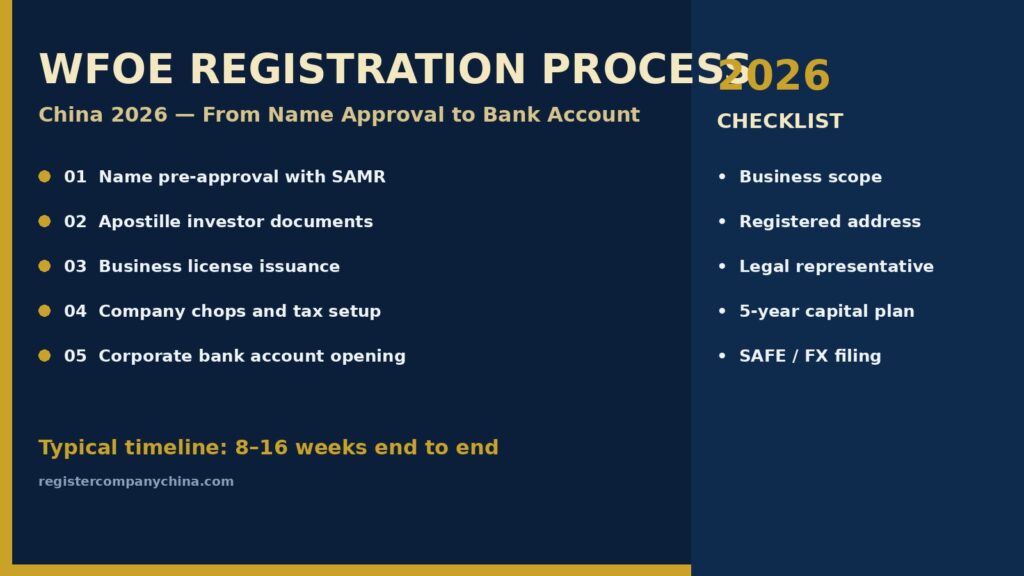
Quotes that promise a four-week WFOE usually describe only the licence phase. End to end, including apostille work in the home country and a corporate bank account in China, most service or trading files close in 8 to 16 weeks. Cities with mature online portals, such as Shanghai, Shenzhen, and Guangzhou, sit at the short end when documents arrive complete. Manufacturing and files with messy address proof sit at the long end.
A practical split looks like this:
- Document preparation and apostille: 2 to 4 weeks
- Name pre-approval: 3 to 10 working days
- Business licence and foreign investment information report: 1 to 3 weeks
- Chops, tax, social insurance, SAFE: 2 to 4 weeks
- Bank account opening: 2 to 8 weeks
Start legalisation and the bank conversation in week one. Those two items, not the licence itself, are the usual bottlenecks.
Step 1. Confirm scope, city, and capital
Before any filing, check that the intended activity is open to 100 percent foreign ownership on the current Negative List. Then write a Chinese business scope as a list of concrete services or goods, not a vague industry label. Vague wording triggers manual review and can leave you with a licence that does not cover the revenue you planned to collect.
There is still no statutory minimum registered capital for most activities. The binding 2024 Company Law rule that matters in 2026 is that subscribed capital must be paid in full within five years of incorporation. Set an amount you can actually inject and defend against a two-to-three-year operating plan. Too low looks weak to banks. Too high creates a cash call you did not need.
City choice matters. The same consulting file moves faster in Shenzhen or Guangzhou than in a smaller city with less digital capacity. The registered address must be a commercial space that banks will inspect. A cheap virtual address that fails physical verification is one of the most common reasons an otherwise approved WFOE cannot open an account.
Step 2. Prepare and apostille investor documents
China joined the Hague Apostille Convention in November 2023. For shareholders in member countries, a single apostille now replaces the old embassy legalisation chain. That cut weeks and several hundred dollars off a typical file. Investors from non-member countries still need consular legalisation.
Corporate shareholders usually provide a certificate of incorporation, articles or bylaws where the city asks for them, a board resolution authorising the China company, a register of directors, and often a recent bank reference. Individual shareholders provide a passport with at least six months of validity and, in some districts, proof of address and a bank reference. All foreign-language papers need a certified Chinese translation.
From July 2026, a single foreign individual can be the sole shareholder of a WFOE. You still cannot combine the director and supervisor roles in the same person. Name a separate supervisor before you file.
Step 3. Name pre-approval
Chinese company names follow a fixed pattern: administrative division, trade name, industry word, and company type such as Co., Ltd. The English name has no legal standing with SAMR or most banks. File three to five options. Restricted words, names that clash with existing marks, and industry words that do not match the scope are the usual reasons for a bounce. Approval is typically valid for six months.
Step 4. File for the business licence
The package goes to the local SAMR or AMR office: application form (the 2026 version collects the capital contribution schedule), articles of association, investor papers, address proof, and appointment letters for the legal representative, director, supervisor, and general manager. A foreign investment information report is filed as part of the same process rather than as a separate MOFCOM pre-approval for open sectors.
When the file is clean, the unified business licence, which carries the 18-digit Unified Social Credit Code, is often issued in 5 to 15 working days. That licence is the company’s legal identity. It is not yet a fully operating company.
Step 5. Chops, tax, and post-licence filings
Company chops are carved and recorded with the public security bureau. In practice the company chop, financial chop, legal representative chop, and invoice chop carry more weight in China than a wet signature. Tax registration with the State Taxation Administration should follow within 30 days. Trading companies add customs and foreign-trade operator filings. SAFE registration is required before inbound capital can land cleanly.
Step 6. Open the corporate bank account
This is still the longest single step in the WFOE registration process in 2026. Banks review the legal representative, inspect the registered address, and apply their own KYC rules. An interview is common. Allow two to eight weeks and do not treat the licence date as the go-live date. Until the basic RMB account and, where needed, the capital account exist, you cannot pay staff or receive investment on a normal timetable.
Mistakes that add months
Founders who have been through the process tend to name the same failures. Apostille names that do not match the passport or corporate registry letter for letter. A business scope written like a marketing slogan. An address that cannot survive a bank site check. Capital set so high that the five-year clock becomes a problem. An agent who sold a licence-only timeline and left banking as an afterthought. A legal representative who cannot attend the bank interview when the bank insists on it.
Fix those items before filing and the official steps are predictable. Leave them loose and a six-week plan becomes a nine-month rebuild.
What to do next
If the sector is open and you need to invoice and hire in China, a WFOE is still the structure that matches that plan. A representative office cannot earn revenue. A joint venture is mainly for Negative List sectors or a partner who brings something you cannot buy. Map the scope, lock a compliant address, start apostille work immediately, and treat the bank as part of week one rather than week twelve.
Register Company China handles the full remote path: name pre-approval, articles, SAMR filing, chops, address, and bank coordination, with fixed packages and no requirement to travel. Request a quote with your city, scope, and shareholder type if you want a file-specific timeline instead of a generic range.