China Trading WFOE Business Scope Drafting Errors That Block Customs Registration and Bank Approval in 2026
Foreign founders setting up a trading company in China still lose weeks after the business licence arrives. The revised Foreign Trade Law (effective 1 March 2026) permanently removed the old foreign-trade-operator record-filing step, yet the practical bottlenecks remain: the exact Chinese wording of the business scope on the licence, customs registration as consignor/consignee, and bank KYC that cross-checks the same scope against expected transaction patterns.
What the 2026 Law Actually Changed
The 2022/2023 abolition of the MOFCOM foreign-trade-operator filing was confirmed (not reversed) by the 2025 revision that took effect on 1 March 2026. You no longer need a separate “foreign trade operator” certificate. Import-export rights now rest on:
- Business scope that explicitly includes “import and export of goods” (货物进出口) and, where relevant, technologies.
- Customs registration with the General Administration of Customs as consignor and consignee (usually via Single Window).
- Bank foreign-exchange arrangements linked to the same scope.
Product-specific licences (food, cosmetics, medical devices, dual-use items, etc.) remain required and sit outside the basic licence.
The Five Scope Errors That Still Cause Rejection or Delay in 2026
Local SAMR officers, customs, and bank compliance teams all read the same short Chinese phrases. These patterns repeatedly surface in practice:
| Error | What happens | Typical delay |
|---|---|---|
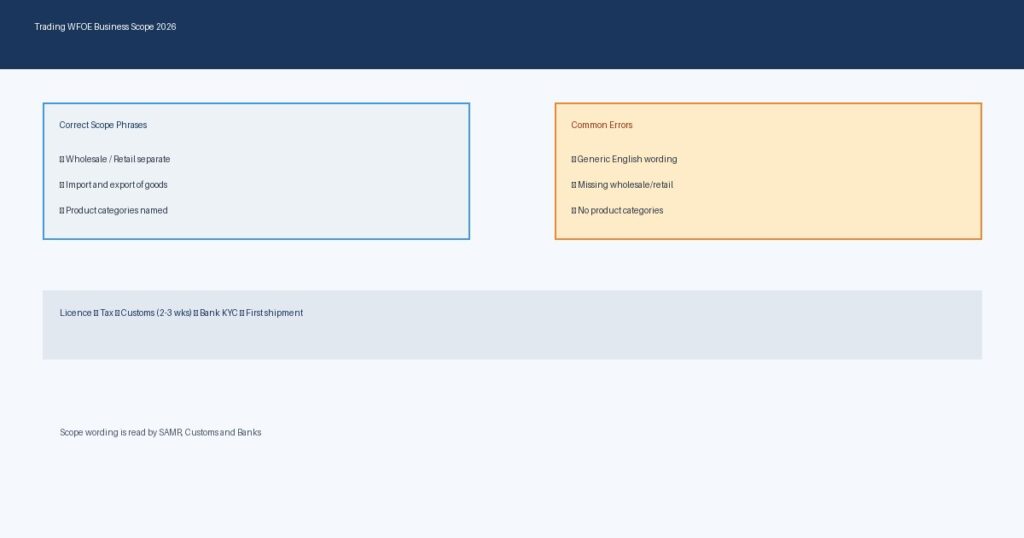
| Scope says only “import and export” without wholesale/retail or product categories | Customs may register, but tax bureau later blocks 13% special fapiao for domestic sales; bank questions transaction profile | 2–4 weeks amendment |
| Missing “wholesale” and “retail” as separate items | Can clear imports but cannot legally sell to end consumers or issue matching invoices | Amendment + re-tax registration |
| Generic English-style description instead of standard GB/T category phrases | SAMR rejects the filing or forces rewrite before licence | 1–2 weeks |
| No product-category language for regulated goods (food, cosmetics, etc.) | Customs registration succeeds, but first shipment held for missing sector licence | Weeks to months |
| Scope too narrow for foreseeable 12-month plans | Licence issued, then first expansion requires change filing, public notice, and updated bank/tax records | 3–6 weeks |
A clean trading scope usually contains short standard phrases such as: wholesale of [product category]; retail of [product category]; import and export of goods and technology; commission agency; and supporting services that match actual contracts (warehousing, logistics consulting, after-sales). Over-broad catalogues are also rejected or later trigger tax scrutiny.
Sequencing That Actually Works
- Lock the Chinese scope wording with your agent before name reservation.
- File SAMR with the five-year capital schedule already on the form (required since May 2026).
- After licence and chops, complete tax registration (general taxpayer status if you will claim input VAT and export refunds).
- Customs registration (2–3 weeks typical once tax is live).
- Bank basic RMB + capital account in parallel; expect the legal representative appearance and UBO penetration under the January 2026 due-diligence rules.
- First shipment only after the customs code is active. Planning the arrival against the business licence alone is the most common avoidable delay.
Registered capital for a trading entity is a commercial decision, not a statutory minimum. Banks and customs look for credibility against expected inventory and working capital (common practical range RMB 500,000–2,000,000 depending on volume and city). Under-declaring still risks questions; over-declaring creates a five-year funding obligation under the Company Law.
Common Failure Points Foreign Founders Hit
- Drafting the scope in English first and translating loosely — Chinese category language is rigid.
- Treating customs registration as an afterthought once the licence is in hand.
- Choosing a registered address that passes SAMR but fails bank physical verification.
- Underestimating that banks now apply the January 2026 beneficial-owner identification rules and cross-check the scope against the business plan and source of funds.
- Expanding product lines later without budgeting for the amendment cycle.
FAQ
Do I still need a separate import-export licence?
No standalone MOFCOM filing is required. You need the scope wording plus customs registration.
How long from business licence to first cleared shipment?
Typically 4–8 weeks if scope, tax, and customs are sequenced correctly; longer if any step requires rework.
Can a consulting scope later add trading?
Yes, but it is a formal change (articles, filing, notice, then customs and bank updates). It is almost always cheaper to include reasonably foreseeable trading language at the start.
Does the bank care about the exact scope wording?
Yes. Compliance teams compare the licence language with the expected transaction types and counterparties. A mismatch is a frequent reason for extra questions or refusal.
For the full incorporation sequence, registered-address rules, and bank-account practicalities that sit behind a clean trading setup, see the related guides on WFOE registration process, corporate bank account opening, and setup cost ranges on the site.
The 2026 law removed one old form. It did not remove the need for precise Chinese business-scope drafting, parallel post-licence filings, and a bank that will accept the resulting transaction profile. Getting those three right is what determines whether a trading WFOE is operational in two months or still waiting at month four.