
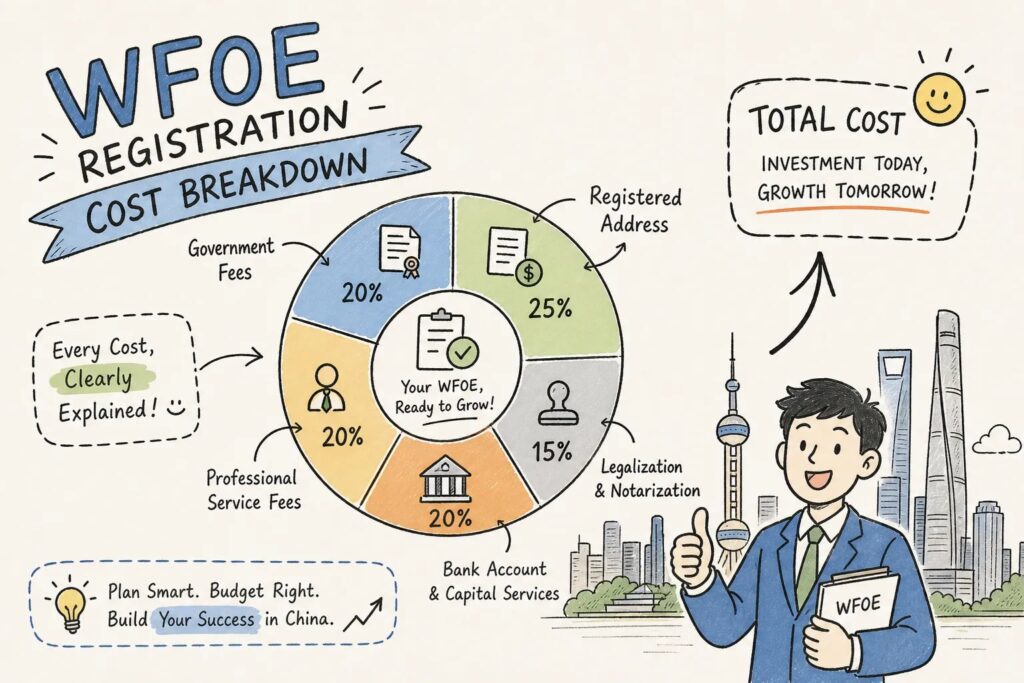
Setting up a Wholly Foreign-Owned Enterprise in China is a common way for US founders to establish a direct onshore presence, and the first question that comes up is almost always the same: what is the China WFOE registration cost actually going to be? It’s also one of the most inconsistently answered questions on the internet. Vague quotes from local agents, incomplete breakdowns that omit registered capital, and wildly different numbers across service provider websites make it nearly impossible to build a reliable budget before you’ve even started. That confusion often results from varying scopes and bundled services in provider quotes. The total China WFOE registration cost depends on several distinct variables, and most quotes address only one or two of them.
At Register Company China, our team has assisted US clients through this exact budgeting process across a wide range of company types and city locations, and the confusion almost always comes from the same few misunderstood line items. The good news is that once you separate the cost components, the number becomes very calculable. This article breaks down every major cost category, gives you three realistic first-year budget scenarios for different company sizes, and flags the hidden charges that quietly inflate what founders thought was a straightforward setup. By the end, you’ll have a clear framework for estimating your own all-in WFOE formation cost, understanding how city choice and company type affect the total, and knowing exactly what questions to ask before signing any service agreement.
China WFOE Registration Cost: What Actually Goes Into It
The total cost to establish a WFOE in China is not a single fee, it’s a stack of distinct charges that arrive at different stages of the process, from different parties. Understanding the categories first makes the actual numbers far less surprising.
Government filing fees and official charges
Here’s something most US founders don’t expect: government filing fees in China are remarkably low. In major cities like Shanghai, Beijing, and Shenzhen, the business license registration itself is often free, with total official government charges typically running RMB 0 to 1,000, including company seal engraving. The government fee is almost never the expensive part of WFOE formation. If a quote you’ve received seems high, the cost is coming from elsewhere in the stack.
Notarization, apostille, and document preparation costs
This is where US clients consistently get surprised. Before your WFOE application can be filed with Chinese authorities, your foreign shareholder documents, including passport copies, articles of incorporation, and authorization letters, must be notarized and apostilled in the United States. The realistic cost for this step runs USD 800 to 2,500, depending on your state, the number of documents, and whether you need expedited processing. Certified translation of each document into Chinese adds approximately RMB 200 to 500 per document. This step alone typically adds two to four weeks before filing can even begin. Timeline delays mean delayed operations, which is a real cost that rarely shows up in any quote.
Service provider fees by WFOE type
Professional service fees are typically the largest single line item in your WFOE registration budget. For a consulting or service WFOE, expect USD 2,500 to 8,000 from a reputable provider. Trading WFOEs run USD 3,000 to 10,000 because of the added complexity around import/export approvals and customs registration. Tech WFOEs generally land in the same range as consulting unless additional licenses, such as an ICP license or software certification, are required. One important distinction: some providers quote registration-only fees, while others bundle in company chop delivery, bank account opening assistance, and tax registration handoff. Always confirm what’s included before comparing quotes.
How registered capital shapes your total upfront commitment
Registered capital is the single biggest source of confusion for US founders planning their WFOE formation expenses. Many assume it’s a government fee paid at registration. It isn’t. Registered capital is the working capital you commit to inject into your Chinese company over time, typically within five years under current company law. It’s money your business will actually use, not a charge you pay to register.
What the legal minimum actually means in practice
China’s company law technically allows a minimum registered capital of RMB 1, but local Administration for Market Regulation (AMR) offices review whether the declared amount is commercially reasonable for the planned business scope. In practice, a consulting WFOE is commonly funded at RMB 100,000 to 500,000. A trading WFOE typically requires RMB 500,000 to 1,500,000 to pass scrutiny. A manufacturing WFOE often starts at RMB 1,000,000 or more, because authorities expect the capital to cover equipment, leasehold, and initial production costs. Choosing an amount that’s too low for your business type can slow your application or prompt a request for revision.
City-tier benchmarks across major markets
Tier 1 cities like Shanghai, Beijing, and Shenzhen expect registered capital amounts that credibly cover at least 12 months of operating costs, including rent, payroll, and compliance. In Shanghai, a consulting WFOE is generally comfortable at RMB 100,000 to 500,000, while a trading WFOE sits in the RMB 500,000 to 1,500,000 range. Second-tier cities tend to accept amounts on the lower end of those ranges because the operational cost base is smaller. The practical takeaway: if you’re flexible on location, setting up your registered address in a second-tier city can meaningfully reduce the capital amount the local AMR expects to see. Regulated industries, including fintech, telecom, and insurance, carry statutory minimums set by sector rules that are far higher and must be confirmed separately.
Three realistic budget scenarios for different WFOE sizes
Abstract cost ranges are useful, but a concrete planning scenario is more actionable. Here are three profiles that reflect common US client setups, with realistic first-year cost estimates for each.
Small consulting or service WFOE (1 to 2 staff)
Consider a US-based founder with one or two local employees, using a serviced registered address rather than a leased office, with a remote legal representative. First-year setup costs, including service provider fees, notarization and apostille, and address registration, typically run USD 6,000 to 12,000. Annual bookkeeping and tax filing adds approximately RMB 12,000 to 36,000 in Shanghai, and roughly 30 to 50 percent less in a comparable second-tier city. Registered capital for this profile commonly sits at RMB 100,000 to 300,000. Total first-year cash commitment in Shanghai, excluding the registered capital injection itself, runs approximately RMB 250,000 to 400,000 for a lean model; a second-tier city location can reduce that meaningfully across nearly every line item. Choosing a second-tier city over Shanghai for this type of company lowers address costs, compliance fees, and salary expectations simultaneously.
Mid-size trading WFOE (3 to 5 staff)
For founders formalizing import/export operations in China, with a small physical office and multiple local employees, WFOE service provider fees for a trading company run USD 5,000 to 10,000. Office rent for a small physical space in Shanghai adds approximately RMB 120,000 to 240,000 per year. A team of three employees carries a realistic payroll and social insurance budget of around RMB 730,000 per year in Shanghai, with lower figures in secondary markets. Bookkeeping and compliance for a trading company with active transactions runs RMB 20,000 to 50,000 annually. With registered capital expectations of RMB 500,000 to 1,500,000 for a trading WFOE, the total first-year operating budget, excluding capital, lands in the RMB 700,000 to 1,200,000 range in Shanghai. The same structure in a second-tier city can be meaningfully cheaper across nearly every line item.
Larger or more complex WFOE (manufacturing, tech with licenses, or multi-city)
US companies entering manufacturing or regulated tech sectors face additional license applications alongside standard registration. Service provider fees for complex structures run USD 8,000 to 15,000 or higher, because import/export licenses, ICP approvals, or environmental permits each add scope, time, and cost. Additional licensing can extend the overall timeline by two to six weeks. Registered capital expectations for manufacturing start at RMB 1,000,000 and often go higher depending on scale and equipment requirements. First-year operating costs for this profile routinely exceed RMB 1,500,000. Complex structures benefit most from a provider who scopes the total cost upfront rather than billing by the hour, because overruns in this category are the largest and least predictable.
Hidden costs that quietly inflate your first-year budget
Vague quotes from service providers leave out several charges that US founders consistently discover after they’ve committed. Knowing them in advance puts you in a stronger position to evaluate any proposal.
The apostille delay cost and rush fee reality
The notarization and apostille process in the US takes two to four weeks under standard processing, and filing in China cannot begin until those documents are ready. Rush fees for expedited document handling or fast-tracked bank onboarding are typically quoted case by case, not published as a standard tariff. A standard WFOE registration runs six to twelve weeks for the core filing, with full operational status, including a corporate bank account, taking two to four months. Every week of delay is a week your business isn’t generating revenue in China, which is a real cost even when it doesn’t appear on any invoice.
Post-registration compliance costs that start on day one
Many WFOE registration quotes cover the setup process only. China’s compliance calendar activates immediately after your business license is issued: monthly or quarterly tax filing, annual reporting to SAMR, bookkeeping, and a statutory audit are all mandatory. A lean annual compliance package runs RMB 12,000 to 50,000 depending on transaction volume, city, and service scope. Founders who don’t budget for this in year one often face compounding penalties. Work permit and residence permit costs for any foreign staff member add another RMB 4,000 to 15,000 per person, a line item that is almost universally absent from initial WFOE cost estimates.
How Register Company China’s fixed-price packages remove the guesswork
Every pain point covered in this article, from inconsistent quotes to surprise compliance costs, points to the same underlying problem: most providers structure their fees in ways that make the total China WFOE registration cost impossible to know upfront. Regardless of which provider you ultimately choose, the right approach is to demand full scope transparency before signing. Fixed-price packaging is how Register Company China solves that problem directly.
What a fixed-price package actually includes
Register Company China bundles the full WFOE registration process into a single transparent package: name approval through business license, company chop set, registered address, bank account opening assistance for both RMB and foreign currency accounts, and a clean handoff to post-registration compliance. The entire process is managed remotely, which means US clients don’t need to fly to China for document signing, government meetings, or bank visits. That’s not a minor convenience. Return flights to Shanghai plus hotels and time away from the office represent a meaningful additional outlay, commonly USD 3,000 to 6,000 or more depending on origin city and trip count, that many traditional local agents or generalist law firms assume is simply part of the process. With Register Company China, it isn’t.
Getting an accurate quote for your specific situation
Your WFOE formation cost depends on four variables: your industry type, your target city, your expected staff headcount, and whether your business scope requires additional licenses. Register Company China scopes all four upfront so US clients receive a firm, itemized number before committing, not a moving target. If you’re ready to move from estimates to a real budget, reach out to our team directly for a custom quote specific to your company type and city. You’ll get a clear number you can actually plan around.
Frequently asked questions about China WFOE registration costs
What is the typical China WFOE registration cost for a small consulting company?
For a lean consulting or service WFOE with one to two staff in a major city, total first-year setup fees, covering service provider fees, notarization, apostille, and address registration, generally run USD 6,000 to 12,000. First-year operating costs, including bookkeeping and tax compliance, add on top of that. Registered capital of RMB 100,000 to 300,000 is common for this profile, though that amount is injected into the company over time rather than paid as a registration fee.
Does city choice affect the total WFOE registration cost?
Yes, significantly. Setting up in a second-tier city rather than Shanghai or Beijing can reduce registered capital expectations, office costs, compliance fees, and salary baselines simultaneously. For a small service WFOE, the difference in annual operating costs between Shanghai and a second-tier city can be 30 to 50 percent or more across multiple line items.
Is registered capital a fee I pay to the Chinese government?
No. Registered capital is working capital you commit to inject into your Chinese entity over time, typically within five years under current company law. It becomes the company’s operating funds, not a registration charge. The amount must be commercially reasonable for your business type and will be reviewed by the local AMR office.
What is the all-in range for WFOE setup fees?
Professional service fees for WFOE registration alone typically run USD 2,500 to 15,000 depending on company type and complexity. When you add notarization, apostille, translation, address registration, and bank account assistance, the realistic all-in setup range runs approximately USD 6,000 to 25,000 or more. First-year operating costs, payroll, rent, bookkeeping, compliance, are layered on top of those figures.
The bottom line on WFOE registration costs in China
China WFOE registration cost is not a single number, but it is a calculable one once you understand the components: service provider fees, government charges, notarization and apostille costs, registered capital, and first-year operating expenses. The two biggest levers in your total budget are company type and city choice. A consulting WFOE in a second-tier city costs significantly less across nearly every line item compared to a trading WFOE in Shanghai.
The realistic all-in range for setup fees runs approximately USD 6,000 to 25,000 or more depending on company type, complexity, and location, with first-year operating costs layered on top. The best way to close the gap between a range and an actual budget is to work with a provider who gives you a fixed, scoped number before you commit. That’s what Register Company China is built to deliver. Get in touch with our team and walk away with a real budget, not another estimate.