
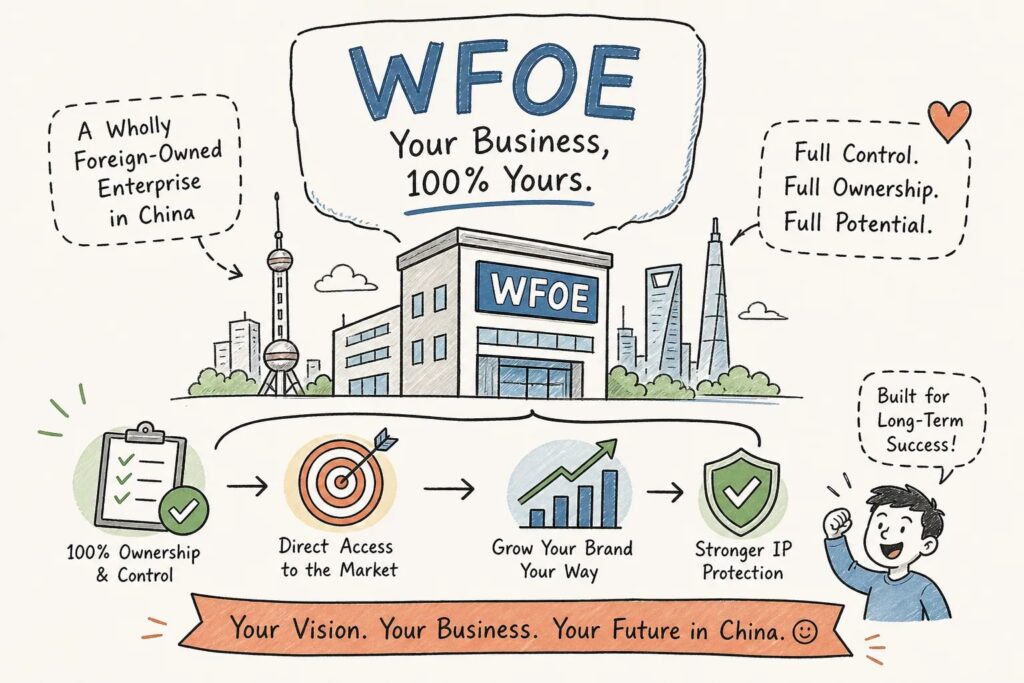
When a US founder first searches “what is a WFOE in China,” they’re usually past the curiosity stage. They’re serious about entering the market, they’ve heard the acronym in a call or a blog post, and now they need a real answer. A Wholly Foreign-Owned Enterprise, or WFOE, is a Chinese-incorporated company that is 100% owned by one or more foreign investors, with no required Chinese partner. That’s it at its core. (You’ll also occasionally see it spelled WOFE, an alternate rendering of the same acronym.)
The term sounds more complicated than it is. Most of the confusion comes from the legal shorthand layered on top of a concept that is, at its heart, just a foreign-owned Chinese LLC. At Register Company China, we’ve guided US businesses through this exact decision, and the questions are almost always the same: What can a WFOE actually do? How does it compare to a joint venture or rep office? What does setup cost, and how long does it take? This article answers all of it, in plain language, so you can move forward with confidence.
What makes a WFOE a distinct legal entity in China
Before 2020, WFOEs were governed by a separate WFOE-specific statute that treated foreign-invested enterprises as their own legal category. When the Foreign Investment Law took effect in 2020, that changed. WFOEs are now governed under the same PRC Company Law framework as domestic Chinese companies, which means “WFOE” is industry shorthand for a fully foreign-owned Chinese limited liability company rather than a formal legal category. For practical purposes, the label still tells you everything you need to know about ownership and control, and you’ll continue seeing it in official documents and filings.
Every WFOE shares three defining characteristics. First, it is 100% foreign-owned by one or more foreign individuals or entities, with no Chinese partner required. Second, it carries separate legal personality, meaning the WFOE is its own Chinese company and not merely a branch or extension of the foreign parent. Third, it operates under limited liability, so shareholders’ exposure is generally capped at their subscribed registered capital contribution. Before you can form a WFOE in a given sector, however, you need to check China’s foreign investment negative list, which identifies industries that are restricted or fully closed to foreign ownership.
A WFOE can sign contracts, issue Chinese VAT invoices (fapiao), hire employees directly under Chinese labor law, and open both RMB and foreign currency bank accounts. That operational independence is precisely what separates it from a representative office, which cannot do any of those things. If your business needs to bill clients, employ staff, or sell goods in China, a WFOE is almost certainly the right structure.
What is a WFOE in China? Types and use cases
Not all WFOEs are the same. China categorizes them by the nature of their commercial activity, and the type you choose shapes your registration process, capital expectations, and setup timeline. The three categories are service/consulting, trading, and manufacturing, each with its own approval path and cost profile.
Service and consulting WFOEs are the simplest structure to register and the most common starting point for US-based businesses. They cover consulting, IT, marketing, training, professional services, and similar knowledge-based work. Unless your sector is specifically regulated, there are no extra approvals beyond the core registration. US e-commerce brands that need a local Chinese entity to access platforms like Tmall or JD.com commonly use this structure as well.
Trading WFOEs, sometimes called Foreign-Invested Commercial Enterprises (FICEs), are built for import, export, wholesale, retail, and distribution. They follow a similar registration path as service WFOEs but add one meaningful step: customs registration and import/export filing are required as part of the post-registration setup. That adds a layer of work but unlocks the ability to trade goods directly inside China without routing through an intermediary.
Manufacturing WFOEs are the most document-intensive path. They require a physical factory address, a site inspection by local authorities, and often an environmental impact assessment before the business license can be issued. These are best suited for companies with a confirmed manufacturing plan, not for early-stage market testing. Setup costs and timelines are noticeably higher than for service or trading structures.
WFOE vs. joint venture vs. representative office: choosing the right structure
Three foreign investment structures are available in China, and each one serves a different purpose. A WFOE is 100% foreign-owned with full management control. A Joint Venture (JV) splits equity with a Chinese partner, which means shared decision-making and shared governance over key business choices. A Representative Office is not a separate legal entity at all; it is an extension of the foreign parent, with no equity structure and no ability to generate revenue.
For US founders who want to move quickly without negotiating internal governance with a local partner, a WFOE is often the cleaner choice, provided the sector is fully open to foreign ownership. The core operational difference is this: a WFOE can generate revenue, sign contracts, issue fapiao, and hire staff directly. A JV can also conduct commercial operations, but the scope and execution of those operations are shaped by the joint venture agreement and the partner’s consent. A Representative Office is restricted to liaison work, market research, and coordination activities, meaning it cannot sign commercial contracts, issue invoices, or receive income in China.
A JV makes strategic sense in two scenarios: when Chinese law requires local partnership in a restricted sector, or when a US company genuinely needs a local partner’s distribution network, licenses, or relationships to operate effectively. That trade-off matters more as the partnership grows, local access comes with governance complexity and shared control. Most US founders default to a WFOE when their sector is fully open because it keeps decision-making clean and ownership entirely in their hands.
How to register a WFOE in China: from name approval to business license
Before any filings begin, you need to lock in four core decisions: your business scope, registered capital amount, legal representative identity, and registered address. Errors in any of these areas cause delays or rejection at the SAMR filing stage, so the preparation phase matters as much as the filing itself.
The required documents include Articles of Association, parent company incorporation documents (or investor ID documents for individuals), board or shareholder resolutions, passport copies for directors, a power of attorney, and proof of the registered address. For US-based applicants, foreign documents typically require notarization and apostille under the Hague Convention before they can be used in China. Certified Chinese translations are also required for all foreign-language documents.
The registration sequence follows this order:
- Submit proposed Chinese company names to the local SAMR for pre-approval. This step typically takes 1 to 5 working days.
- Submit the full incorporation package to SAMR forbusiness license issuance, which is the core registration step.
- Complete post-registration filings: tax registration, company seal (chop) issuance, bank account opening, and SAFE registration for foreign exchange where applicable.
- For trading WFOEs, add customs registration. For manufacturing WFOEs, add site inspection and environmental approvals.
Realistic timeline for US-based applicants: core registration for a service or trading WFOE typically lands between four and eight weeks once documents are ready. Full operational readiness, including bank account opening and tax setup, takes two to four months in most cases. These are typical ranges as of 2026; local variation and industry-specific rules can affect both ends of the window. Document preparation and notarization are usually the biggest variable for US founders given the time zone difference and the legalization process for American corporate documents.
Setup costs, registered capital, and annual compliance obligations
Service and consulting WFOEs typically cost USD 5,000 to 15,000 in professional service fees for a full-service setup, excluding rent, payroll, and the capital commitment itself. Trading WFOEs fall in a similar range, with modest additions for customs-related filings. Manufacturing WFOEs run significantly higher, often USD 18,000 to 30,000 or more. Environmental approvals, factory inspections, and higher capital requirements all push the total up. These figures represent typical market ranges as of 2026 and cover professional fees only; they do not include registered capital, which is held separately in the company’s own corporate account.
On registered capital, China uses a subscribed-capital model, meaning the amount is a commitment rather than an upfront cash deposit. Under the 2024 Company Law, shareholders must fully pay in their subscribed capital within five years of incorporation. In practice, service WFOEs commonly set registered capital at RMB 100,000 to 500,000. Trading WFOEs typically run higher, often RMB 500,000 to 1.5 million. Manufacturing WFOEs commonly start at RMB 1 million or above, because local authorities and banks expect capital levels that reflect the actual operating footprint.
Ongoing compliance is not optional and does not start when revenue begins. Monthly bookkeeping and tax filing are mandatory from the first month of registration. Annual obligations include corporate income tax filing, VAT reporting, a statutory audit by a licensed Chinese CPA firm, and the SAMR annual report. Key 2026 deadlines to put on your calendar: the annual corporate income tax reconciliation is due May 31, and the SAMR annual report must be filed by June 30. Annual compliance costs for a basic service WFOE commonly run USD 5,000 to 12,000 before rent and payroll. More active or complex entities run higher.
How Register Company China sets up your WFOE without you traveling to China
Register Company China manages the WFOE registration process for US-based founders with a remote-first approach: document preparation, notarization coordination, SAMR filing, and post-registration setup are all handled without requiring the client to travel. That matters because the time zone gap, language barrier, and long-haul travel cost make in-person management of the process both impractical and expensive for most US companies. Bank account opening assistance is also part of the service; note that final bank onboarding requirements vary by institution and city, and some banks may require a principal’s in-person visit depending on their internal policies.
Services are priced transparently with a defined scope and a clear timeline, so clients know what is included before work begins. The scope covers not just registration but the full market-entry lifecycle: monthly accounting, tax filing, annual reports, SAMR compliance, and trademark registration support. A US company gets a single English-language point of contact from formation through ongoing operations, rather than coordinating across multiple local vendors who may not communicate with each other.
Whether you’re still deciding between entity types, ready to file, or already registered and managing ongoing compliance obligations, Register Company China provides the guidance you need at every stage. Reach out to our team to review your situation and get a fixed-price proposal for the right service package.
The bottom line on WFOEs for US companies entering China
A WFOE is a 100% foreign-owned Chinese company that gives US investors direct control over their operations, the ability to hire staff, issue fapiao, and sign commercial contracts. All of this is achievable without a Chinese partner. Unlike a representative office, it operates commercially. Unlike a joint venture, it keeps full ownership in your hands.
The right entity type depends on your business model, sector, and timeline. A service WFOE suits knowledge-based businesses and e-commerce brands. A trading WFOE suits importers and distributors. A manufacturing WFOE suits companies with a confirmed production plan. Getting that entity decision right before filing can avoid significant delays and costly rework down the road.
Understanding what a WFOE is, and whether it fits your business, is the first step. The second is matching the right structure to your specific goals and getting the setup done correctly from day one. That’s exactly what Register Company China is built to do, remote setup, fixed pricing, and a single accountable partner from formation through ongoing operations.
Frequently asked questions about WFOEs in China
What is a WFOE in China, in simple terms?
A WFOE (Wholly Foreign-Owned Enterprise) is a Chinese limited liability company that is 100% owned by foreign investors. It operates under Chinese law, can generate revenue, hire employees, and issue VAT invoices, all without requiring a local Chinese partner. The acronym is sometimes written as WOFE, but both refer to the same structure.
How is a WFOE different from a joint venture or representative office?
A representative office cannot generate revenue or sign commercial contracts, it’s a liaison entity only. A joint venture shares equity with a Chinese partner, which introduces governance complexity. A WFOE gives full ownership and operational control to the foreign investor, making it the preferred structure when the sector permits it.
How long does WFOE registration take for a US company?
Core registration for a service or trading WFOE in China typically takes four to eight weeks from the point when documents are ready. Full operational readiness, including bank account activation and tax registration, generally takes two to four months. Timelines vary by city and business activity.
What are the tax obligations for a WFOE in China?
WFOEs are subject to Chinese corporate income tax (standard rate 25%), VAT, and various local levies depending on the business scope. Monthly tax filings are mandatory from the first month of registration, regardless of whether revenue has been generated. An annual audit by a licensed Chinese CPA firm is also required.
Where does WFOE fit in China company formation options?
In the landscape of China company formation, a WFOE is the most common structure chosen by US businesses entering the market independently. It offers more operational flexibility than a representative office and more ownership control than a joint venture. For sectors open to 100% foreign investment, it is typically the starting point for serious market entry planning.