A licensed China WFOE can hire. It cannot skip social insurance for staff who hold a Foreigner's Work Permit. The five employee schemes are a statutory payroll item, not a perk the company and the founder can cancel with a waiver letter. The housing provident fund sits beside those schemes and follows a different rulebook, which is where most new entities get the cost model wrong.
This 2026 guide covers employer registration after incorporation, what foreign staff must join, which countries can claim a partial exemption, how contribution bases work in the major cities, what the September 2026 housing-fund amendment changed, and how departing foreigners close accounts.

What the WFOE Must Open First
Social insurance and the housing fund are paid by a Chinese employer that already has a unified social credit code, tax registration and, in practice, a working RMB payroll path. The company registers as a contributing unit with the local social insurance agency and, separately, with the municipal housing provident fund centre.
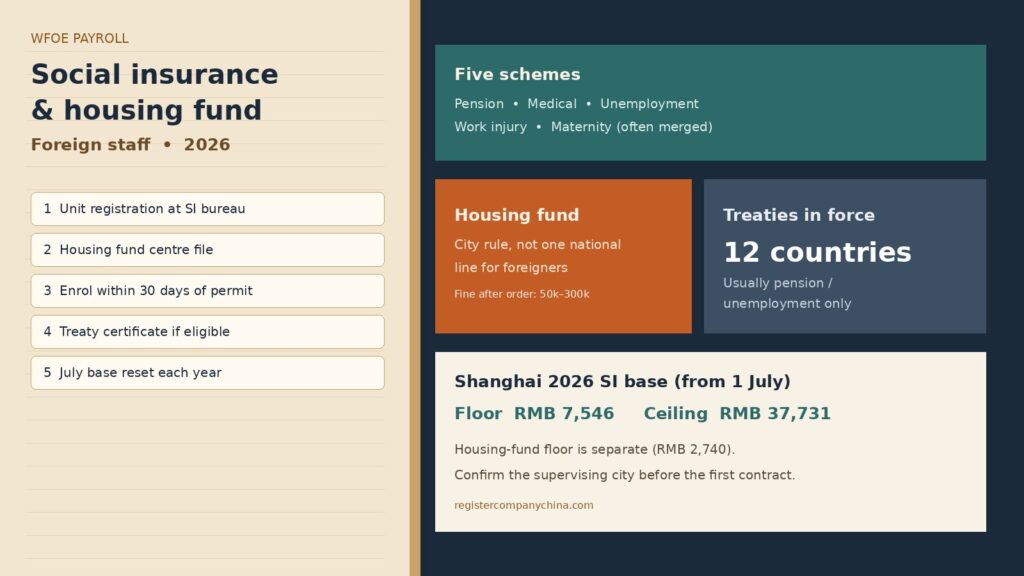
For a newly formed WFOE the usual sequence is licence, chops, tax file, bank account, then employer social-insurance and housing-fund accounts. Cities publish slightly different clocks. Housing-fund rules that took effect on 20 September 2026 still expect a new unit to complete contribution registration within 30 days of establishment and to open employee accounts within 20 days after that registration. Missing the unit file is now more expensive: after a rectification order, the fine range for failure to register or to open employee housing-fund accounts rose from RMB 10,000–50,000 to RMB 50,000–300,000.
A company that has not finished the corporate bank account and tax file will struggle to remit even if the bureau accepts the paper registration. Treat payroll setup as part of post-licence work, not as an optional extra after the first hire.
Five Insurances for Foreign Staff
The operating text is the Interim Measures for Foreigners Employed in China Participating in Social Insurance (MOHRSS Decree No. 16, in force since 15 October 2011 and revised on 23 December 2024). A foreign national who is lawfully employed in the mainland and holds a work permit, a qualifying employment credential or permanent residence, must join the five employee schemes:
- Basic pension insurance
- Basic medical insurance
- Unemployment insurance
- Work-related injury insurance
- Maternity insurance (merged into medical insurance in some cities, including Shanghai)
Registration for the individual is due within 30 days of the work permit or other employment document being issued. That clock is the same one used for Chinese staff. A one-page “I waive social insurance” addendum does not change the public-law duty. Labour-arbitration files still treat unpaid statutory contributions as a ground for the employee to resign and claim economic compensation.
The contribution base is the employee’s average monthly wage from the prior year, clamped between the city floor and ceiling (commonly 60 percent and 300 percent of the local average wage). Most cities reset that range on 1 July, not 1 January. Shanghai’s 2026 social-insurance base, announced in August 2026 and applied from 1 July 2026, sits at RMB 7,546–37,731 a month. Differences for July and August payrolls were to be settled by 30 September 2026 without a late-payment surcharge if paid on time.
| Scheme | Typical employee rate | Typical employer rate | Notes in 2026 practice |
|---|---|---|---|
| Pension | 8% | 14–16% | Personal account can often be closed and withdrawn when the foreigner leaves China for good. |
| Medical | 2% plus a small fixed add-on in some cities | About 6–10% | This is the scheme that actually buys local hospital access. Rarely covered by a bilateral exemption. |
| Unemployment | 0.2–0.5% | 0.5–0.8% | Often paired with pension in totalisation agreements. |
| Work injury | None | 0.2–1.9% by industry risk | Employer only. Usually still due even when pension is exempted. |
| Maternity | None where still separate | 0.5–1% where still separate | Merged into medical in several cities. |
Exact percentages belong to the city that supervises the WFOE. Beijing’s employer load is at the high end of the first-tier range. Guangzhou and Shenzhen sit lower on several lines. Do not budget one national percentage for a multi-city headcount.
Bilateral Agreements Are Partial, Not a Blanket Opt-Out
China has signed social-security agreements with 13 countries. As of late 2026, 12 are in force: Germany, South Korea, Denmark, Finland, Canada, Switzerland, the Netherlands, Spain, Luxembourg, Japan, Serbia and Kyrgyzstan. France has signed but the agreement is not yet in force.
An agreement does not take the employee out of the Chinese system. It usually pauses pension, and sometimes unemployment, for a posted worker who remains covered at home and who produces a Certificate of Coverage. Medical insurance and work-injury insurance generally stay payable in China because those benefits are used on the ground.
Since 15 September 2025, Chinese certificates used in the other direction are issued online through the national social insurance public service platform. Paper filing is no longer the default channel. A certificate is tied to a specific employment relationship. Moving from an EOR onto the new WFOE, or changing employer inside China, usually means a new certificate and a new filing.
Nationals of the United States, the United Kingdom, Australia and most other countries have no agreement in force. Their WFOE payroll should assume the full five schemes unless a later treaty is confirmed locally.
Housing Fund: Separate Centre, City Rules, Higher Fines
The housing provident fund is not one of the five insurances. It is a matched long-term housing savings scheme run by a municipal fund centre. For Chinese employees of a WFOE it is a normal statutory item. For foreign employees it is city practice, not a single national sentence.
Shanghai’s contribution measures allow specified foreign staff with a work permit or permanent-residence ID to contribute when both sides agree. Shenzhen guidance in 2026 likewise allows qualifying foreign personnel through employer withholding or a voluntary agreement. Beijing and Guangzhou have their own document lists; Guangzhou’s published text is tighter on permanent residence. Do not copy a Shanghai clause into a Beijing contract and assume the centre will open the account.
Where foreigners may join, the employer and employee usually pay the same rate, commonly 5–12 percent of the contribution base. Shanghai’s 2026 housing-fund ceiling matches the social-insurance ceiling at RMB 37,731, but the housing-fund floor is much lower (RMB 2,740 in the 2026 announcement). The two systems do not share one floor.
The State Council decision amending the Housing Provident Fund Regulations took effect on 20 September 2026. Contribution rates stay in a national band of not less than 5 percent and not above the state cap. Withdrawal grounds now expressly include renovation of self-occupied housing and payment of property-management fees. Flexible workers may join voluntarily. The compliance point for a WFOE is the higher fine for ignoring unit registration and employee accounts after an order to rectify.
Foreigners who leave China permanently can usually withdraw the housing-fund balance (employee plus employer portions plus interest) after the work permit is cancelled and exit papers are in order. Confirm the current counter list with the local centre; tax-clearance or departure records are still commonly asked.
How This Interacts With Work Permits and Payroll
Some cities look at whether a young WFOE already employs local staff and pays social insurance before they treat a founder’s work-permit file as real. That is local practice, not a line printed on every business licence. Plan for it in Shenzhen and Guangzhou and ask before you lock a start date. The work permit sequence still runs notification letter, Z visa, work-permit card, then residence permit. Social-insurance enrolment sits on that same employer file.
Payroll, individual income tax withholding, social insurance and the housing fund must tell the same salary story. A contribution base set far below the contract wage is a classic inspection finding. IIT and social-insurance bases do not have to be identical in every city, but a large unexplained gap draws questions.
A WFOE with no employees still needs the unit accounts ready. The first foreign hire, including a working legal representative, starts the 30-day individual clock. Remote founders who never take a China labour contract and never work from the mainland are a different fact pattern; titles on the licence alone do not create a contribution duty.
Mistakes That Show Up After the Licence
- Treating social insurance as optional because “our last city did not enforce it.”
- Filing a waiver letter instead of a Certificate of Coverage from a treaty country.
- Assuming the housing fund is mandatory, or forbidden, for every foreigner nationwide.
- Opening the social-insurance unit account and forgetting the housing-fund centre.
- Using last year’s Shanghai base after the July reset.
- Changing employer inside China and keeping an old certificate of coverage.
- Paying cash “in lieu” from an offshore company. There is no lawful route for a foreign parent to remit statutory contributions without a mainland employer account.
What to Do Next
Map the city that will supervise the WFOE. Confirm whether the first hire is a treaty national and whether a certificate can be obtained before payroll starts. Budget employer cost on that city’s current rates and on the July base cycle, not on a single national average. Register the unit accounts as soon as tax and banking are live, then enrol each work-permit holder inside 30 days.
Remote setup support covering licence, address, bank, tax and post-registration payroll filings is described on the services page. Ask for a city-specific contribution estimate before you issue the first China labour contract.
FAQ
Must a WFOE pay social insurance for a foreign founder who also holds the work permit?
Yes, if that person is employed in China under the company’s labour contract. The title of legal representative does not replace enrolment.
Can the company and the employee agree to skip the five insurances?
No. A private waiver is not an exemption. The only structured opt-out for named schemes is a bilateral agreement plus a filed certificate of coverage.
Is the housing fund compulsory for foreigners in 2026?
Not as a single national rule. Many cities allow or expect participation when documents match the local list. Chinese staff of the same WFOE are in the ordinary mandatory system.
When can a departing foreigner take money out?
Pension personal-account balances and housing-fund balances are commonly withdrawable on permanent departure after the work permit is cancelled. Medical pooling funds are not a personal savings pot in the same way. Procedures are local.
Does the September 2026 housing-fund amendment change foreigner eligibility?
It raised registration penalties, widened withdrawal uses and opened a clearer voluntary path for flexible workers. Foreigner eligibility is still set by each municipal fund centre.