Every China WFOE must complete two connected year-end obligations: a statutory annual audit and the SAMR annual enterprise report. Miss either one and the company can land on the public abnormal operations list, face fines, lose the ability to issue fapiao cleanly, or find profit repatriation blocked at the bank.
This guide focuses on the practical 2026 calendar, the real deadlines that matter, what happens when filings are late, and the decisions foreign founders still get wrong.
The Two Deadlines That Actually Matter in 2026
China uses the calendar year for almost all companies. The financial year runs 1 January to 31 December. Two hard dates then follow:
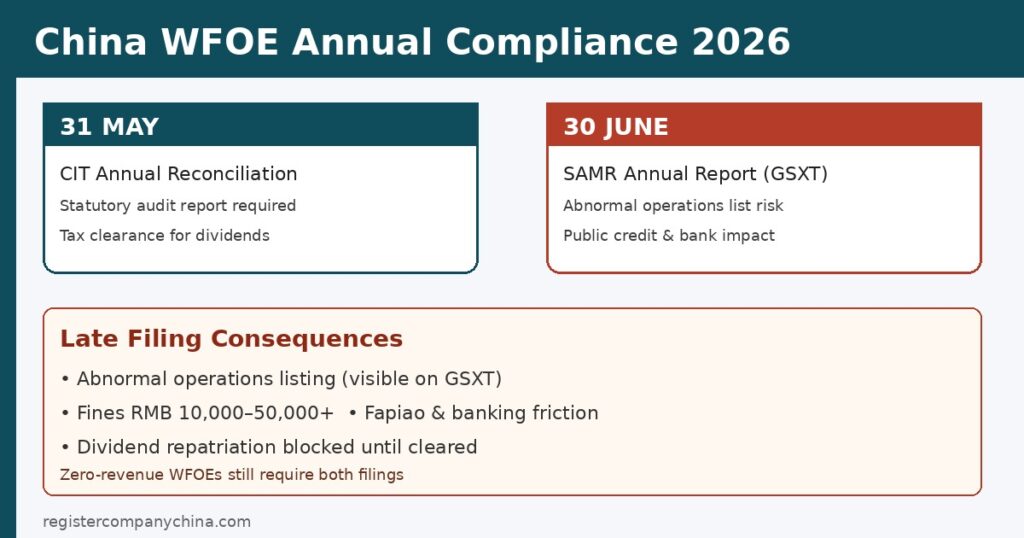
- 31 May — Corporate Income Tax (CIT) annual reconciliation (汇算清缴). The statutory audit report is normally required as supporting material for this filing.
- 30 June — SAMR annual enterprise report submitted through the National Enterprise Credit Information Publicity System (GSXT / 国家企业信用信息公示系统). Foreign-invested enterprises also file related foreign investment information in the same window.
These are not the same filing. Treating them as one interchangeable deadline is a common source of last-minute problems.
What the Statutory Audit Actually Covers
The annual audit must be performed by a licensed Chinese CPA firm. Overseas parent-company auditors are not accepted for this purpose. The audit covers the full calendar year of books kept under Chinese Accounting Standards.
Even a dormant or zero-revenue WFOE still needs the audit. Banks and the tax bureau treat “no activity” claims as something that must be verified, not simply declared.
Typical practical timeline many firms follow:
- January–February: finalise year-end books and reconciliations
- February–March: audit fieldwork
- Target by end of April: signed audit report ready
- By 31 May: CIT annual return filed using the audited figures
Missing the audit does not only create a compliance gap. It blocks the downstream steps that matter to most foreign shareholders: tax clearance and outbound dividend remittance.
SAMR Annual Report: What Must Be Disclosed
Between 1 January and 30 June the company files its annual report on GSXT. Core sections include:
- Basic registration and contact information
- Shareholder and capital contribution details (including the five-year paid-in schedule under the current Company Law)
- Selected financial figures (often in ranges)
- Employee and social insurance information
- Website or online business details where relevant
- For foreign-invested enterprises, additional investment and operational data
Failure to file by 30 June is one of the most common triggers for listing on the Catalogue of Enterprises with Irregular Operations (经营异常名录).
What Happens If You Miss the Deadlines
Consequences are progressive and public:
- Late or missing SAMR annual report → company can be placed on the abnormal operations list. This status is visible on GSXT and is checked by banks, counterparties, and government departments.
- Fines for non-filing or late filing typically range from RMB 10,000 to RMB 50,000, with higher amounts possible in serious or repeated cases.
- Prolonged non-compliance (commonly two consecutive years without rectification) raises the risk of business licence revocation proceedings.
- Tax side: late CIT reconciliation triggers daily late-payment surcharges (0.05% per day on any tax due) plus possible administrative fines. Tax credit rating can drop, which immediately affects fapiao quotas and customs processes.
- Banking and repatriation: most banks require a clean audit report and tax clearance before approving dividend or capital remittances. An abnormal status or missing audit can freeze that process for months.
The abnormal operations listing is not a private administrative note. It is a public signal that counterparties and banks treat as a red flag.
Common Practical Mistakes in 2026
Three patterns keep repeating:
- Assuming zero-revenue means no audit or no report is needed. It is still required.
- Leaving bookkeeping incomplete until March or April. Audit fieldwork then compresses and the 31 May CIT deadline becomes high-risk.
- Treating the SAMR report as a simple form. Capital contribution schedules, social insurance data and financial ranges must be consistent with tax filings. Inconsistencies trigger follow-up questions or rejection.
City-level practice also varies. Some districts are stricter on supporting documents; others move faster if the file is clean. The national deadlines remain the same.
What to Prepare Before the Window Opens
Useful checklist items for a standard service or trading WFOE:
- Complete and reconciled books for the full calendar year
- All fapiao issued and received properly recorded
- Bank statements and capital injection records
- Social insurance and housing fund contribution records
- Updated shareholder and capital contribution schedule information
- Engagement letter with a licensed Chinese CPA firm early enough for fieldwork in Q1
If the legal representative or key decision-makers are overseas, plan document signing and power-of-attorney logistics in advance so the audit and filings are not delayed by signature logistics.
How This Fits into Ongoing WFOE Operations
Annual audit and SAMR reporting sit alongside monthly or quarterly tax filings, payroll and social insurance obligations, and any sector-specific licences. They are not optional extras that can be deferred until the company starts generating revenue or until a dividend is needed.
For foreign founders the practical takeaway is simple: treat the audit and the 30 June report as fixed calendar items from the first full year of the WFOE’s existence. The cost of a clean annual compliance cycle is almost always lower than the cost of clearing an abnormal status or unblocking a stalled remittance later.
Frequently Asked Questions
Is a statutory audit required even if the WFOE had no revenue?
Yes. All registered companies are subject to the annual audit requirement regardless of activity level.
What is the exact SAMR annual report deadline?
30 June for the previous calendar year. The filing window opens on 1 January.
Can missing the annual report affect bank accounts or fapiao?
Yes. Abnormal operations status is visible and frequently checked. It can complicate banking relationships, fapiao quota increases, and government filings.
Does the audit report need to be submitted to SAMR?
The full audit report is primarily used for the tax reconciliation and banking purposes. The SAMR annual report contains selected financial disclosures drawn from the books, not the full audit document itself.
What happens after two consecutive years of non-filing?
Risk of escalation toward licence revocation rises significantly, and the company may move from the irregular operations list toward more serious dishonesty listings.
Register Company China handles the full post-registration compliance cycle for foreign-owned entities, including coordination of the statutory audit, CIT reconciliation support, and timely SAMR annual report filing. If your WFOE is approaching its first or next year-end cycle, the practical next step is to confirm the current bookkeeping status and lock in the CPA engagement before the Q1 fieldwork window closes.