How Americans Can Register a Company in China
Yes. A U.S. citizen or a U.S. company can register a Chinese limited liability company and own 100 percent of it in most open sectors. The usual vehicle is still called a WFOE in practice: a Chinese LLC owned only by foreign shareholders.
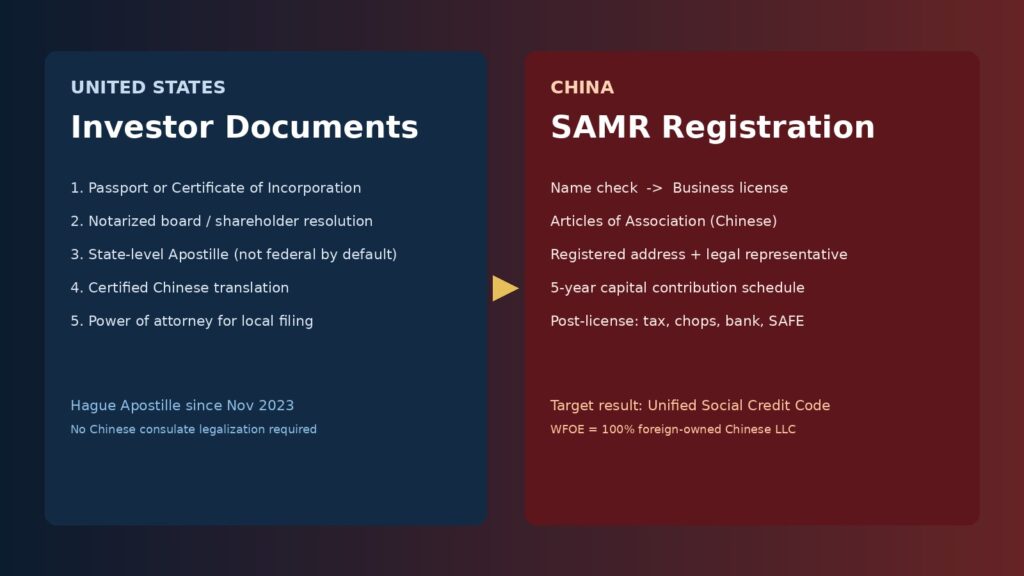
The process is no longer a consular-legalization marathon. Since 7 November 2023, the United States and China both apply the Hague Apostille Convention, so U.S. public documents need a state (or, for federal papers, Department of State) apostille rather than Chinese embassy authentication. The harder work in 2026 is choosing the shareholder structure, drafting a defensible business scope, setting a realistic five-year capital schedule, and getting the U.S. document package right the first time.
What “register a company in China” actually means for a U.S. founder
You are not moving your Delaware or California entity into China. You are creating a new Chinese legal person. That company receives a business license from the local Administration for Market Regulation (AMR / SAMR), an 18-digit Unified Social Credit Code, company chops, a tax profile, and the right to open RMB and foreign-currency accounts.
Three structures still appear in U.S. search results. Only one of them is a full operating company:
- WFOE (wholly foreign-owned LLC) — 100 percent foreign ownership, can invoice, hire, import, and sign contracts in its own name. Default choice when the sector is off the Negative List.
- Joint venture — needed only when the Foreign Investment Negative List still caps foreign equity or requires a Chinese partner.
- Representative office — cannot generate revenue or issue fapiao. Useful for liaison, not for selling.
The 2024 edition of the Negative List (effective 1 November 2024) has 29 restricted items and removed remaining manufacturing-sector access caps. Wholesale, most professional services, and ordinary trading are open to 100 percent foreign ownership. Product-specific rules still apply (tobacco, certain publications, some online pharmaceutical sales).
Individual American vs U.S. company as shareholder
Either can be the investor. The choice changes the document chain more than the SAMR form.
| Investor | Core U.S. documents | Typical extra time | When it is cleaner |
|---|---|---|---|
| U.S. individual | Passport (notarized + apostille in many cities), proof of address, appointment papers | Shorter package | Solo founder, consulting or light trading WFOE |
| U.S. corporation or LLC | Certificate of incorporation or good standing, parent articles or operating agreement, board or member resolution, signatory authority proof — each apostilled in the issuing state | 1–3 extra weeks if several states are involved | Group wants limited liability at the U.S. layer, or multiple founders |
A Delaware holding company with a resolution notarized in California and a passport copy notarized in Texas needs three separate apostilles. That mismatch is the most common U.S.-specific delay.
U.S. apostille path (the step most guides still get wrong)
Chinese consulates in the United States no longer legalize ordinary public documents destined for mainland company registration. The New York consulate published this change after 7 November 2023.
- Notarize private papers (board resolution, power of attorney, passport copy where a notary is required) in the state where the signer appears.
- Obtain the apostille from that state’s Secretary of State. A Delaware good-standing certificate is apostilled in Delaware. A California notarized resolution is apostilled in California.
- Federal documents (rare for WFOE setup) go to the U.S. Department of State, not a state office.
- Commission a certified Chinese translation of the apostilled bundle. SAMR files in Chinese.
Do not send the package to a Chinese embassy “just in case.” Extra stamps do not help and can confuse the local AMR clerk.
Documents China will actually file
Local checklists vary by city, but the 2026 SAMR standardized materials for business-entity registration point to the same core set:
- Company registration application form (the 2026 version, in force from 1 May 2026, collects the capital-contribution timetable on the form itself)
- Articles of Association in Chinese, signed by all shareholders
- Investor qualification papers (apostilled U.S. corporate set or individual identity set)
- Appointment of the legal representative, director or executive director, and supervisor
- Registered-address proof: commercial lease plus the landlord’s property certificate
- Beneficial-owner declaration (PBOC/SAMR beneficial-owner information rules)
- Power of attorney if a China agent files on your behalf
The legal representative must be a natural person. A foreign national may serve. There is no nationality or China-residency requirement in the Company Law. Many U.S. founders still appoint themselves and give a local manager a narrow power of attorney for chops and tax portals.
Step-by-step from the United States
- Confirm market access. Check the current Foreign Investment Negative List against the real activity, not the marketing slogan.
- Lock four decisions: Chinese name options, business-scope wording from SAMR catalogue phrases, registered capital and five-year payment dates, legal representative and supervisor.
- Secure a registrable address in the target city. Consulting WFOEs often use a compliant hosted address; trading and manufacturing usually need real space.
- Build and apostille the U.S. package in the correct state offices. Start this in parallel with name checks. It is usually the longest U.S.-side task.
- File with the local AMR. Name declaration is typically one to two business days. A clean license filing is often five to ten business days after the full package is accepted.
- Activate the company: chops, tax registration, social-insurance file if you will hire, RMB basic account, foreign-currency capital account and SAFE linkage, customs registration if you will import or export in the company’s name.
For a service or trading WFOE with documents ready, core license issuance commonly lands in four to eight weeks. Full operational readiness, including the bank account, is more often two to four months. Bank onboarding still expects the legal representative to complete KYC in person or by video at many branches.
Registered capital after the 2024 Company Law
There is no statutory minimum for a general WFOE. Shareholders must pay the subscribed capital within five years of establishment. From 1 May 2026 the application form itself records that schedule.
Banks, customs, and counterparties still read the figure as a solvency signal. Practical working ranges used on active formation files are roughly RMB 200,000–500,000 for consulting, RMB 500,000–1,500,000 for trading, and higher where first-year inventory or customs deposits are large. Inflating the number to “look serious” creates a cash obligation, not an advantage.
Do you have to fly to China?
Incorporation itself can usually be completed remotely with apostilled papers and a local filing agent. Two later steps still pull many Americans onto a plane:
- Corporate bank-account KYC, where major banks still want the legal representative in the branch or on a recorded video session
- Industry licenses or site inspections for manufacturing, food, medical devices, and similar regulated scopes
If the founder cannot travel in the first quarter, appoint the legal representative and bank signatory with that constraint in mind rather than discovering it after the license prints.
City choice for U.S. applicants
Shanghai, Shenzhen, Beijing, Guangzhou, and several free-trade-zone districts process foreign-invested filings every week and have international bank desks. Second-tier cities can be cheaper on rent but slower on first-time foreign files and bank onboarding. Match the city to customers, staff, and port access, not to a marketing slogan about “easiest registration.”
Common U.S.-side mistakes
- Apostille issued in the wrong state relative to the notary or the certificate of good standing
- Board resolution that authorizes “investment in Asia” but does not name the Chinese company, capital, or legal representative
- English-only articles of association
- Business scope copied from a U.S. NAICS description instead of SAMR catalogue language
- Registered capital set for optics, then left unpaid against the five-year clock
- Assuming a representative office can issue invoices “for now”
- Skipping beneficial-owner filing or treating a U.S. LLC manager as if they were automatically the China legal representative
After the license: what still blocks operations
The business license is not a bank account and not a tax clearance. Until chops, tax onboarding, and the RMB basic account exist, the company cannot pay suppliers, run payroll, or complete capital injection. Trading companies also need customs registration against the unified social credit code. Those steps are separate workstreams, not footnotes.
Frequently asked questions
Can an American own 100 percent of a Chinese company?
Yes, in sectors that are not restricted or prohibited on the Foreign Investment Negative List. That is the standard WFOE / foreign-invested LLC model.
Can I use my Delaware LLC as the China company?
No. The Delaware entity can be the shareholder. The operating company in China is a new Chinese LLC with its own license and tax number.
Is Chinese embassy legalization still required?
Not for ordinary U.S. public documents used in mainland company registration after 7 November 2023. Use the correct state or federal apostille instead.
Can a U.S. passport holder be the legal representative?
Yes. The role must be a natural person who is a director or the general manager responsible for company affairs. Practical friction is bank KYC and chop custody, not nationality law.
How long does registration take for a U.S. founder?
Plan four to eight weeks for the license once the apostilled file is complete, and two to four months to be able to bank and invoice. Multi-state apostilles and incomplete leases are the usual overruns.
What official systems should I know by name?
SAMR / local AMR for the license, the National Enterprise Credit Information Publicity System (GSXT) for public records, STA for tax, SAFE for inbound capital, and PBOC rules for the basic RMB account and beneficial-owner information.
If you already know the city, the intended scope, and whether the shareholder will be you personally or a U.S. company, those three facts determine almost the entire document list.