Once a WFOE is licensed and banked, the recurring cost that most foreign founders underestimate is the annual compliance cycle: statutory audit, corporate income tax reconciliation, and the SAMR annual report. These are not optional. Missing the deadlines blocks profit repatriation and can put the company on the abnormal operations list.
This guide gives realistic cost ranges for foreign-invested companies, explains what drives the price, and shows how the filings connect.
What Must Be Done Every Year
Every WFOE must complete three linked pieces of work:
- Statutory annual audit by a Chinese-licensed CPA firm. The audit report is the foundation for the tax filing that follows.
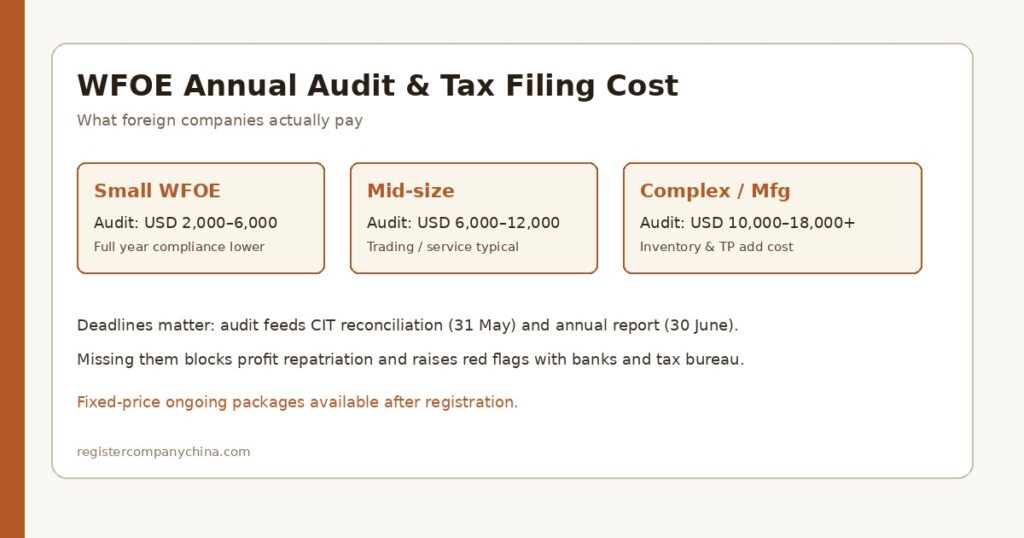
- Corporate Income Tax (CIT) annual reconciliation, due by 31 May. Late filing attracts daily interest and potential penalties.
- Annual enterprise report (including foreign-investment information) filed with SAMR, generally by 30 June.
The audit feeds the CIT reconciliation; the CIT clearance and audit report together support dividend remittances through the bank and SAFE.
Cost Ranges That Foreign Companies Actually Pay
Figures below are typical professional fees for the statutory audit itself (local or mid-tier firm). Bookkeeping and monthly tax filings are separate.
- Small, low-activity WFOE (few invoices, under roughly USD 1 million revenue, clean books): USD 2,000–6,000
- Mid-size service or trading WFOE: USD 6,000–12,000
- Manufacturing WFOE with inventory or more complex cost accounting: USD 10,000–18,000
- Larger or multi-entity groups, or those needing transfer-pricing documentation: USD 15,000–35,000+
Big Four branding usually adds 30–50 percent and is rarely necessary for unlisted FIEs. Many small WFOEs combine monthly bookkeeping, tax filings and the annual audit into an outsourced package that can sit in the low thousands of US dollars per year when volume is modest.
What Drives the Price Up or Down
Transaction volume and number of fapiao, inventory counts, intercompany flows, payroll headcount, and whether transfer-pricing local files are required. First-year audits often take longer because accounting policies and opening balances need to be established. Clean monthly books throughout the year keep the year-end fee lower.
Timeline in Practice
Financial year ends 31 December. Bookkeeping should be finalised in January. Audit fieldwork typically runs February–March, with the report targeted for April so the CIT reconciliation can be filed by 31 May. The SAMR annual report window runs to 30 June. Profit repatriation is usually possible after both the audit and CIT are cleared.
How Register Company China Supports Ongoing Compliance
Register Company China provides fixed-price packages that cover registration and can continue into monthly bookkeeping, tax filings and coordination of the annual audit. The goal is predictable cost and clean hand-over so foreign shareholders are not surprised by year-end fees or missed deadlines.
If your WFOE is already operating or you are about to file, request a fixed-price quote for the compliance scope that matches your transaction volume and city.
View our services or request a quote. Related reading: Remote WFOE Registration, WFOE Registration Process, and Legal Representative Requirements.
FAQ
Is the annual audit required even if the company had no revenue?
Yes. A dormant or zero-revenue WFOE still needs the audit and the annual report. The cost is lower, but the obligation remains.
Can I skip the audit and only file the tax return?
In practice no. The CIT reconciliation relies on audited figures in most cases, and banks and SAFE expect the audit before approving outward dividends.
Who can sign the audit report?
Only Chinese-registered CPAs. Foreign parent auditors cannot replace the local statutory audit.
What happens if I miss the 31 May CIT deadline?
Interest accrues daily on any unpaid tax, and repeated late filings raise the chance of a tax bureau review of prior years.