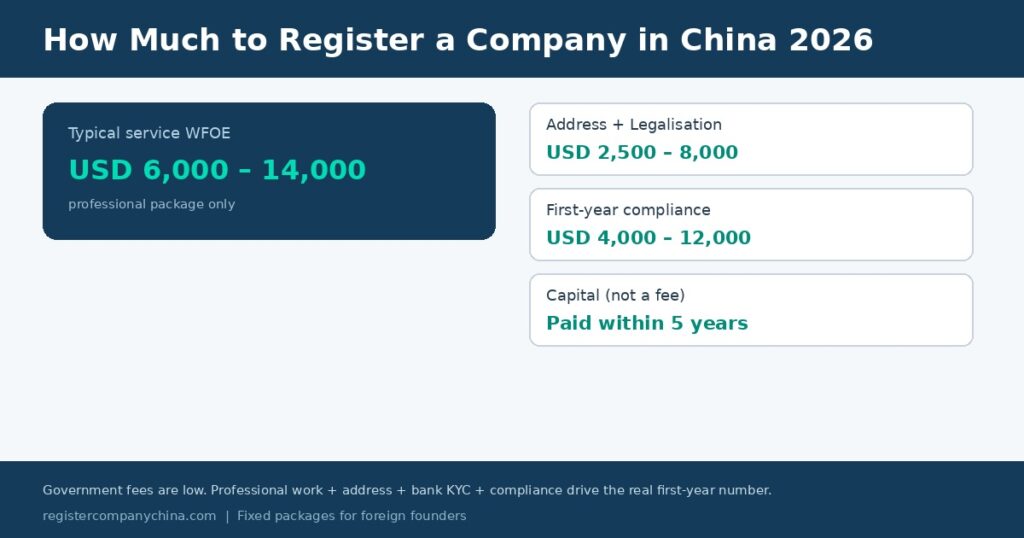
How much does it cost to register a company in China in 2026? The short answer most foreign founders need is this: professional setup fees for a standard service or trading WFOE typically fall between USD 6,000 and 14,000. That figure covers name approval, articles, SAMR filing, chops, tax registration and basic bank coordination. It does not include registered capital, a bank-acceptable address, or the first year of bookkeeping and audit.
Most quotes stop at the professional package. The real first-year cash a foreign founder should plan for is higher once the address, legalisation and mandatory compliance are added. This page gives the numbers used by active formation practices in 2026, separates fees from capital, and explains the two cost items that still catch people after the business licence is issued.
Direct Answer: Typical 2026 Ranges
- Service / consulting WFOE (foreign individual or overseas company shareholder): USD 6,000–14,000 professional package
- Trading / import-export WFOE: USD 8,000–16,000 (extra customs and SAFE preparation)
- Manufacturing WFOE: USD 18,000–30,000+ (licences, environmental steps, longer timeline)
- Representative Office: USD 4,000–8,000 (no capital, but limited to liaison and cost-plus tax)
Government filing fees themselves are low — often RMB 0–1,000 for the licence and basic seals in Shanghai, Shenzhen and Guangzhou. Almost everything else is professional work, document handling and post-licence requirements.
What the Professional Fee Usually Includes (and What It Does Not)
A full-service package from a reputable provider normally covers:
- Name pre-approval and articles of association
- SAMR business licence filing and foreign-investment information report
- Company chops (official, finance, legal-representative, contract, invoice)
- Tax registration and basic fapiao setup hand-over
- Coordination for the corporate bank account application
It almost never includes:
- Notarisation, apostille and certified Chinese translation of shareholder documents (USD 800–2,500 depending on home country)
- A registered address that both SAMR and the bank will accept (USD 1,500–6,000 per year in tier-1 cities for a compliant commercial solution)
- Travel for the legal representative to complete bank KYC (still required in most cases in 2026)
- First-year bookkeeping, monthly tax filings and the statutory audit
Registered capital is not a fee. Under the revised Company Law it must be paid in full within five years of incorporation. The amount should be commercially realistic for the business scope; local AMR offices and banks both review it.
City Differences That Move the Number
Shanghai and Beijing sit at the higher end of professional fees and expect stronger address and capital documentation. Shenzhen and Guangzhou often process clean service and trading files faster and quote 10–20 percent lower for comparable work. Many tier-2 cities (Hangzhou, Suzhou, Chengdu, etc.) are lower still on both professional fees and annual address costs, while the legal capability of the WFOE remains the same.
Free-trade-zone options (Lingang, Qianhai, Hainan) can reduce corporate income tax to 15 percent for encouraged industries. They do not remove the setup fees or the five-year capital rule.
Realistic First-Year Cash for a Foreign Founder
For a lean consulting or service WFOE with one or two people, a practical first-year budget (excluding salaries and the capital injection itself) looks like this:
- Professional package + document legalisation: USD 7,000–15,000
- Compliant registered address (year 1): USD 1,500–6,000
- Bookkeeping, tax filings and statutory audit: USD 4,000–12,000
Total first-year cash outside capital and payroll: commonly USD 12,000–30,000 depending on city and whether the address is a simple approved cluster or a full commercial lease. Trading files and any additional licences push the total higher.
Two Cost Items That Still Cause Delays and Extra Fees
1. Address that the bank rejects
SAMR may accept certain serviced or cluster addresses for the licence. Most mainland banks still require a commercial lease they can physically verify. A virtual address that fails bank KYC forces a change of address, extra filings and often a second round of fees. Choose an address that both the registration office and the target bank will accept from the start.
2. Legal representative appearance for bank opening
Registration filings can usually be completed remotely. Corporate bank account opening in 2026 still normally requires the legal representative (or an authorised director) to appear in person for biometric and KYC checks. Travel, hotel and time away from the office add a real cost that is rarely shown in the original quote. Plan for one short trip after the licence is issued.
These two points explain why some low advertised prices later expand. The licence is only the first milestone; the company is not operational until the RMB account is open and capital can be received.
How to Read Any Quote You Receive
Ask for an itemised list that separates:
- Government and official charges
- Professional fees and exactly what is included through bank hand-over
- Document legalisation and translation
- Registered address solution and bank acceptance
- First-year compliance (bookkeeping, tax, audit)
- Any expected travel for the legal representative
Fixed-price packages that cover the full path from name pre-approval to a usable bank account remove most of the surprise. Remote handling of the SAMR stage is now standard; the remaining in-person step is almost always the bank.
If you already know the city and approximate business scope, a short scoping conversation produces a number you can put into a budget without later amendments. Register Company China works with fixed packages for foreign individuals and overseas companies, manages the process remotely where possible, and provides clear inclusions so the first-year cost is known before work starts.
Frequently Asked Questions
Is there a government fee to register a company in China?
In most major cities the business licence itself carries little or no official charge. The visible cost is professional work, documents and post-licence requirements.
Does registered capital count as a registration cost?
No. It is the shareholder’s commitment to fund the company and must be paid within five years. It should match the commercial needs of the planned scope.
Why do some agents quote much lower numbers?
They often cover only the SAMR filing and basic chops. Legalisation, a bank-acceptable address, tax registration and first-year compliance are left out and appear later.
How long until the company is actually usable?
Licence in 1–3 weeks after a complete filing is common. Full operational status, including a working RMB account, usually takes 8–16 weeks for a clean service or trading file.
Can everything be done without travelling to China?
Most registration steps can. Bank account opening for a foreign legal representative still normally requires an in-person appearance.
For a precise figure based on your shareholder type, city and scope, the practical next step is a tailored quote rather than another generic range.