China Business Setup Fees Explained
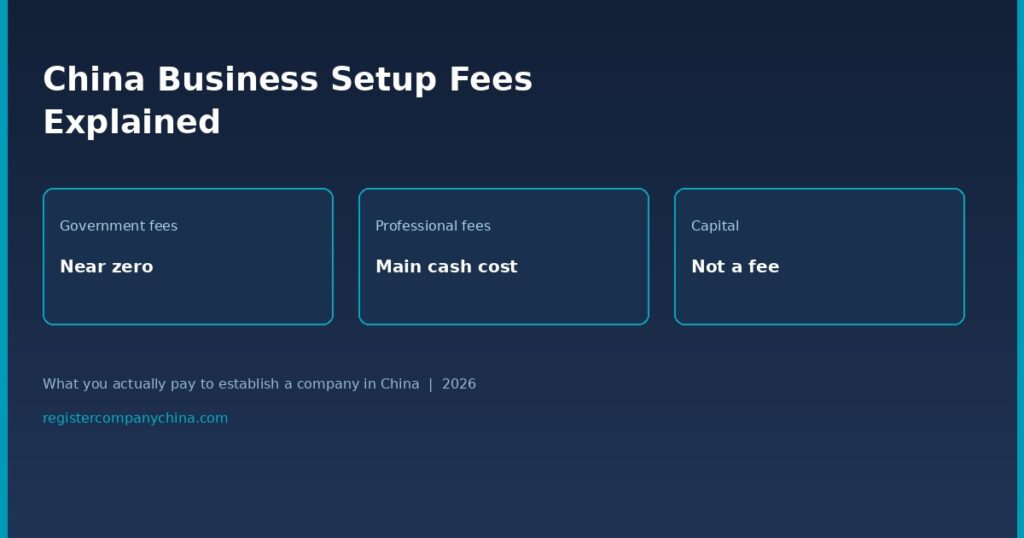
When people ask about China business setup fees, they usually expect one number. The reality is simpler and more useful once you separate the categories. Official government registration fees for a standard company are near zero in most cities. The money you actually spend goes to professional coordination, document legalisation, a compliant registered address, company seals, and bank-account support. Registered capital is not a fee at all; it is shareholder funding that must be paid into the company within five years.
This article explains each fee type, what is typically included or excluded in provider quotes, and how the numbers change by entity type so you can read any proposal with a clear checklist.
The three things people mix up
Almost every confusing quote collapses three different concepts:
- Official / government fees — what the market regulation bureau and related authorities charge for the licence and basic filings.
- Professional and administrative fees — the cost of the people who prepare documents, file them, handle chops, tax registration and bank coordination.
- Registered capital — the amount the shareholder commits to inject into the company. It is equity, not an expense paid to the government or the agent.
Keep these three lines separate and most “hidden cost” surprises disappear.
Government fees: almost free in practice
In Shanghai, Beijing, Shenzhen and the majority of other major cities, the business-licence filing itself carries no material government charge. Shanghai’s official guidance states that establishing a company is free of charge. Electronic business licences and electronic seals are issued at no cost, and many districts still provide a complimentary set of physical seals for newly established companies.
Across China the official component of ordinary company registration typically runs from RMB 0 to roughly RMB 1,000. If a quote you receive is several thousand dollars, the difference is professional work, document handling or address costs, not a government registration fee.
Special licences (food, medical devices, certain education or telecom activities, environmental assessments for manufacturing) can add official fees or third-party assessment costs. Those are sector-specific, not the base company-registration fee.
Professional and agency fees
This is the largest cash line for most foreign investors. A full-service provider handles Chinese name pre-approval, articles of association, SAMR filing, tax registration, chops, address coordination and bank-account support. Market ranges in 2026 for a standard service or trading WFOE commonly fall between USD 3,000 and USD 10,000, with manufacturing and regulated scopes higher.
What is usually included in a transparent package:
- Name reservation and availability checks
- Drafting and filing of the articles of association
- Business-licence application and foreign-investment information report
- Company seal (chop) set
- Basic tax and e-fapiao registration
- Coordination for the corporate bank account
What is often billed separately or left out of the headline number:
- Notarisation, apostille and certified translation of foreign shareholder documents
- Registered-address lease or serviced-office fee for the first year
- Any sector-specific licences or environmental assessments
- Ongoing bookkeeping, tax filing and statutory audit after the licence is issued
Always ask for an itemised scope before comparing two quotes. A lower number that stops at the licence is not cheaper if you still have to pay for bank opening, address and post-licence compliance.
Document legalisation and translation
Foreign shareholder identity documents, corporate certificates and powers of attorney must be notarised in the home country and, for Hague Convention members, apostilled. China joined the Apostille Convention in November 2023, which removed the old multi-step embassy legalisation chain for most Western investors.
Realistic cost for a U.S. or European individual or company shareholder is typically USD 500–2,500 depending on the number of documents and whether expedited processing is required. Certified Chinese translation adds a further few hundred dollars. This step usually takes two to four weeks and must be finished before the SAMR filing can begin.
Registered address
China requires a commercial address that the local market regulation bureau will accept. Pure residential addresses are almost never accepted for a WFOE. Serviced or virtual commercial addresses that meet local rules typically cost RMB 5,000–20,000 per year in tier-1 cities and less in many second-tier locations. A genuine leased office is more expensive and is needed only when you actually require the space.
Banks later verify that the address exists. An address that fails inspection creates problems at the bank-account stage even if the licence was issued. For more detail on choosing an address that will survive both SAMR and bank checks, see the guide on registered address requirements for a WFOE.
Company seals and bank-account support
Physical company seals (official, finance, legal-representative, invoice and contract) cost a few hundred RMB if not provided free by the local government. Bank-account opening itself is often free or charged only a modest fee. The real cost is time: some banks still require the legal representative to complete identity verification in person or by video, which can add weeks and possible travel expense.
Until the basic RMB account and capital account are live, the company cannot receive capital injections or make ordinary payments. Factor bank timeline into the overall project plan even when the bank fee itself is low.
Registered capital is not a setup fee
Registered capital is the amount the shareholder commits to put into the company’s capital account. Under Article 47 of the revised Company Law, that amount must be fully paid within five years of the business-licence date. There is no statutory minimum for most open sectors, but local bureaus and banks expect an amount that looks commercially reasonable for the declared business scope.
Once injected, the capital can be used for rent, salaries, inventory and other legitimate company expenses. It stays on the company’s books; it is not paid to the government or to the service provider. Treating it as a “registration fee” is the most common budgeting error. For practical ranges by business type and the five-year contribution rule, see the dedicated guide on WFOE registered capital.
How fees differ by entity type
| Entity | Typical setup fee range (professional + admin) | Key difference |
|---|---|---|
| Service / consulting WFOE | USD 5,000–12,000 | Lightest scope, fastest path |
| Trading / import-export WFOE | USD 7,000–14,000 | Customs registration adds work |
| Manufacturing WFOE | USD 15,000–30,000+ | Environmental and sector licences |
| Representative office | Usually lower than a WFOE | Cannot invoice or trade; limited activities |
A representative office is cheaper to open but cannot issue fapiao, sign trading contracts or engage in profit-making activities. For any revenue-generating business a WFOE remains the standard vehicle.
What to ask before you sign a quote
- Is the government filing fee included or charged at cost?
- Does the package include bank-account opening support or only the licence?
- Who pays for and arranges the registered address for the first year?
- Are notarisation, apostille and translation of shareholder documents included or extra?
- What happens after the licence — is the first year of bookkeeping and tax filing part of the package or a separate engagement?
- Is the quote fixed or subject to change if the scope needs adjustment?
Clear answers to these six questions turn most “hidden fee” problems into known variables.
Common questions
Are China business setup fees the same as registered capital?
No. Setup fees are the cash you pay for professional work, documents, address and related services. Registered capital is money the shareholder injects into the company and can later use for operations.
Why do quotes vary so widely?
Scope. One quote may cover only the business licence. Another includes bank support, address, tax setup and first-year compliance. City, industry and shareholder type also move the number.
Can I do the registration myself and avoid professional fees?
In theory yes for a simple domestic company. For a foreign-invested WFOE the combination of language, document authentication, bank KYC and post-licence filings makes most foreign founders choose a specialist. Mistakes on scope wording or capital contribution schedules are expensive to correct later.
Do government fees ever become material?
For ordinary service or trading WFOEs they stay low. They rise when the activity requires sector licences, environmental assessment or other pre-approvals. Those are activity-specific costs, not the base company-registration fee.
Register Company China uses fixed-scope remote packages so the total professional and administrative cost is known before work begins. If you already know the city and approximate business scope, that is enough to request a concrete, itemised quote.