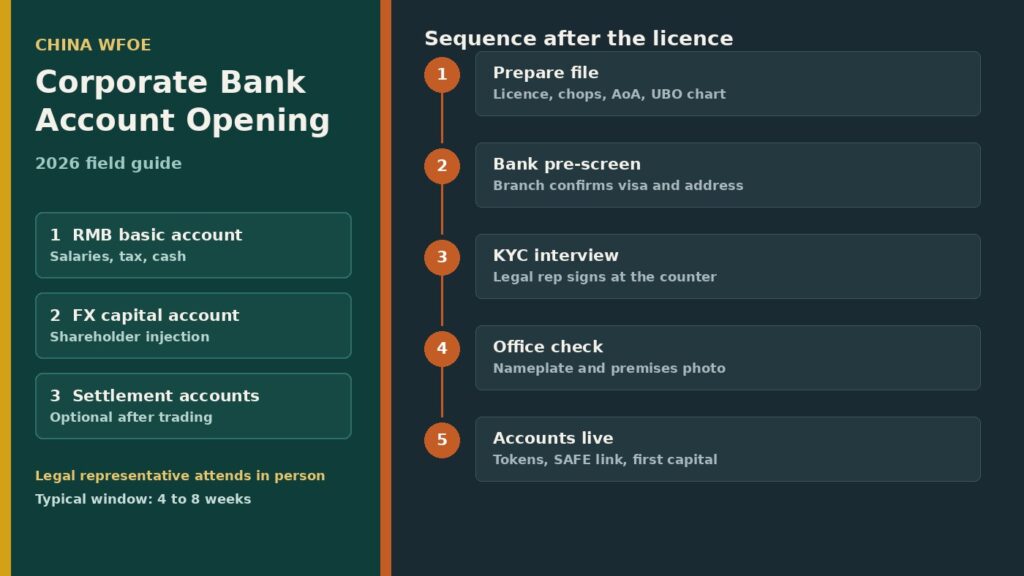
A China business licence is not enough to operate. Until the company has a corporate bank account, it cannot receive registered capital, pay tax, issue salaries, or settle with suppliers. For most foreign-invested enterprises, opening that account is now the longest and least predictable step in the whole setup.
This guide explains which accounts a WFOE actually needs in 2026, what banks ask for, why the legal representative still has to appear in person, how long the process takes, and the mistakes that cause applications to stall.

Which Bank Accounts a China WFOE Must Open
A newly licensed WFOE normally needs two accounts on day one, and often a third once trading starts.
RMB basic deposit account (基本存款账户). This is the company’s primary operating account under People’s Bank of China rules. It is the only account that can pay salaries, pay tax, and withdraw cash. A company may hold only one basic account. The bank that opens it is registered with the PBOC and later linked to the tax system.
Foreign-currency capital account. This account receives registered capital from the overseas shareholder. It is opened at a bank that can handle SAFE (State Administration of Foreign Exchange) reporting. Capital must arrive from an account in the shareholder’s own name, in the currency stated in the Articles of Association.
General RMB or settlement accounts. Extra RMB accounts and a foreign-currency current-account settlement account are optional but useful once the company starts invoicing customers or paying overseas suppliers. They cannot replace the basic account.
Opening the basic account and the capital account at the same bank usually saves a second KYC round.
How Long China Corporate Bank Account Opening Takes
Plan on four to eight weeks after the business licence is issued. Document collection and a bank pre-screen take one to two weeks. The legal representative interview and compliance review take another two to four weeks. Online banking tokens and the SAFE link for the capital account add a further week or two.
Domestic banks with an international desk in Shanghai, Shenzhen or Beijing sometimes finish faster when the file is complete. Foreign banks such as HSBC China or Standard Chartered China can be quicker for groups that already bank with them offshore, but their KYC is often stricter on ultimate beneficial owners.
Bank fees themselves are modest, often zero to a few hundred US dollars. The real cost is travel time for the legal representative and any delay to capital injection.
Documents Banks Ask For in 2026
Checklists differ by branch, but the core pack is consistent:
- Original business licence and several certified copies
- Articles of Association filed with SAMR, including the five-year capital contribution schedule
- Company chop, finance chop and legal representative chop, plus the bank’s specimen seal card
- Legal representative’s original passport and a valid visa or residence permit (a tourist L-visa is often refused)
- Shareholding chart through to natural-person ultimate beneficial owners
- Lease or property certificate for the registered address, plus the landlord’s title documents in many cities
- Board or shareholder resolution authorising the account
- A short description of expected counterparties, currencies and monthly volumes
Overseas parent documents still need notarisation and apostille (or consular legalisation if the home country is not in the Hague Apostille Convention). Incomplete UBO charts and mismatched English names on passports are the two most common reasons a file is sent back.
Why the Legal Representative Must Appear in Person
Company registration can be handled remotely. Bank opening generally cannot. In 2026 almost every mainland bank requires the legal representative to sit in the branch, present the original passport, answer questions about the business model and source of funds, and sign the account forms.
Powers of attorney and video calls are rarely accepted for the first basic account. A few foreign banks may allow video KYC when the group already has a relationship, but that should not be assumed when planning travel.
Two practical workarounds exist if the overseas founder cannot fly: appoint a China-resident legal representative before incorporation, or choose a bank branch that will lock a date once the pre-screen is approved so the trip is a single appointment rather than an open-ended wait.
Office Visits and Virtual Addresses
Many branches inspect the registered office. Officers photograph the nameplate, the licence on the wall and whoever is working there. Virtual addresses and empty co-working desks fail this check regularly. If the company uses a service address for SAMR filing, confirm in writing that the chosen bank will accept it before booking flights.
Nameplate installation and a short-term staff presence on the visit day prevent a second inspection.
Choosing a Bank
Bank of China remains the default for first-time FIEs because of SAFE experience and a wide branch network. ICBC and China Construction Bank work well for larger operations. China Merchants Bank is often easier for smaller service companies that care about online banking. HSBC China and Standard Chartered China suit groups that already hold accounts with those banks in Hong Kong or Singapore and need smoother outbound payments.
English-language service varies by branch, not by brand. Ask for a relationship manager who has opened FIE accounts in the last year, not a retail counter.
After the Account Opens
Activate online banking and the USB or mobile tokens immediately. Then inject registered capital into the foreign-currency capital account from the shareholder’s own overseas account. The bank reports the inflow to SAFE. Using those funds inside China still follows SAFE conversion rules; keep contracts and invoices that match the stated business scope.
The basic account should be linked to tax withholding so VAT, corporate income tax and social insurance can be paid. Without that link, the company cannot complete monthly filings even if the licence looks complete.
Cross-border cash pooling rules were expanded nationwide in September 2026 for qualifying multinational groups. A first-year WFOE with a single entity usually does not need a cash pool. It still needs clean basic and capital accounts.
Problems Founders Report Most Often
Forum threads and advisory case notes keep repeating the same failures. The legal representative arrives on a tourist visa and is turned away. The registered address cannot be inspected. The UBO file stops at a holding company instead of a person. Expected transaction volumes look implausible next to a thin business scope. A second bank application is filed after a refusal without refreshing chops and resolutions, which restarts KYC from zero.
Inbound transfers from personal wallets or third-party payment apps also trigger freezes on new accounts. Capital should come from the shareholder entity named in the Articles of Association.
FAQ
Can a WFOE open a China corporate bank account without anyone travelling?
Almost never for the first basic account. Budget for the legal representative to attend the branch.
How many accounts does a new WFOE need?
At least an RMB basic account and a foreign-currency capital account. Extra settlement accounts can wait.
Do I need a minimum deposit?
There is no nationwide legal minimum. Some branches still ask for a courtesy balance. Treat any figure quoted by one branch as that branch’s practice, not a statute.
Can I use a Hong Kong or NRA account instead?
Those accounts help with cross-border settlement. They cannot pay China tax, issue local salaries, or receive registered capital into a mainland WFOE. A licensed operating company still needs mainland accounts.
What visa should the legal representative hold?
A work or residence permit is safest. Many banks reject tourist L-visas for corporate KYC.
What to Do Next
Pick the bank before the licence is printed so the document pack and travel window are ready. Confirm the branch’s current visa, address and UBO rules in writing. If the founder cannot travel, decide whether to appoint a local legal representative at incorporation rather than trying to force a remote opening later.
Corporate bank account opening support is part of the same post-licence work as chops and tax registration. For the entity itself, start with WFOE registration and a clear fixed-package process so banking is scheduled, not improvised.