A China business licence does not move money. Until a Wholly Foreign-Owned Enterprise opens its corporate bank accounts, it cannot receive registered capital, pay tax or salaries, or settle with local suppliers. In 2026 that banking step is still the usual choke point after incorporation.
This guide covers which accounts a WFOE actually needs, what banks ask for, why branches refuse files that look complete, and how long the work takes when the legal representative can attend in person.
What a WFOE bank account is for
Chinese banks treat a foreign-invested company as a new customer even when the shareholder already banks with the same group overseas. The file is a corporate KYC review plus a foreign-exchange registration, not a retail account application.
Until the basic RMB account is live, the company is a certificate. Tax bureaus expect tax to leave that basic account. Staff expect payroll from it. Overseas shareholders expect a foreign-currency capital account before they remit registered capital under the contribution schedule in the articles of association.
Company registration itself can be managed remotely. Banking generally cannot. Most mainland branches still require the legal representative to appear with a passport and the company chops. That is the gap many founders discover only after the licence arrives. For the earlier steps, see the overview of WFOE and company registration in China.
Which accounts a WFOE needs in 2026
A working WFOE almost always needs more than one account. The labels differ slightly by bank, but the functions do not.
| Account | Currency | Main use | Notes |
|---|---|---|---|
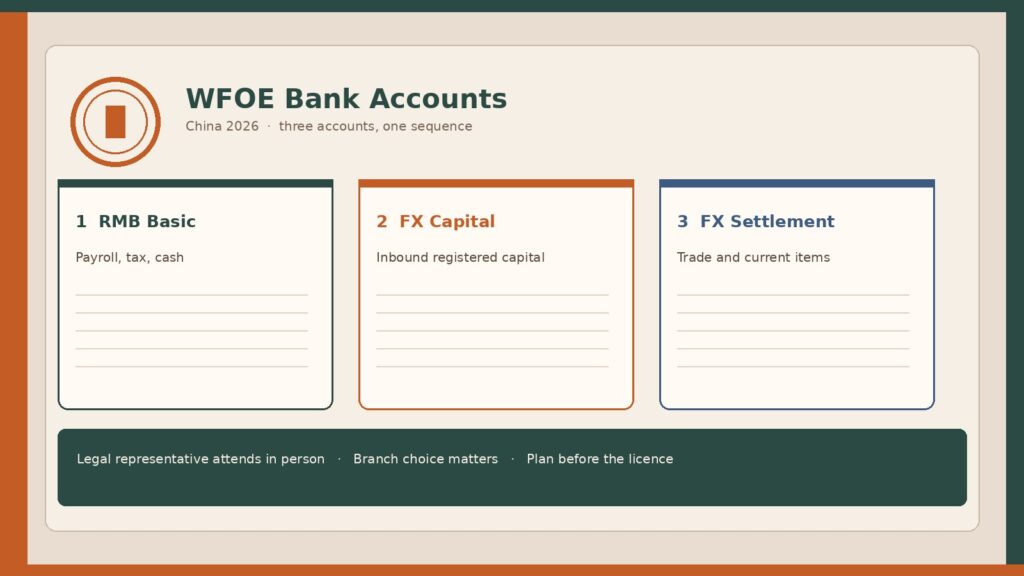
| RMB basic deposit account | RMB | Daily operations, payroll, tax, cash withdrawal | Only one basic account per company. Must be registered with the People’s Bank of China. |
| RMB general account | RMB | Extra settlement at another bank or city | Optional. Cannot withdraw cash. Useful if suppliers bank elsewhere. |
| Foreign-currency capital account | USD, EUR, HKD, and others | Receive registered capital from the overseas shareholder | Tied to the foreign-investment filing and SAFE records. |
| Foreign-currency settlement account | Foreign currency | Current-account trade receipts and payments | Needed if the company invoices or pays overseas counterparties in foreign currency. |
Open the RMB basic account first. The capital account follows once the bank can see the licence, chops, and foreign-investment filing. Settlement accounts are added when the business actually has current-account flows. Putting all three in the same bank saves a second KYC cycle.
A Non-Resident Account held by the overseas parent is not a substitute. It cannot issue Chinese fapiao, run local payroll, or hold the WFOE’s registered capital.
Who must attend and what banks check
Banks apply enhanced due diligence to foreign-controlled companies. In practice they look at four things.
First, the legal representative. Most branches still insist on an in-person interview. Video KYC exists in isolated pilots and should not be treated as the default. If the representative lives overseas, book the trip before the licence prints. Changing the representative later to avoid travel is a separate SAMR filing and can take weeks.
Second, the registered address. Some branches send staff to look at the office. A thin virtual address that cannot host a visit is a common reason a file stalls. Address rules sit next to the licence, not inside the bank’s marketing brochure.
Third, beneficial owners. Banks must identify the natural persons who ultimately control the WFOE. Multi-layer offshore holding companies without a clean UBO chart trigger extra review. Prepare the ownership chain to the individuals before the appointment.
Fourth, expected flows. Officers ask where capital comes from, which currencies will move, and who the first counterparties are. Vague answers look like an empty shell. A one-page description of the first six months of activity is more useful than a generic business-plan template.
Choice of legal representative therefore affects banking as much as it affects the licence. The role, residency, and travel availability are covered in more depth in a dedicated piece on WFOE legal representative requirements.
Documents banks usually request
Lists vary by city and by branch. The core pack is consistent enough to prepare in advance.
- Business licence original and copies (unified social credit code)
- Articles of association as filed with SAMR
- Foreign investment information report receipt
- Full chop set: company chop, financial chop, legal-representative chop, and often the contract chop
- Legal representative passport original, plus a Chinese translation if the branch asks for one
- Board or shareholder resolution authorising the account and naming signatories
- Lease or property proof that matches the registered address
- Beneficial owner declaration and ownership chart to the natural persons
- Overseas shareholder corporate documents, apostilled or legalised, with certified Chinese translations when the investor is a company
Hague Apostille documents are faster than consular legalisation for investors in contracting states. Incomplete authentication of the parent company is still one of the most common delays on the capital account, not the basic RMB account.
Registered capital that will arrive through the capital account should already be a number the company can defend. Banks will ask about source of funds. The contribution timetable under the current Company Law is a separate planning issue from the bank interview itself.
How to choose a bank
The brand on the door matters less than the branch behind it. The same bank can approve a file in one district and refuse an identical file two kilometres away because the officers have never processed a foreign legal representative.
State banks such as Bank of China, ICBC, China Construction Bank, and Agricultural Bank of China have the deepest FIE volume and the widest networks. China Merchants Bank is often easier for smaller foreign-owned companies that want usable online banking. HSBC China and Standard Chartered China help when the shareholder already banks with the group in Hong Kong, because part of the KYC file can travel internally.
Foreign banks in China generally cannot serve as the sole basic RMB account for tax and cash in the way a domestic bank can. Many groups keep the basic account at a Chinese bank and use an international bank for cross-border cash management.
Practical filters before you book an interview:
- Does this exact branch open accounts for foreign-invested companies, not only for local firms?
- Will an officer who has done FIE KYC handle the appointment?
- Can the legal representative attend on the dates the branch offers?
- Will the same bank open the capital account after the basic account?
- What does online banking look like for dual-authorisation payments and English interfaces?
Call the branch. Do not rely on the head-office brochure. Founders on public forums still report that two branches of the same bank in the same city issue different document lists.
Step-by-step opening process
- Pick the bank and the branch while the licence is still in process. Pre-clear the document list.
- Assemble chops, licence copies, UBO papers, and the lease. Translate what the branch named in writing.
- Submit the pack and book the legal-representative interview.
- Attend the interview. Expect questions on business purpose, source of capital, and who will operate online banking.
- Wait for branch compliance and the PBOC basic-account registration.
- Collect account numbers, specimen seal cards, and online-banking tokens.
- Open the foreign-currency capital account and complete the SAFE-linked filing the bank requires.
- Test a small inbound transfer and a domestic tax or utility payment before you rely on the accounts for payroll.
Some banks still inspect the registered office. If the address cannot receive a visitor, fix that before the interview rather than after a failed visit.
Realistic timeline and cost
Published ranges disagree because they start the clock at different points. A clean file at a branch that already handles FIEs can produce a basic account in about one to three weeks after the appointment. Capital and settlement accounts add days, not months, once the basic account exists.
Four to eight weeks from licence to a usable set of accounts is a safer planning number when the legal representative must fly in, the shareholder stack needs apostilles, or the first branch declines the file. Treating banking as an afterthought is how a two-week licence turns into a two-month stall.
Bank fees for opening are often modest or waived. The real cost is travel for the legal representative, translations, and idle time while capital sits offshore. Professional support for bank coordination is usually a line item inside a setup package rather than a separate government fee. For the wider budget around incorporation, see the China WFOE registration cost discussion on the site.
Why banks say no
Refusal is rarely a statement that foreign companies cannot bank in China. It is usually one of these:
- The branch has no workflow for a foreign passport as legal representative.
- The UBO chain is incomplete or the parent documents are not authenticated.
- The registered address cannot be verified.
- The business scope on the licence does not match the activity described in the interview.
- The company looks inactive: no staff plan, no counterparties, no capital timeline.
- The legal representative cannot attend and the branch will not accept a proxy.
The usual fix is another branch, not another country. Embassy-area and CBD branches process more foreign files than suburban counters. If one officer declines, ask which nearby branch handles international corporate customers.
After the account is open
Keep the chops and the online-banking tokens under dual control. The financial chop plus the company chop is how money leaves the account. A single person holding both is an operational risk, not a banking product feature.
New accounts often carry conservative transfer limits until the bank sees a few months of ordinary activity. Large outbound payments need contracts, invoices, and a clear current-account purpose. Record-keeping expectations at banks have lengthened; keep the underlying contracts.
Capital arriving into the capital account still has to be converted or used in line with the filed business. Empty capital sitting unused while the company invoices through personal accounts is a compliance problem, not a shortcut.
Once money can move, tax filing and annual compliance become the next calendar. Those obligations sit with the company from the first month the licence exists, whether or not the bank appointment is finished.
What to do next
Decide the bank and the travel window for the legal representative before SAMR issues the licence. Prepare the UBO chart and parent-company documents in parallel with name pre-approval. If you need the licence, address, chops, and bank appointment handled as one sequence rather than three vendors, the company registration and bank-account services page lists what can be done remotely and what still requires a person in the branch.
FAQ
Can a WFOE open a bank account without anyone travelling to China?
Generally no. Most mainland branches require the legal representative in person. Do not plan on a power of attorney as the primary path.
How long does WFOE bank account opening take in China in 2026?
Plan one to three weeks after a complete appointment at an experienced branch, and four to eight weeks if travel, apostilles, or a branch change are involved.
Which account should be opened first?
The RMB basic account. The foreign-currency capital account comes next so shareholders can remit registered capital.
Can the company use a Hong Kong account instead?
A Hong Kong account can move group funds. It cannot replace the onshore basic account for tax, payroll, or domestic supplier settlement.
Do all banks accept virtual registered addresses?
No. Many branches want an address they can visit. Confirm the branch policy before you lock the lease.
Is Bank of China always the safest choice?
It has long FIE experience, but branch quality varies. ICBC and China Merchants Bank are common alternatives. Choose the branch that has done this file type recently.
What if the first bank refuses?
Take the written reason, fix the document gap if there is one, and book a branch that already serves foreign-invested companies. Switching banks is normal. Starting from a new licence is not required.