How to Repatriate Profits from a China WFOE in 2026
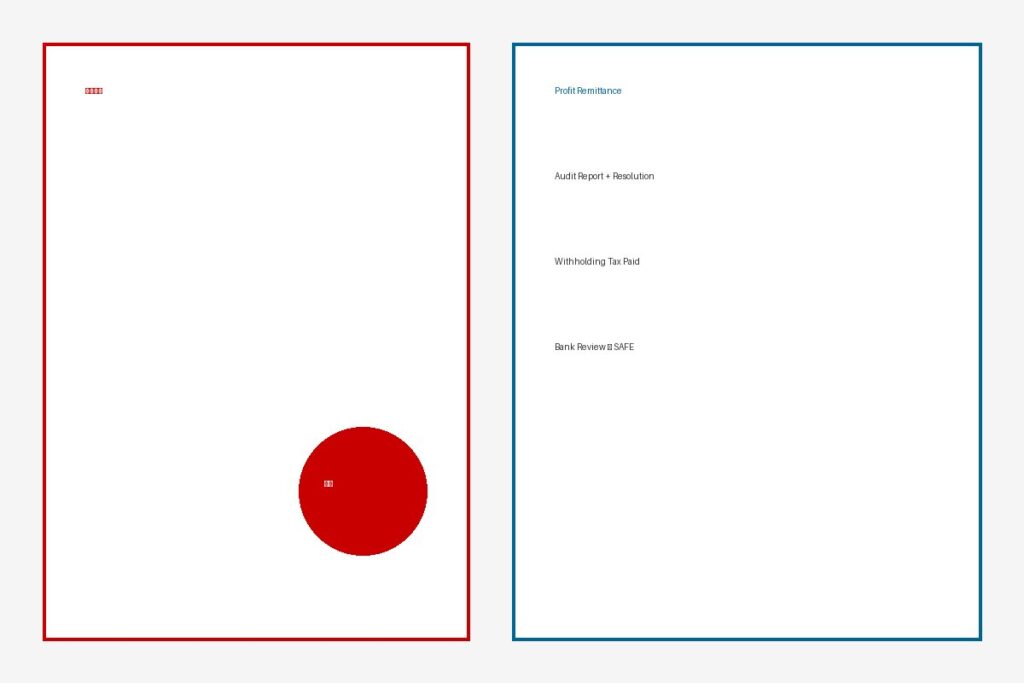
Foreign shareholders can repatriate after-tax profits from a China WFOE. The process is not automatic and cannot start from management accounts alone. The company must first complete its statutory annual audit, settle its corporate income tax position, allocate the statutory reserve, pass a formal resolution, withhold the applicable tax, and satisfy the bank’s documentary review under SAFE rules.
Most delays happen because one of these steps is incomplete or the documents do not match. Planning the distribution after the audit is finished usually produces a cleaner result than trying to reverse-engineer the paperwork later.
What Must Be in Place Before a Dividend Can Be Declared
Chinese Company Law and bank practice require several conditions before profits become legally distributable:
- A statutory annual audit by a Chinese-licensed CPA firm. The audit report is the primary evidence of after-tax profit and accumulated distributable reserves.
- Completion of the corporate income tax annual reconciliation (normally by 31 May). Banks and SAFE expect the tax position for the relevant year to be settled.
- Prior-year losses fully offset.
- Allocation of the statutory reserve: at least 10% of after-tax profit until the reserve reaches 50% of registered capital.
- Shareholders have contributed registered capital in accordance with the articles of association and the five-year contribution rule that applies to companies formed under the current Company Law.
Only the amount remaining after these steps is available for distribution. Cash sitting in the account is not the same as distributable profit.
Withholding Tax Rates That Apply in 2026
The tax treatment depends on whether the shareholder is a foreign company or a foreign individual.
| Shareholder type | Standard rate | Possible reduction | Key 2026 note |
|---|---|---|---|
| Foreign corporate shareholder | 10% withholding tax | Often 5% under the Mainland–Hong Kong arrangement if the Hong Kong company holds at least 25% and meets the beneficial-ownership test | Treaty claims require a tax residency certificate and supporting substance evidence |
| Foreign individual shareholder | 20% individual income tax | May be reduced by an applicable tax treaty | The long-standing exemption ended on 1 September 2026 under Ministry of Finance and State Taxation Administration Announcement No. 27 of 2026 |
The paying WFOE is responsible for withholding and remitting the tax. For individual shareholders the change is material: dividends paid on or after 1 September 2026 are subject to 20% IIT. Companies that previously relied on the old exemption should recalculate the net amount that will actually reach the shareholder.
If you are still deciding whether the WFOE should be owned by a foreign individual or by an overseas company, the tax difference on future distributions is one of the practical factors to weigh. See our earlier note on individual versus corporate ownership of a China WFOE.
Typical Step-by-Step Sequence
- Finish the year-end books and engage a Chinese CPA firm for the statutory audit.
- File the corporate income tax annual reconciliation using the audited figures.
- Confirm the distributable amount after losses and statutory reserve.
- Pass a shareholder or board resolution that specifies the amount, the recipient, and that the legal conditions have been met.
- Withhold and pay the applicable withholding tax (or IIT). Obtain the payment receipt.
- For a single payment of USD 50,000 or more, complete the tax bureau filing required for certain cross-border payments.
- Submit the complete package to the bank. The bank reviews authenticity and consistency, then processes the remittance.
Banks now act as the front-line reviewer for SAFE on these payments. Incomplete or inconsistent documents commonly result in a request for additional explanation or a refusal.
Documents Banks Commonly Require
- Business licence (chopped copy)
- Audited financial statements for the relevant year, signed by the Chinese CPA firm
- Corporate income tax settlement documentation
- Shareholder or board resolution approving the distribution
- Proof that withholding tax has been paid
- Foreign-investment information / FDI registration records
- For treaty rate claims: tax residency certificate and beneficial-ownership supporting materials
- Bank application forms and the foreign-exchange purchase/remittance instruction
Exact lists vary slightly by bank and city. It is normal to send the package to the relationship manager for a pre-check before the formal submission.
Common Reasons the Remittance Is Delayed
The most frequent practical obstacles are:
- Audit not yet finished or the audit report does not clearly support the amount being distributed
- Statutory reserve not yet allocated or prior losses not fully covered
- Mismatch between the resolution, the tax filings, and the shareholder information on the business licence
- Attempt to claim a treaty rate without adequate substance evidence for a Hong Kong or other intermediate holding company
- Capital contribution schedule not yet satisfied under the five-year rule
Addressing these points before the bank submission reduces the chance of a multi-week clarification loop.
Reinvestment Alternative Worth Considering
Foreign investors who reinvest qualifying China-sourced profits in certain encouraged sectors can claim a tax credit equal to 10% of the reinvested amount under a temporary scheme running from 2025 through 2028. The credit can offset future withholding tax on distributions from the same Chinese company. For groups that plan further expansion inside China, this option can be more efficient than an immediate full remittance.
Frequently Asked Questions
Can a WFOE with no revenue still distribute profits?
Only if there are accumulated distributable profits from prior years that have already been audited and cleared of tax. A company that has never generated taxable profit generally has nothing to distribute.
Does the legal representative need to be in China for the remittance?
No. The remittance is handled through the bank based on documents. The legal representative’s physical presence is more commonly required at the account-opening stage than at later dividend payments.
How long does the bank review usually take?
When the package is complete, many banks process the transfer within one to two weeks. Requests for additional documents or explanations can extend this.
Is the 20% rate for individuals automatic?
The 20% rate applies under Announcement No. 27 from 1 September 2026 unless a tax treaty provides a lower rate and the individual successfully claims it. Treaty claims for individuals are generally simpler than for intermediate holding companies because no further substance test is required.
Proper sequencing of the audit, tax clearance, resolution and bank package is what turns book profit into cash that can leave China. Teams that treat the distribution as a year-end project rather than an ad-hoc request tend to finish faster and with fewer questions from the bank.