WFOE for Cross-Border E-Commerce in China: When You Need One
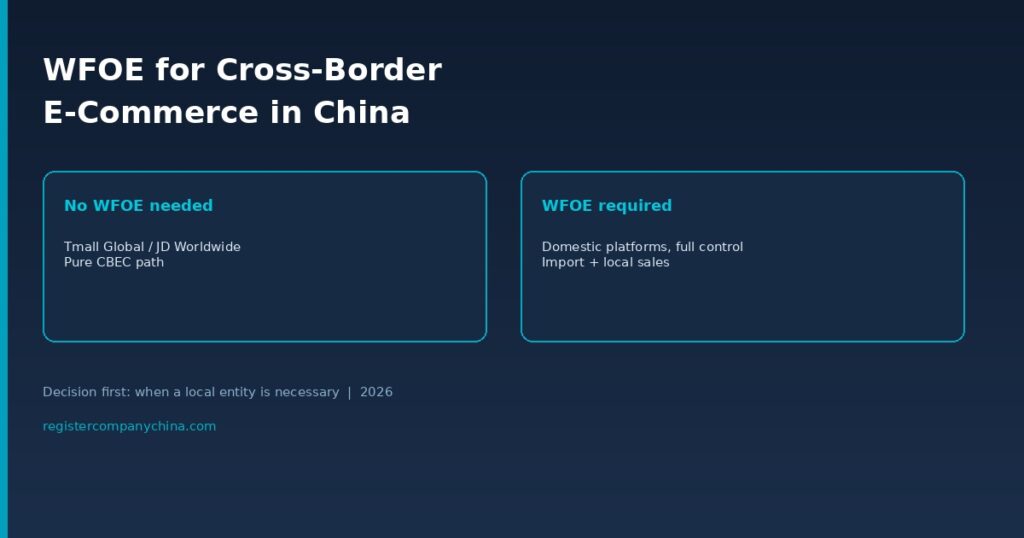
Many foreign brands assume they must open a WFOE before selling to Chinese consumers online. That is not true. China still allows pure cross-border e-commerce (CBEC) sales through platforms such as Tmall Global and JD Worldwide without any local company. A WFOE becomes necessary only when you move beyond those limited channels and need full operational control, domestic platform stores, local invoicing, or general-trade import.
This article first answers the decision question — do you actually need a WFOE? — then explains how to structure and register one when the answer is yes.
Two paths: pure CBEC vs WFOE
| Factor | Pure CBEC (no Chinese entity) | WFOE (local entity) |
|---|---|---|
| Chinese company required | No | Yes |
| Main platforms | Tmall Global, JD Worldwide, Douyin Global, etc. | Tmall (domestic), JD.com, Pinduoduo, own DTC site, offline |
| Tax treatment | Preferential CBEC rates (often ~9.1% effective on most goods); order and annual caps apply | Full general-trade duty + VAT; input VAT recoverable |
| Product registration | Many items on the positive list need no Chinese product registration | Full product compliance and labelling rules apply |
| Local staff & fapiao | No | Yes — can hire, issue VAT invoices, sign local contracts |
| Best for | Testing, low-to-medium volume B2C, brands still validating demand | Long-term brand building, higher volume, multi-channel, offline or B2B |
If your current plan is only to sell packaged consumer goods through the official cross-border stores and stay under the personal-use limits (RMB 5,000 per order, RMB 26,000 per shopper per year), a WFOE is usually unnecessary. You appoint a domestic agent that shares liability and handles customs filings; your overseas company remains the seller.
A WFOE becomes the better vehicle when you need any of the following:
- Access to fully domestic platforms (not the “Global” versions) that require a Chinese business licence
- Ability to issue Chinese VAT invoices (fapiao) to local customers or partners
- General-trade import of goods that fall outside CBEC positive-list or volume limits
- Local inventory, bonded or non-bonded, under your own company name
- Hiring staff in China and building an on-the-ground team
- Offline retail, franchise, or multi-channel distribution
What kind of WFOE for cross-border e-commerce
In practice most foreign brands use a trading WFOE (historically called a Foreign-Invested Commercial Enterprise, or FICE). The business scope printed on the licence must explicitly allow the activities you intend to perform. Typical wording includes:
- Import and export of goods and technologies
- Wholesale and retail of [relevant product categories]
- E-commerce and online sales activities
- Commission agency or related supporting services where needed
Customs, the tax bureau and the bank all read the scope. If import/export language is missing, you cannot declare goods in the company’s own name even after the business licence is issued.
After the licence, the company must complete customs registration as a consignor/consignee and obtain the relevant electronic-port access. Only then can it operate under the main cross-border e-commerce customs supervision codes (9610 for B2C retail, 9710 for B2B direct export, 9810 for export to overseas warehouses, and related codes). These codes determine the declaration method, tax treatment and logistics options available to the company.
Registered capital expectations
There is no statutory minimum for ordinary trading activities. Under the 2024 Company Law, whatever amount you declare must be fully paid within five years. In practice, local market-regulation bureaus and banks expect a commercially reasonable figure for a trading or e-commerce scope. Common ranges used by active formation practices in 2026 are:
- Light trading / early-stage CBEC support: RMB 300,000 – 1,000,000
- Active import + domestic distribution: RMB 500,000 – 1,500,000 or higher
Setting the figure too low can slow the application or create problems later with bank onboarding and platform qualification. Capital is equity, not a fee; once injected it can be used for inventory, rent, salaries and other legitimate company expenses.
Setup sequence and realistic timeline
End-to-end, a clean trading WFOE for cross-border e-commerce usually takes 8–16 weeks once the decision is made:
- Name reservation and business-scope drafting (1–5 days)
- Notarisation and apostille of shareholder documents in the home country (2–4 weeks)
- SAMR business-licence filing (5–15 working days after a complete file)
- Company chops, tax registration, and e-fapiao setup
- Customs registration and electronic-port card
- Corporate bank account (often the longest single step)
- SAFE registration so capital can be injected cleanly
Manufacturing elements, food or cosmetics pre-approvals, or complex multi-shareholder structures add time. Pilot free-trade zones and comprehensive cross-border e-commerce pilot zones can offer faster customs facilitation and, in some cases, preferential tax treatment for qualifying export models, but they do not remove the need for a proper business licence and customs registration.
Cost picture
Government registration fees themselves remain low. The real cash outlay is professional coordination, document legalisation, a compliant registered address, chops, bank support and the first year of bookkeeping. For a standard trading WFOE aimed at cross-border e-commerce, all-in professional and administrative setup commonly falls in the USD 7,000–15,000 range before registered capital. Address cost and any sector licences sit on top.
Ongoing annual compliance (bookkeeping, tax filings, statutory audit, annual report) for a small active trading entity typically runs several thousand US dollars more each year.
Common mistakes
- Assuming a pure CBEC store on Tmall Global automatically requires a WFOE — it does not.
- Filing a business scope that omits import/export or retail language, then discovering the company cannot clear goods or open a domestic store.
- Under-capitalising relative to the declared trading scope and facing bank or platform push-back later.
- Treating the business licence as the finish line; customs registration and bank account are still required before goods can move in the company’s name.
How to decide right now
Ask three practical questions:
- Can my current and next-12-month sales stay inside the official CBEC platforms and the personal-use tax/volume limits?
- Do I need to issue Chinese fapiao, hire local staff, or sell on fully domestic platforms?
- Is general-trade import or multi-channel (online + offline) part of the plan?
If the answer to the first question is yes and the second and third are no, stay on the pure CBEC path and keep costs low. If any of the later questions are yes, a trading WFOE is the standard vehicle and the registration sequence above applies.
Register Company China handles remote setup of trading WFOEs for cross-border e-commerce use cases, including scope drafting that customs and platforms actually accept. If you already know the product category and target channels, that is enough to request a concrete, itemised quote.