
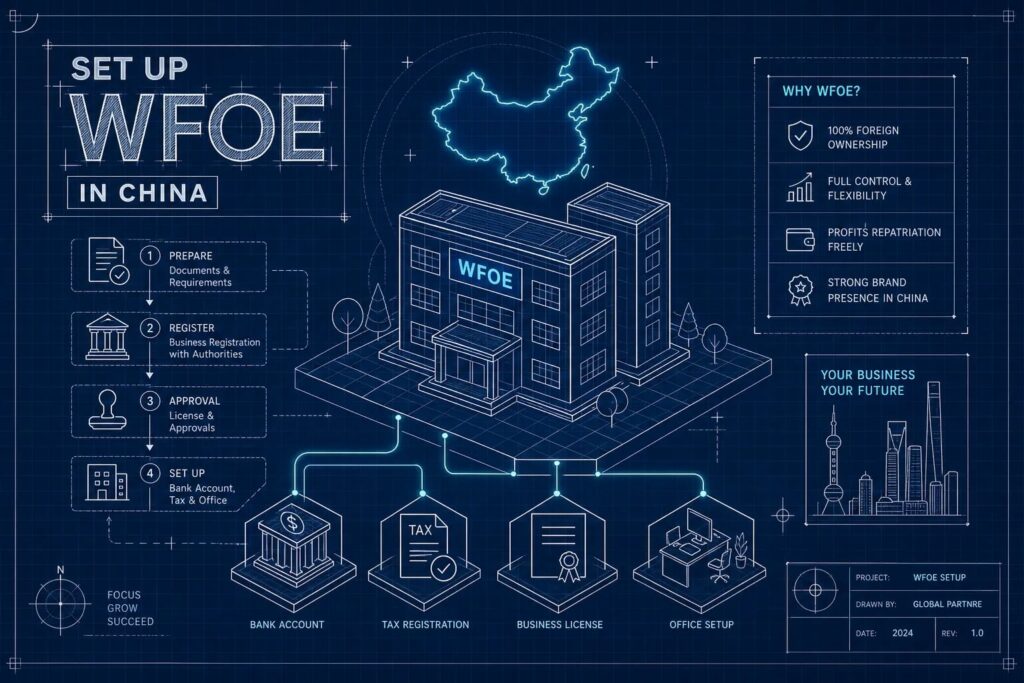
If you’re wondering how to set up a WFOE in China, this guide covers the complete process for 2026: what to decide before you file, what documents to prepare, how the official registration sequence works, what it costs, and where the most common traps are. Setting up a Wholly Foreign-Owned Enterprise is a consequential decision for any US company planning to operate directly in China, given the regulatory, tax, and operational implications involved. A WFOE gives you full operational control, the ability to hire local staff, issue Chinese invoices, and repatriate profits, all under your own brand, without a Chinese partner. But the incorporation process is layered across multiple government authorities, almost entirely in Mandarin, and built around Chinese regulatory logic that most foreign founders have never encountered before.
US founders who skip the planning phase often stall for months on fixable issues: documents sent before apostille, a business scope that triggers an unlisted pre-approval requirement, or registered capital set at an amount that raises questions during review. These delays are avoidable. Services like Register Company China exist specifically to manage the WFOE setup process from start to finish, handling filings, translations, and coordination with Chinese authorities so US clients don’t have to navigate government portals in a language they don’t read. Note that while most of the registration process can be coordinated remotely, some banks and local offices may require the legal representative to appear in person at certain stages, particularly for account opening.
What to Settle Before You File a Single Document
Three decisions shape everything downstream in a WFOE registration, and most founders treat them as afterthoughts: your business scope, your registered capital amount, and your city of incorporation. Getting all three right before you touch a government form saves weeks of back-and-forth later.
Defining Your Business Scope Accurately
China’s State Administration for Market Regulation (SAMR) requires every WFOE to declare a specific business scope. That scope controls what the company can legally do, which licenses it needs, and whether the application gets flagged for sector-specific pre-approval before the business license can be issued. An overly broad scope triggers regulatory scrutiny; a too-narrow scope locks you out of activities you actually need on day one. A consulting WFOE that also plans to issue VAT invoices for product sales needs a trading scope in its registration. Without it, the company faces immediate compliance problems the moment it tries to invoice for goods.
How to Set Up WFOE Registered Capital That Passes Review
China removed universal minimum registered capital requirements for most industries, but SAMR still expects the declared amount to reflect real operating needs. Underfunding signals that the business isn’t serious; overcapitalizing creates a contribution obligation that must be met within five years under China’s 2024 Company Law reform. For 2026, practical benchmarks, drawn from active formation caseloads and consistent with SAMR filing practice, look like this:
- Consulting and services: RMB 200,000 to 500,000
- Trading and import-export: RMB 500,000 to 1,500,000
- Cross-border e-commerce: RMB 1,000,000 to 3,000,000
- Manufacturing: RMB 1,000,000 to 5,000,000 and up
The five-year capital contribution window introduced by the 2024 reform means the amount you choose must be an amount your company can realistically pay in. Don’t set capital high to look credible if you can’t fund it within the timeline.
Choosing the Right City for Your WFOE
City selection matters beyond simple geography. Local AMR offices vary in processing speed, serviced-address availability, and industry preferences. Shanghai, Beijing, and Shenzhen are the most common choices for US companies: all three have active registered-address markets, experienced formation agents, and AMR offices familiar with foreign-invested enterprises (FIEs). Your industry focus and supplier relationships often point naturally toward one of these cities. If not, consider processing speed, address cost, local industry clusters, and the availability of experienced formation agents, the combination of factors, not any single variable, usually points to the right choice.
How to Set Up WFOE: Documents and Authentication Requirements
This is where US founders consistently underestimate lead time. Document preparation for a WFOE registration starts weeks before any China filing begins, and delays here cascade through every subsequent step.
What a Foreign Corporate Investor Must Submit
If the investor is a US entity, the core document set includes a certificate of incorporation, articles of association, a board resolution authorizing the China investment, and a bank reference letter. Depending on the local AMR office and the WFOE’s sector, you may also need a UBO ownership chart or financial statements to verify the investor’s financial standing. All of these must be sourced from the US side and fully prepared before any China filing begins. These are standard WFOE requirements for China company formation for foreign investors, and sourcing them takes longer than most founders expect.
The Apostille and Notarization Requirement Explained
Since the United States is a member of the Hague Apostille Convention, foreign investor documents must be notarized by a local notary public and then apostilled at the state level before they’re accepted in China. For countries outside the Hague Convention, consular legalization through the Chinese embassy is required instead. This step typically takes two to four weeks in the US, turnaround varies by state and provider, and is a common source of pre-filing delays for American founders. Build apostille lead time into your project plan before you set any China filing deadlines.
Documents for Directors, the Legal Representative, and Supervisors
Every foreign-appointed corporate officer needs a passport copy and an appointment letter or board resolution confirming their role. The legal representative position carries statutory responsibilities and potential legal exposure under Chinese law, so this choice deserves deliberate consideration, not a default appointment. Chinese translations of all foreign-source documents are required before submission to SAMR, as local practice consistently requires certified translations; this adds both time and cost if translation isn’t bundled into your registration package.
The Official WFOE Registration Process, Step by Step
Once your documents are authenticated and your pre-registration decisions are locked in, the official filing sequence moves through four main phases. Each one feeds the next, so a delay at any point holds up everything downstream.
Name Approval and Business License Issuance with SAMR
The process starts with a name check against the national SAMR database, which is typically resolved in one to two business days through the online system. After name approval, the full incorporation package goes to the local AMR for business license issuance, standard cases take five to ten business days. Restricted sectors require a pre-approval permit from a sector regulator before or alongside the AMR filing, which is why business scope accuracy at the start is non-negotiable.
Tax Registration, Social Security, and Housing Fund Setup
After the business license is in hand, the company registers with the State Taxation Administration (STA) for tax type verification and fapiao (official invoice) access. Employers must also register for social insurance and housing fund contributions before hiring any staff. These steps run sequentially but move quickly once the license is issued, typically completing within one to two weeks combined. Getting tax registration right from the start is critical: fapiao access directly affects your ability to operate and invoice clients in China.
How to Set Up WFOE Bank Account and SAFE Foreign Exchange Registration
At minimum, the company needs an RMB basic account. If registered capital is being injected from the US, a foreign currency capital account is also required. SAFE-related foreign exchange registration is now handled through the bank rather than as a separate government filing in most cases. Bank KYC review is the most variable step in the entire timeline: depending on the bank and the company’s ownership structure, account opening takes anywhere from two to eight weeks. Some banks require the legal representative to appear in person, a critical planning consideration for US-based founders that should be confirmed with your chosen bank before you finalize timelines.
Realistic Timeline and Cost Breakdown for 2026
Here are the numbers you can actually plan around, based on 2026 filing practice rather than best-case scenarios. These figures reflect practitioner benchmarks that vary by city, industry, and provider.
How Long Each Milestone Takes from Start to Finish
Name approval resolves in one to two business days. After that, business license issuance typically takes one to two weeks for standard cases, with tax and social security registration adding another one to two weeks once the license is in hand. Bank account opening, the most unpredictable step, runs two to eight weeks depending on the bank and ownership structure. For a standard service or trading WFOE with clean documents and no sector pre-approvals, the realistic total is six to twelve weeks from first filing to a usable bank account. Manufacturing WFOEs with zoning or environmental pre-approvals regularly run longer.
What You’ll Actually Spend: Fees, Notary, Agency, and Ongoing Costs
Government registration fees in China are near zero in most major cities. The real cost picture for a service or trading WFOE breaks down like this (ranges vary by city, provider, and complexity):
- Agency or professional fees: USD 2,300 to 8,000 depending on complexity
- Notarization and apostille: USD 200 to 800 for US-based investors
- Company chops and seals: RMB 500 to 2,000
- Registered address: RMB 6,000 to 15,000 per year
- Ongoing bookkeeping and tax filing: RMB 2,000 to 5,000 per year for smaller entities
All-in first-year setup for a service or trading WFOE typically lands between USD 5,000 and USD 15,000 depending on city, complexity, and address costs. Manufacturing WFOEs run USD 18,000 to 30,000 and up. Annual audit requirements can add RMB 3,000 to 20,000 on top of routine bookkeeping, so factor that into your ongoing compliance budget.
Common Pitfalls That Slow Down or Derail WFOE Registration
Most registration delays trace back to two categories of errors, both of which are entirely avoidable with proper preparation.
Business Scope and Pre-Approval Errors
The two most common scope mistakes are: choosing a scope that triggers a sector-specific license the founder didn’t know existed, and listing activities that fall on China’s Foreign Investment Negative List without securing the required approvals first. Either mistake stalls the AMR filing completely until the scope is corrected and, in some cases, a separate regulatory approval is obtained. Industries that frequently trigger hidden pre-approval requirements include food, healthcare, financial services, education, and certain e-commerce models. Check the negative list and the sector-specific licensing requirements before writing your scope language.
Document Authentication and Translation Failures
A consistent pattern emerges: foreign founders send documents to China before getting them apostilled, or they send English-language originals without certified Chinese translations. Both cause immediate rejection at the AMR window, resetting timelines by weeks. Authentication lead time must be built into the project plan before any China deadlines are set. For US founders, this means starting the notarization and apostille process as soon as the decision to incorporate is made, not after a China filing date is already on the calendar.
How Register Company China Handles the WFOE Setup Process
Everything covered in this guide, from scope drafting to apostille coordination to AMR filing to bank account opening, is the workflow that Register Company China manages for US clients. The complexity is real, but it’s manageable with an experienced team that handles these filings regularly and knows where the delays typically occur.
A Dedicated Legal Expert and Fixed-Price Package from Day One
When you work with Register Company China, you’re assigned a dedicated legal expert who manages every filing with SAMR, the State Taxation Administration, social security authorities, and the bank, entirely in Mandarin. The fixed-price package structure means you know the total cost before you start. There are no surprise invoices when an authority requests an additional document or a second round of review, because that kind of variance is already accounted for in how the service is designed. This directly addresses the two barriers this guide has surfaced repeatedly: the language and process complexity of Chinese government filings, and the unpredictable cost exposure that makes it hard to budget a China market entry. Where in-person bank appearances are required by your chosen institution, your legal expert will advise you on how to plan for that step.
What Post-Registration Compliance Looks Like with Ongoing Support
The work doesn’t stop when the business license arrives. After incorporation, your WFOE needs monthly or quarterly tax filings, fapiao management, annual report submission to SAMR, and ongoing corporate bank account maintenance. Register Company China handles all of this on a continuing basis, so your China entity stays fully compliant without requiring you to build internal China expertise from scratch. If you’ve read this far and are ready to move forward, the next step is straightforward: reach out for a consultation, share your business model and target city, and get a clear fixed-price quote before committing to anything.
The Process Is Defined, Execution Is Everything
Now you know how to set up a WFOE in China. The steps are clear: pre-registration decisions, document authentication, SAMR filing, tax and social security registration, and bank account opening. Each step has predictable timelines and knowable costs when you approach it with the right preparation.
The challenge is execution. Precision matters across multiple government authorities, Mandarin-language filings, and a bank KYC process that can stretch your timeline by weeks if anything is out of order. For US founders who want to launch without delays, working with a team that manages this process regularly removes the guesswork. The roadmap is clear. The next move is yours.