
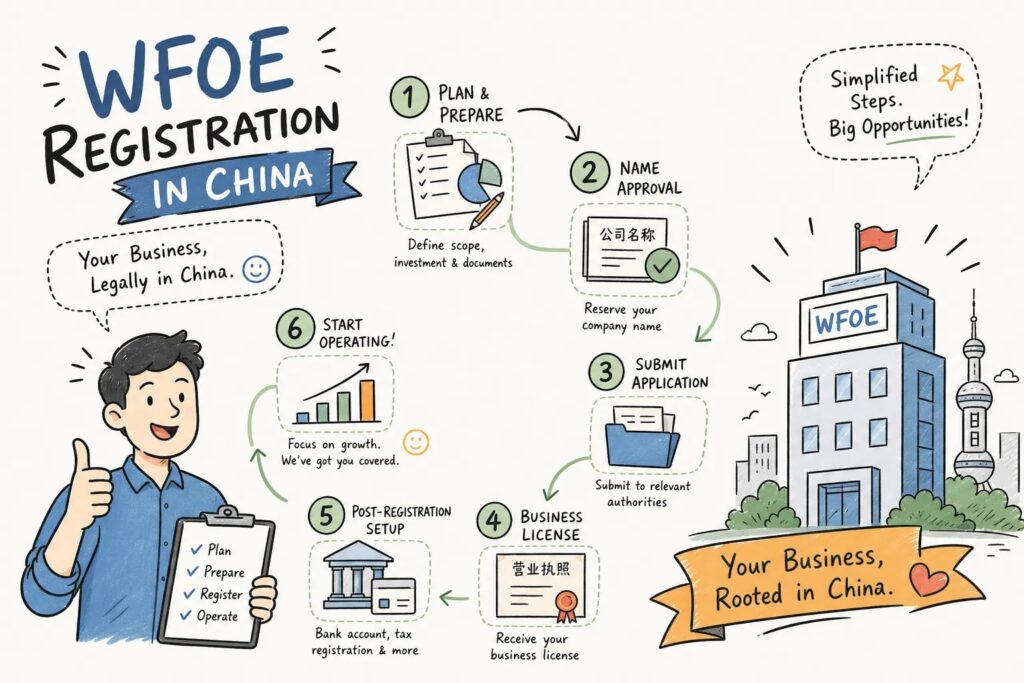
Most US founders who want to operate legally in China hit the same wall: they know they need a local entity, but the process feels like a black box. Which documents go first? Which government office handles what? How long does this actually take? WFOE registration in China follows a predictable sequence, and once you understand the order of operations, the process stops feeling opaque and starts feeling manageable.
A WFOE, a Wholly Foreign-Owned Enterprise, is the most common legal structure for American businesses entering China because it gives you full ownership and control with no Chinese partner required. Once post-license registrations (bank account, tax and invoicing setup, and social security registrations) are complete, you can hire employees, sign contracts, issue Chinese tax invoices, and receive RMB revenue all through one entity. This guide walks through every phase of the WFOE registration process, from the decisions you make before touching a single form to getting your corporate bank account open and operational. Register Company China specializes in guiding US clients through this entire sequence, and we’ll point out exactly where experienced on-the-ground support pays off.
WFOE Registration in China: What to Confirm Before You Touch a Single Document
The most expensive mistake US investors make is jumping into document preparation before resolving two foundational questions: whether their business activity is permitted for foreign investment, and what registered capital amount is realistic for their industry. Getting either of these wrong doesn’t just slow you down; it can require restarting the process from scratch.
Checking the negative list and defining your business scope
China’s foreign investment negative list identifies sectors that are restricted or prohibited for foreign ownership. For most US business activities, including consulting, software, trading, and manufacturing, the path is a standard filing rather than a substantive approval process. Restricted sectors, such as certain telecom services, media, education, and healthcare, require pre-access approval before registration can even begin. Confirming your sector first tells you whether you’re on the standard track or the longer one.
Your business scope definition is equally critical. This is the precise description of what your WFOE is authorized to do, and it determines which government authority reviews your application and what additional licenses the entity may need later. A consulting WFOE has a faster path than a trading or manufacturing entity. Get the scope wrong and you’ll face amendment filings, delays, and in some cases, activity restrictions that affect your actual operations.
Setting a registered capital amount that will pass review
China removed statutory minimum registered capital requirements for most WFOEs, but that doesn’t mean any number works. SAMR reviewers assess whether your proposed capital is credible given your business scope, staffing plan, and operating costs. Based on current market practice, the ranges that typically pass review break down by entity type:
- Consulting or service WFOE: RMB 100,000 to 500,000
- Trading entities: RMB 500,000 to 1,500,000 or higher
- E-commerce and cross-border trade WFOEs: RMB 1,000,000 to 5,000,000, because platform deposits, inventory, and returns require real working capital
A widely applied practitioner benchmark, one that both regulators and banks reference in practice, is whether your registered capital covers roughly 12 months of operating costs, including payroll, rent, tax, and social insurance. Under the amended Company Law, subscribed capital must be paid in within five years, so choose an amount that’s both credible to reviewers and genuinely fundable within that window.
Documents You Need and How to Authenticate Them from the US
This phase catches most US investors off guard. The document requirements aren’t complicated, but the authentication steps add real time to your timeline, and errors here mean starting over. Understanding the full picture upfront prevents weeks of wasted effort.
Corporate vs. individual investor document requirements
If a US parent company is making the investment, you’ll need the certificate of incorporation, articles of association, a board resolution approving the China investment, and often a certificate of good standing. Individual investors provide a passport copy along with supporting identity materials. For both tracks, passport copies are also required for the WFOE’s legal representative, directors, and supervisors, so gather those early and in parallel.
The US apostille process and Chinese translation requirements
Since China joined the Hague Apostille Convention, US corporate documents no longer require consular legalization through the Chinese embassy. Instead, the process is: notarize the document with a US notary, obtain the apostille from the relevant Secretary of State’s office, then have certified Chinese translations prepared. This is simpler than the old consular legalization route, but it still takes time. In practice, the full document legalization phase adds two to six weeks before your actual SAMR filing can begin, and that’s assuming no errors or resubmissions.
WFOE Registration in China: The Process, Step by Step
With authenticated documents in hand, the registration process moves through two distinct phases. Phase one gets you the business license. Phase two activates the company so it can actually operate. Both matter, and the second phase takes longer than most people expect.
Phase 1: Name reservation and business license through SAMR
The sequence starts with reserving your company name through the local Administration for Market Regulation (AMR). Once the name clears, you submit the full registration package: Articles of Association for the new WFOE, proof of registered address, shareholder documents, legal representative details, and the capital declaration. The local AMR reviews the filing and, once accepted, issues the business license. In Shanghai, Beijing, and Shenzhen, business license issuance typically runs 5 to 15 working days after a complete filing is accepted. One critical point: you need a compliant registered address at the time of filing, before you have the license. Serviced or virtual addresses that meet SAMR standards are acceptable, which is how remote registration works in practice.
Phase 2: Post-license steps that activate the company
The business license is the midpoint, not the finish line. After receiving the license, you have the official company seals (chops) made, which are required for virtually every subsequent transaction and filing. Next comes opening the RMB basic bank account and, if you’ll be receiving foreign-currency capital contributions, the capital account. Tax registration and invoicing setup with the local tax bureau follows. If your WFOE will import or export goods, customs registration is also required at this stage. Each of these steps has its own processing window, and they stack sequentially onto your total timeline.
WFOE Registration Timelines and Costs: What to Build Into Your Plan
US founders consistently underestimate both how long this takes and what a realistic budget looks like. The numbers below reflect real-world ranges, not best-case scenarios.
Registration timelines by city and WFOE type
For a service or consulting WFOE, here’s how the timeline typically breaks down:
- Document preparation and US apostille: 2 to 6 weeks
- SAMR filing to business license issuance: 5 to 15 working days in Shanghai, Beijing, and Shenzhen
- Post-license registrations, including bank account opening: 2 to 4 additional weeks
End-to-end for a service WFOE, starting from a complete document set, runs 6 to 12 weeks. Shanghai tends toward the faster end of that range. Manufacturing and trading entities run longer because customs registration, product licensing, and environmental reviews add steps. Build in the longer end of the range for your planning, then treat a faster outcome as a bonus.
What to budget from incorporation through year-one compliance
Government filing fees are minimal, often under USD 300 total. The real costs are professional services, document legalization, and ongoing compliance. For a service WFOE, a realistic all-in setup budget runs USD 5,000 to 15,000, broken down roughly as follows:
- Professional incorporation services: USD 2,500 to 6,000
- Document notarization, apostille, and translation: USD 800 to 2,500
- Compliant registered address: RMB 5,000 to 30,000 per year, depending on city and service level
Year-one compliance costs, including bookkeeping, monthly and quarterly tax filings, and the annual statutory audit, typically run USD 2,000 to 5,000 for a lean service entity. Per-item billing from local Chinese agents can make budgeting unpredictable for US clients, which is why many American founders prefer a fixed-price package that covers the full scope upfront, with no surprise invoices from sub-agents mid-process.
Common Sticking Points for US Investors and How to Avoid Them
Where the process breaks down for remote applicants
Document legalization errors are the most common source of restarts. A notarization done in the wrong sequence, an apostille from the wrong state authority, or a translation that doesn’t meet the local AMR’s format requirements forces the whole authentication phase to begin again. The second friction point is communication breakdown with local Chinese agents who don’t provide English-language updates on timeline, status, or next steps. With a 12 to 16 hour time difference between the US and China, and no dedicated English-speaking contact, weeks can pass without clarity on where things stand.
The third friction point is the registered address requirement. You need a compliant address before filing, but you’re applying from abroad with no physical presence in China. Banks add another layer: Chinese banks conduct due diligence interviews and require follow-up documentation, and that back-and-forth moves slowly when you’re responding asynchronously across time zones during business hours that don’t overlap.
How Register Company China’s remote package is built around these exact problems
Register Company China’s end-to-end WFOE incorporation service is designed specifically for US clients who can’t or won’t travel to China. The package covers document preparation guidance, a compliant SAMR-approved registered address, the full SAMR filing, chop registration, bank account opening support, tax registration, and a dedicated English-speaking project manager who coordinates every step on your behalf. You get one point of contact who speaks your language and understands your timeline, rather than a chain of local sub-agents with no accountability to you directly.
Fixed-price packaging means you know the full projected cost before signing anything, no ambiguous line items, no discovering mid-process that bank account opening was listed as a separate fee. Note that certain steps, particularly bank account opening, may involve branch-level requirements that can affect timing; our team walks you through those scenarios upfront so nothing comes as a surprise. If you’re evaluating your options for WFOE registration in Shanghai, Beijing, Shenzhen, or another city, get in touch with our team for a custom timeline and cost quote based on your specific business type and location.
Getting Your WFOE to the Finish Line
The WFOE registration process in China follows a structured sequence, and it’s more manageable than it looks from the outside. The two phases where US investors lose the most time are document authentication before filing and post-license bank account and tax registration afterward. Both are predictable, and both move faster with the right support coordinating on the ground in China.
The biggest wins come from having your documents correctly prepared and authenticated before the SAMR filing begins, and from having a local team handling bank account opening and tax registration in parallel where the timeline allows. These aren’t shortcuts, they’re the result of running this process repeatedly and knowing exactly what each AMR office and bank branch needs.
Once your WFOE is registered and your corporate bank account is live, a significant portion of China’s market becomes accessible. You can sign supplier contracts with legal standing, issue fapiao for customer transactions, and receive RMB revenue. Platform access on Tmall, JD.com, or WeChat Commerce also becomes possible, though each platform has its own onboarding requirements, deposits, and category approvals that go beyond entity registration. The registration process is a one-time investment that pays off across every future transaction, supplier relationship, and sale you make in China. Register Company China helps US investors get through that process correctly, remotely, and within the budget they planned from day one. Reach out to our team to start the conversation.