Foreign founders setting up trading or consulting WFOEs in China still see applications returned or delayed because the proposed business scope collides with the Foreign Investment Negative List. The 2024 edition (effective 1 November 2024 and still governing in 2026) cut the list to 29 items and fully opened manufacturing, yet several service-related restrictions remain highly relevant to ordinary consulting and trading scopes.
Most rejections are not dramatic “prohibited sector” cases. They come from wording that looks too close to restricted activities, missing standard catalogue language, or including licensed items without the correct prefix. This page explains the exact Negative List points that still trip trading and consulting files, the three most common rejection patterns, and how to draft a scope that passes SAMR and later survives bank and customs checks.
What the 2024 Negative List Still Restricts for Trading and Consulting
Ordinary import-export of goods and standard management, business or technical consulting are generally open to 100% foreign ownership. The problems arise at the edges:
- Market surveys — limited to joint ventures. Radio and television ratings surveys must be Chinese-controlled.
- Social surveys — foreign investment is prohibited.
- Chinese legal services — prohibited (the only exception is providing information about the impact of the Chinese legal environment). Foreign investors cannot become partners in a Chinese law firm.
- Internet content services — internet news, online publishing, online audiovisual programmes, most internet cultural operations (music is the exception) and certain public information services remain prohibited.
Free Trade Zones offer limited relaxations. In some FTZs, market research can be done through a WFOE (except radio/TV audience surveys), and social surveys may be allowed under strict Chinese equity and legal-representative conditions. These openings are location-specific and do not apply nationwide.
The Market Access Negative List (2025 edition) and sector licences still apply even when the Foreign Investment Negative List is clear. Food, medical devices, certain chemicals and value-added telecom activities need additional permits regardless of ownership.
Three Rejection Patterns That Still Appear in 2026
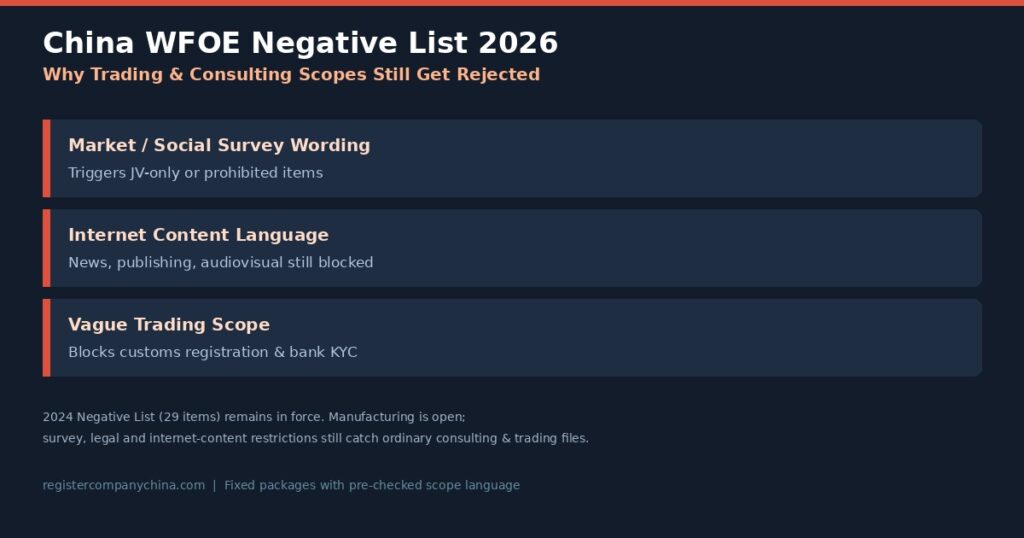
1. Scope wording that triggers “market survey” or “social survey” language
Founders often write “market research”, “industry analysis”, “consumer survey” or “data collection services”. SAMR reviewers map these phrases to the restricted market-survey item or the prohibited social-survey item. The application is returned for revision or, in stricter districts, rejected.
Safer approach: use precise, catalogue-aligned terms such as “business management consulting”, “technical consulting services”, “enterprise management consulting” and “information consulting (excluding market surveys and social surveys)”. If the real work involves surveys, structure it as a joint venture or keep the activity outside the China entity.
2. Accidental inclusion of internet content or publishing activities
A trading or consulting scope that mentions “online information services”, “content production”, “digital publishing”, “news aggregation” or broad “internet services” can be read as falling under the prohibited internet-content items. Even if the founder only intends B2B software or ordinary e-commerce support, the Chinese wording triggers a Negative List review.
Keep internet-related language extremely narrow and only when the activity is clearly open (for example, ordinary software development or online data processing under current VATS pilots in specific zones). When in doubt, omit it and add it later by amendment after the licence is issued.
3. Missing or incorrect “import and export” language for trading companies
A trading WFOE whose scope does not explicitly include “import and export of goods” (or the precise Chinese equivalent) will face problems at customs registration and often at bank KYC. Banks and customs check the business licence against the expected transaction type. Vague “trading”, “wholesale” or “distribution” alone is frequently insufficient.
For goods that themselves require licences (food, medical devices, etc.), the scope must carry the “(after approval)” or equivalent licensed-item marker, and the sector permit must be obtained before those activities begin.
How SAMR Actually Reviews the Scope in Practice
Reviewers compare the proposed Chinese text against the national Business Scope Standards Catalogue and the current Negative List. They look for:
- Standard catalogue phrasing rather than free English translation
- Any item that matches or closely resembles a restricted or prohibited entry
- Licensed activities without the correct approval prefix
- Overly broad catch-all language that could later be used for restricted work
City practice differs. Shanghai and Beijing tend to be stricter on survey-related and internet-adjacent wording. Shenzhen and many tier-2 cities are often more pragmatic on clean consulting and ordinary goods trading scopes, provided the language is precise. FTZ filings can use the slightly shorter FTZ negative list, but the difference is limited for pure trading and consulting.
Practical Drafting Rules That Reduce Rejection Risk
- Start from the official catalogue language, not from the English pitch deck.
- For consulting: prefer “business management consulting, technical consulting, information consulting (excluding market surveys and social surveys)”.
- For trading: include explicit “import and export of goods” plus the main product categories and any necessary supporting activities (warehousing, after-sales, etc.).
- Never include Chinese legal practice, social surveys, internet news or online publishing unless the structure is deliberately a joint venture and all conditions are met.
- If a licensed activity is needed, put the correct “(after approval)” marker and obtain the permit before invoicing in that activity.
- Keep the first-version scope focused. Adding activities later by amendment is usually faster than fighting an over-broad initial filing.
What Happens After a Rejection or Return
Most cases are returns for revision rather than hard rejections. The founder or agent revises the Chinese wording, resubmits, and the timeline extends by one to three weeks. Hard rejections occur when the scope clearly falls inside a prohibited item and no restructuring (for example, moving to a joint venture) is offered.
Banks and customs later re-check the same scope. A licence that passed SAMR but uses non-standard language can still delay account opening or customs registration. Aligning the scope with both the Negative List and the practical needs of banking and customs at the drafting stage avoids the second round of friction.
Next Step for Trading or Consulting Founders
Before filing, map every intended activity against the current 2024 Foreign Investment Negative List and the relevant FTZ list if a zone is being used. Then draft the Chinese scope in catalogue language and stress-test it for survey, legal and internet-content triggers.
Register Company China prepares fixed-scope packages for trading and consulting WFOEs that already incorporate these checks. The goal is a business licence that clears SAMR on the first or second pass and remains usable for bank KYC and customs registration without further amendment. If you already have a draft scope or a returned application, a short review against the current Negative List items above usually identifies the exact wording that needs to change.
Frequently Asked Questions
Is ordinary management consulting still open to a 100% WFOE in 2026?
Yes. Standard business management, technical and information consulting remain open. The restrictions apply to market surveys, social surveys and Chinese legal practice.
Can a trading WFOE do market research as a side activity?
Nationwide, market surveys are limited to joint ventures. Some Free Trade Zones allow market research through a WFOE (with exceptions). Confirm the specific zone list before including the activity.
What is the safest way to describe consulting services?
Use precise catalogue phrases and explicitly exclude market surveys and social surveys. Avoid broad terms such as “research”, “survey”, “data collection” or “market analysis” unless the structure and location support them.
Does the Negative List affect import-export of ordinary goods?
No. Ordinary goods trading is open. Problems arise when the goods themselves require sector licences or when the scope wording is too vague for customs and banks.
How long does a scope revision usually take after a return?
Typically one to three weeks once the corrected Chinese wording is ready, depending on the local SAMR office workload.