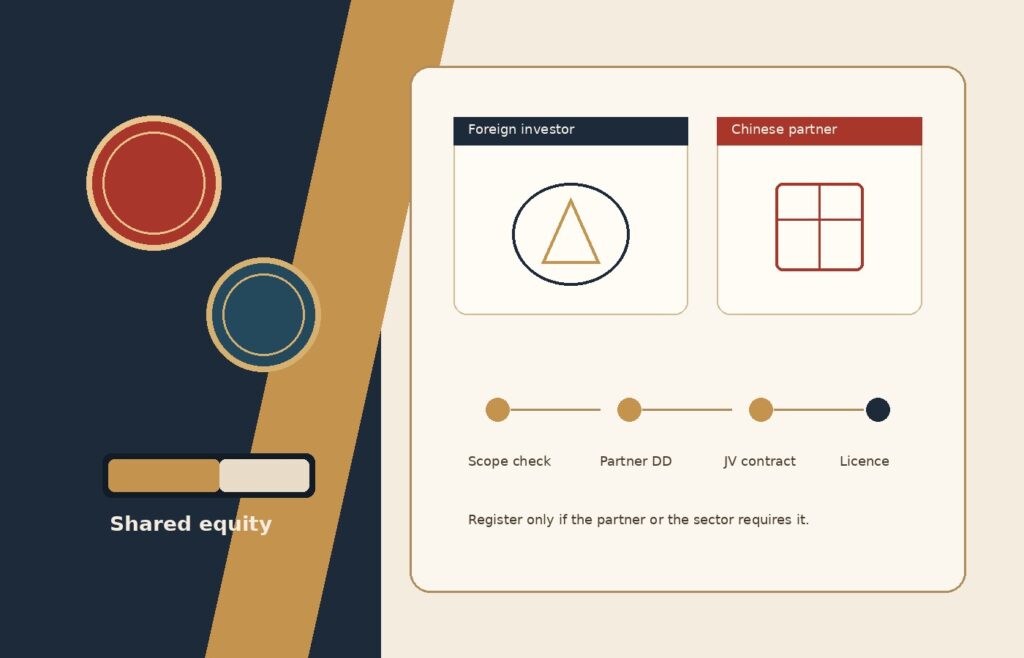
China entity choice
China Joint Venture Registration for Foreign Companies: When a JV Is Worth It
A China joint venture is worth registering only when a Chinese partner is legally required, or when that partner brings a licence, asset, or channel you cannot buy on contract. In open sectors, a wholly foreign-owned enterprise is usually faster, cleaner, and easier to control.
As of 2026, most commercial activities sit outside the foreign-investment negative list. New joint ventures are limited liability companies under the Company Law, not the old equity or contractual joint-venture statutes. The registration filing can be handled remotely. Partner due diligence, the shareholders agreement, and the bank account usually cannot.
Register Company China scopes both paths before filing. If a WFOE is available, that is the default recommendation. If a JV is actually required, the package covers name check, articles, joint-venture contract support, SAMR filing, chops, and a fixed-price handoff to banking and compliance. Request a fixed-price quote for your China entity.
Start with the sector, not the partner pitch
The first question is access, not chemistry. China Briefing’s guide to the 2024 Foreign Investment Negative List, still the edition cited in 2026 practice, counts 29 restricted or prohibited entries. Some require a Chinese equity share. Many manufacturing caps were removed in that edition. Sectors not on the list can generally be 100 percent foreign owned, subject to the separate market-access list and any industry licence.
A local distributor offering a joint venture is not evidence that a joint venture is required. In consulting, software, trading, and most services, a WFOE can invoice, hire, and hold the bank accounts without sharing the board. Use a JV when one of these is true:
- The negative list, or a sector rule, caps foreign ownership or requires a Chinese partner.
- The partner contributes a licence, land-use right, factory, or distribution right that cannot be contracted cleanly.
- A specific project, often with a state-linked counterparty, will not proceed without shared equity.
The Encouraged Foreign Investment Catalogue (2025 edition) took effect on 1 February 2026. It can improve incentives in listed industries. It does not force a joint-venture structure.
WFOE or joint venture: the decision that changes the file
| Question | WFOE | Joint venture |
|---|---|---|
| Ownership | 100 percent foreign | Shared with at least one Chinese investor |
| Control | Shareholder appoints directors and legal representative | Reserved matters, board seats, and vetoes must be negotiated |
| Revenue and fapiao | Yes, inside the approved scope | Yes, inside the approved scope |
| Typical licence timeline once documents are complete | Often 2 to 6 weeks in mature cities | Similar filing time, but negotiation sits in front of it |
| End-to-end before banking | Commonly 8 to 16 weeks including apostille | Commonly 3 to 6 months once partner work is real |
A representative office is a third option only for liaison work. It cannot invoice. If the goal is revenue, do not use an RO as a cheaper JV. Compare scope and cost on the WFOE registration cost breakdown before locking a partner term sheet.
What China joint venture registration actually requires
The AMR filing looks familiar if you have registered a WFOE. The extra work is the Chinese shareholder and the contract that governs them.
- Confirm the business scope against the negative list and any industry licence. A vague scope is a common reason files stall.
- Collect the foreign investor pack: certificate of incorporation, constitutional documents, shareholder chart to natural-person owners, and a board or shareholder resolution. These usually need apostille. Legalisation time in the home country is often two to four weeks.
- Collect the Chinese partner pack: business licence, articles, identity of the legal representative, and a resolution approving the investment. Check the licence on the national enterprise credit system, not from a PDF the partner sends.
- Agree registered capital, contribution form, and the five-year payment schedule. There is no general statutory minimum. Banks and the local AMR still expect a figure that matches the activity. In-kind contributions such as land or equipment need a defensible valuation.
- Sign articles of association and a shareholders agreement covering reserved matters, IP ownership, non-compete, deadlock, and exit. Do this before the name is filed.
- File for the business licence, carve the chops, complete tax registration, and open the basic RMB account and capital account.
Since the Company Law revision effective 1 July 2024, a supervisor is no longer mandatory for many companies. Capital subscribed at incorporation must be paid in within five years. Neither change removes the need for a real registered address or a bank-acceptable legal representative.
Cost and time, without the brochure numbers
Market professional fees for a straightforward JV filing often run above a comparable WFOE, commonly in the USD 8,000 to 20,000 range as of 2026, before partner-side counsel, due diligence, address, and translation. Restricted sectors and in-kind capital push that higher. Those figures are service fees, not registered capital. Capital sits in the company account and is working money.
The delay investors underestimate is not SAMR. It is partner verification, renegotiation after diligence, and the bank. Operator discussions repeatedly land on the same sequence: two to eight weeks to vet a partner, one to four months for the definitive agreement, then local registration. Land-title problems appear when the Chinese side injects property, and technology leakage appears when core IP is assigned into the JV instead of licensed to it.
Budget separately for annual compliance. A JV has the same bookkeeping, monthly or quarterly tax filings, May corporate income tax settlement, and June SAMR annual report as a WFOE, plus shareholder coordination the WFOE does not have.
Partner risks that registration agents cannot file away
- Control looks like 51 percent on a slide and fails in the articles. Deadlock clauses, chop custody, and who can appoint the legal representative matter more than the headline percentage.
- IP assigned to the JV is hard to pull back. License it in, register trademarks in China early, and keep source code and formulas outside the entity unless the sector forces otherwise.
- Related-party contracts with the partner quietly move margin. Pricing, exclusivity, and audit rights belong in the shareholders agreement.
- A partner who cannot explain its ultimate owners is not ready for a bank KYC file either.
Public disputes around forced technology transfer and failed industrial joint ventures are not a reason to avoid every JV. They are a reason to treat the contract as the product, not the business licence.
What can be done remotely
Name screening, document preparation, apostille coordination, articles, and the SAMR filing can be run without a trip if signatories can notarise abroad. A leased registered address can be arranged in cities that accept commercial premises. What still breaks remote plans is the bank. Many branches want the legal representative present with a passport and a visa that is not a short tourist stay. Plan that visit in week one, not after the licence arrives. The same sequence is set out in the WFOE registration process guide; a JV adds the partner pack, it does not remove the bank step.
How to choose the registration firm
Ask whether the firm will tell you not to form a JV. A useful adviser checks the negative list, prices the WFOE alternative, and names what is excluded: partner legal fees, valuation, industry licences, and bank charges. Fixed scope matters more than a low headline. Also ask who holds the chops after licensing, and whether bookkeeping is included or sold later. How Register Company China works is built around that remote, fixed-package model for WFOE, JV, and representative office files.
Questions investors ask before they sign
Is a joint venture still required to enter China?
No. Only where the current negative list or a sector rule requires Chinese participation. Most service, trading, and software files can be WFOEs.
Can foreigners register a JV without travelling?
The company filing can be remote. Bank account opening often still needs the legal representative in person. Partner meetings are a commercial choice, not a filing rule.
Why do JV timelines slip?
Incomplete apostille packs, a Chinese partner whose licence or land title does not match the pitch, renegotiation after diligence, and bank KYC. The licence step itself is rarely the longest part.
What should happen next?
Send the intended city, business scope, shareholder nationalities, and whether a named Chinese partner already exists. A scoped quote will say whether the file should be a WFOE or a JV, what the fixed fee covers, and which steps still need a person in China.
Get a fixed-price quote for your WFOE or joint venture setup