Foreign founders asking “how much does a China WFOE actually cost in 2026” usually get a single range that hides more than it reveals. The professional fee is only one line. Registered capital is a five-year payment obligation, not a one-time charge. Annual compliance starts immediately. Bank account and address requirements for foreign legal representatives add friction that many quotes ignore.
This page breaks down the real numbers foreign investors face in 2026, what is typically missing from agency quotes, and the budget mistakes that still delay projects.
Realistic All-in Setup Cost Ranges (2026)
Figures below reflect current market practice for a standard service or trading WFOE owned by a foreign individual or overseas company. Manufacturing and regulated scopes run higher.
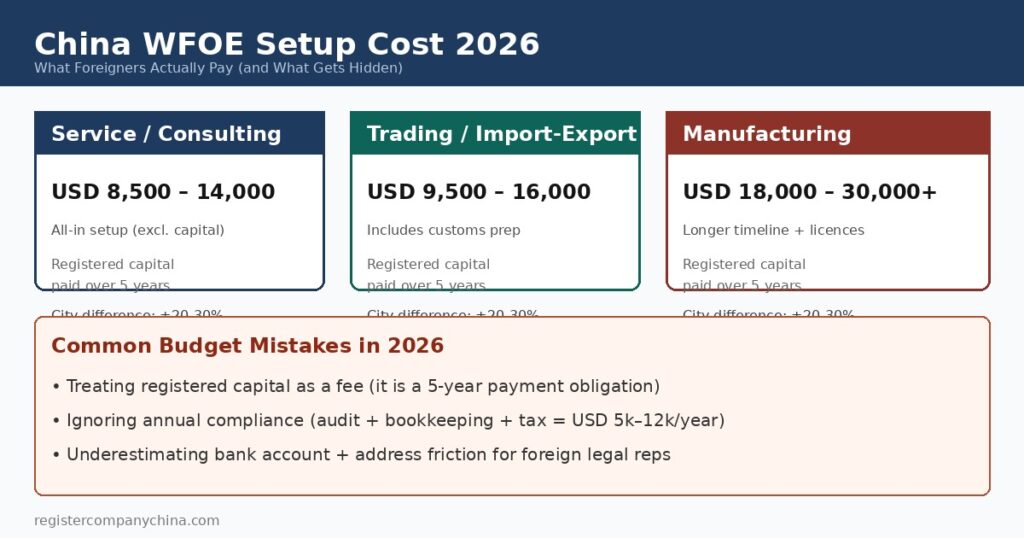
- Service / Consulting WFOE: USD 8,500 – 14,000 all-in setup (professional fees, document legalisation, chops, tax registration, basic bank support)
- Trading / Import-Export WFOE: USD 9,500 – 16,000 (adds customs-related preparation)
- Manufacturing WFOE: USD 18,000 – 30,000+ (longer timeline, additional licences, environmental steps)
City variation is real. Shanghai and Beijing tend to sit at the higher end of the range; Shenzhen, Guangzhou and many tier-2 cities are often 15–25% lower for the same scope.
What Is Usually Not Included in the Headline Number
Most published ranges stop at the registration package. The items below frequently appear as extras or are left for the founder to discover later:
- Notarisation, apostille and certified translation of shareholder documents (USD 800 – 2,500 depending on home country and number of papers)
- Registered address that banks and SAMR will actually accept (USD 1,500 – 6,000 per year in tier-1 cities for a compliant commercial lease or approved cluster address)
- Bank account opening support when the legal representative is a foreign national who must appear in person
- First-year bookkeeping, tax filings and statutory audit (typically USD 5,000 – 12,000 for a small entity)
Registered capital itself is not a fee. Under the current Company Law it must be fully paid in within five years of incorporation. The amount should be commercially credible for the business scope; SAMR and banks both look at it.
Registered Capital: The Five-Year Reality
There is no statutory minimum for most sectors. Practical 2026 ranges used by active formation practices are:
- Consulting / services: USD 100,000 – 500,000 equivalent
- Trading: USD 200,000 – 1,000,000 equivalent
- Manufacturing: significantly higher, often aligned with first-year capex and working capital
Declaring a high number to “look substantial” creates a binding payment schedule. Under-declaring can cause problems at bank KYC or when applying for general taxpayer status and higher fapiao quotas.
First-Year Total Cost vs Ongoing Cost
A realistic first-year budget for a small service WFOE owned by a foreign founder typically looks like this:
- Setup package and legalisation: USD 8,500 – 14,000
- Compliant registered address (year 1): USD 1,500 – 6,000
- Bookkeeping + tax + statutory audit: USD 5,000 – 12,000
- Registered capital first injection (if any is required early): variable
From year two onward the recurring compliance line (accounting, tax, audit, annual report) remains. Founders who budget only the setup fee often face cash-flow pressure once the company is live.
Common Budget Mistakes That Still Happen in 2026
- Treating registered capital as a registration fee. It is a payment obligation over five years.
- Accepting the cheapest virtual address without checking bank and tax acceptance. Many low-cost addresses fail KYC or fapiao quota reviews.
- Assuming the legal representative can stay overseas for the entire process. Most mainland banks still require the legal representative in person for account opening.
- Ignoring the annual compliance cycle. Audit, CIT reconciliation (31 May) and SAMR annual report (30 June) are mandatory even for zero-revenue entities.
City and Structure Differences That Affect Cost
Shanghai and Beijing packages are usually the most expensive. Shenzhen and Guangzhou often offer faster processing and slightly lower professional fees for standard scopes. Free-trade zone locations (Lingang, Qianhai, Hainan FTP) can change the tax profile and sometimes the address options, but they do not remove the core setup and compliance costs.
A single foreign individual can now be the sole shareholder of a WFOE. That structure is simpler on paper but does not reduce the need for a bankable address, proper capital schedule, or the legal representative’s presence for banking.
How to Read a Quote
When comparing offers, ask for an explicit list of what is included and what is not:
- Does the fee cover apostille coordination and Chinese translation?
- Is a bankable registered address included or only “assistance”?
- Is first-year bookkeeping and the statutory audit quoted separately?
- What happens if the bank requires the legal representative to travel?
Transparent fixed packages that list these items reduce the risk of mid-process cost increases.
Frequently Asked Questions
Is there a minimum registered capital for a WFOE in 2026?
No statutory minimum for most activities. The amount must be paid in full within five years and should match the intended business scale.
Can a foreigner register a company in China without travelling?
Company registration itself can often be completed with notarised and apostilled documents. Bank account opening almost always requires the legal representative to appear in person.
What is the biggest cost surprise for first-time foreign founders?
The combination of a compliant address, the first year of mandatory compliance, and the practical need for the legal representative to be present for banking.
Do manufacturing WFOEs cost significantly more?
Yes. Additional licences, longer timelines and higher capital expectations push the all-in figure well above service and trading ranges.
Register Company China provides transparent fixed packages for foreign individuals and overseas companies. The quote covers the full registration sequence through bank account coordination and a clean handoff to ongoing compliance. If you are budgeting a 2026 WFOE, the practical next step is to confirm your business scope, preferred city and whether the legal representative can travel, then request a line-item quote rather than a single headline number.