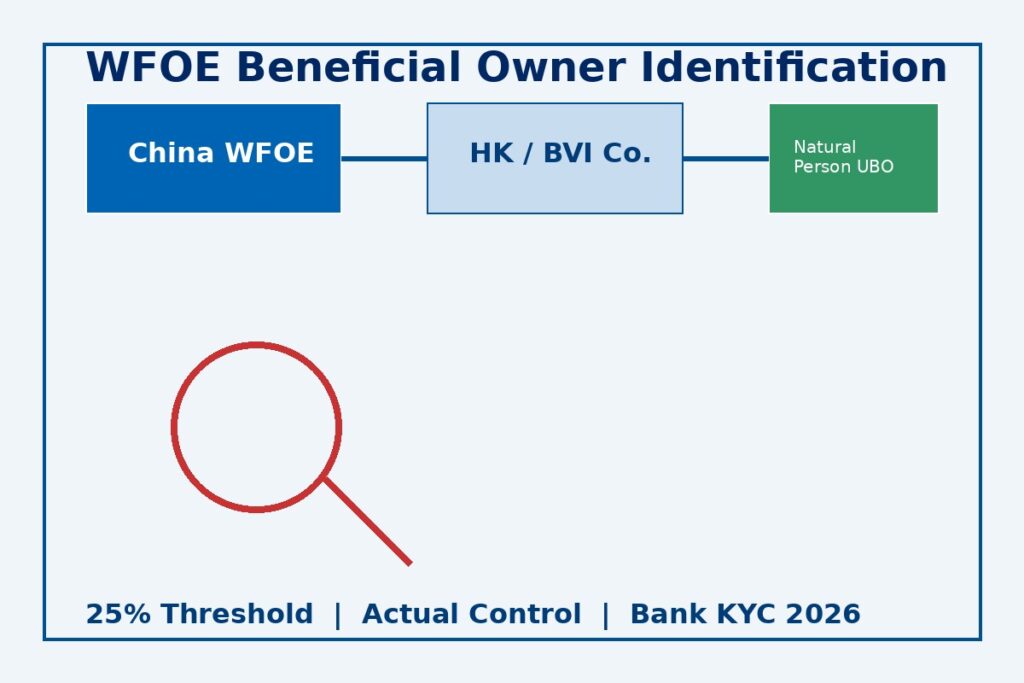
Under rules that took effect on 20 January 2026, Chinese banks must identify the natural person who ultimately owns or controls a WFOE before they open a corporate account. The 25% ownership, benefit, or voting-rights test is the starting point. Actual control can still qualify someone even below that threshold. Filing beneficial-owner information with the authorities does not replace the bank’s own review. Foreign founders with multilayer structures (Hong Kong, BVI, or group holdings) regularly face extra document requests and multi-week delays when the ownership chain is incomplete or inconsistent.
This is one of the most common reasons a newly licensed WFOE remains unable to receive capital or pay suppliers in 2026.
What the 2026 Beneficial Owner Rules Actually Require
The People’s Bank of China issued Order [2025] No. 12, the Measures for the Administration of Identification of Beneficial Owners of Customers of Financial Institutions. It applies from 20 January 2026 to banks and other financial institutions performing customer due diligence.
Article 8 defines a beneficial owner of a legal person or non-legal-person organisation as a natural person who meets any of the following:
- Ultimately owns 25% or more of the equity, shares, or partnership interests, directly or indirectly.
- Ultimately enjoys 25% or more of the income rights or voting rights, even if the equity threshold is not met.
- Exercises actual control alone or jointly, including through agreements, the power to appoint or remove the legal representative or directors, control over major decisions, or long-term practical control of key assets or funds.
If none of those tests identify a qualifying natural person, the person responsible for day-to-day management is treated as the beneficial owner.
A related customer-due-diligence framework (Joint Order [2025] No. 11) took effect on 1 January 2026 and requires institutions to understand the purpose of the relationship and, for higher-risk cases, the source and use of funds. Banks cannot simply rely on information already filed in the beneficial-owner information system. They must perform their own reasonable verification.
Why This Matters for Foreign WFOE Founders
A simple WFOE owned directly by one foreign individual is usually straightforward. The individual is both the shareholder and the beneficial owner. The bank still wants the passport, address proof, and a clear business purpose, but the ownership story is short.
Problems appear when the China company is held by an overseas company, a Hong Kong vehicle, a BVI company, or a multi-layer group. Banks routinely ask for:
- A full ownership chart that ends at natural persons.
- Registration documents for every intermediate company.
- Passports or identity documents for anyone at or above the 25% level, plus anyone who has practical control.
- Consistent names across the chart, the articles, the passport, and any prior filings.
In practice, incomplete charts, English-name mismatches between passport and company records, or vague explanations of “control” are the two most frequent reasons files are returned or delayed. Branch-level risk appetite also varies. A Shanghai branch that routinely handles foreign groups may accept a clean multilayer file faster than a smaller branch that has rarely seen one.
Physical attendance by the legal representative remains common for the first basic RMB account, although the precise verification method (in-person or video) is risk-based under PBOC settlement-account rules. Plan the trip after the ownership file is ready, not before.
Common Rejection or Delay Reasons and How to Avoid Them
Two patterns account for the majority of stuck bank applications we see:
- The ownership chain stops at a company. Banks expect the natural-person beneficial owner. A chart that ends at “XYZ Holdings Ltd” without the individuals behind it triggers further questions or refusal. Prepare the full chain and supporting documents in advance.
- Documents tell different stories. The name on the passport does not exactly match the name on the overseas registry extract. The ownership percentages on the chart differ from the articles or the prior BOI filing. The business purpose described in the bank form does not match the registered scope or the contracts supplied. Align everything before submission. A short cover note that explains the commercial reason for any intermediate holding company also helps.
Other frequent issues include relying solely on the filed beneficial-owner information (the bank still verifies independently), providing only the business licence with no commercial evidence, and choosing a registered address that later fails a bank site check. For address and legal-representative planning, see our guides on the WFOE registration process and legal representative requirements.
Simple vs Multilayer Structures: Practical Comparison
| Structure | Typical bank document load | Common delay risk | Practical tip |
|---|---|---|---|
| Direct foreign individual shareholder | Passport, address proof, business purpose, licence and chops | Low if documents match | Still prepare a short business plan or contracts |
| Overseas company or Hong Kong holding | Full chain to natural persons, intermediate registry extracts, UBO IDs, consistent chart | Medium to high | Build the chart and collect documents before choosing the bank |
| Multi-layer or control-by-agreement | Everything above plus evidence of control rights | High | Explain the commercial reason for the structure in plain language |
Registered capital contribution timelines and annual compliance obligations remain separate requirements. They do not replace the need for a clean ownership file at the bank. Cost ranges and the five-year capital rule are covered in our setup cost guide.
Practical Preparation Steps
- Map the full ownership and control chain to natural persons before you file the company or approach the bank.
- Collect passports, recent address proofs, and registry documents for every intermediate entity and every person at or above the 25% level (or with actual control).
- Prepare one ownership chart that matches the articles, the BOI filing (if already done), and the bank forms exactly.
- Gather basic commercial evidence (contracts, website, business plan, supplier or customer correspondence) so the purpose of the account is clear.
- Confirm with the chosen branch who must appear and which originals are required. Book travel only after the file is complete.
- Keep names, percentages, and addresses identical across every document.
FAQ
Does the beneficial-owner filing with the authorities satisfy the bank?
No. The bank must still identify and reasonably verify the beneficial owner under the 2026 financial-institution rules. The filed information is useful but not a substitute.
What if no one owns 25% or more?
The rules still look for actual control or, if none exists, the person responsible for day-to-day management. Banks will ask how control is exercised.
Can a foreign founder avoid an in-person visit?
Some banks accept video verification on a risk basis, particularly where an existing group relationship exists. Most first-time basic-account openings for foreign legal representatives still involve an in-person interview. Confirm with the branch before booking flights.
How long do ownership-related questions add to the timeline?
A clean file can move in the normal two-to-eight-week bank window. Incomplete or inconsistent ownership documents commonly add several weeks of back-and-forth.
A well-prepared ownership file does not guarantee instant approval, but it removes the most common reasons Chinese banks send WFOE applications back. Foreign founders who treat beneficial-owner identification as a core part of bank preparation, rather than a late-stage formality, reach a usable account faster.
If you are planning a remote WFOE setup and want the ownership chain, document package, and bank coordination handled together, the practical next step is to map your structure against the 25% and control tests before you choose a bank or book travel.