Under the revised PRC Company Law that took effect on 1 July 2024, shareholders of every limited liability company — including every WFOE — must pay their subscribed registered capital in full within five years of the company’s establishment. The old practice of setting a high registered capital figure with a 20- or 30-year contribution schedule is no longer available.
For foreign founders the practical questions in 2026 are no longer theoretical: how the five-year clock runs, what happens if payment is late, when creditors can accelerate unpaid capital, and what existing companies must do before the 30 June 2027 adjustment deadline. This page sets out the enforcement rules and the concrete late-payment risks that now affect WFOE shareholders.
The Core Rule: Five Years from Establishment
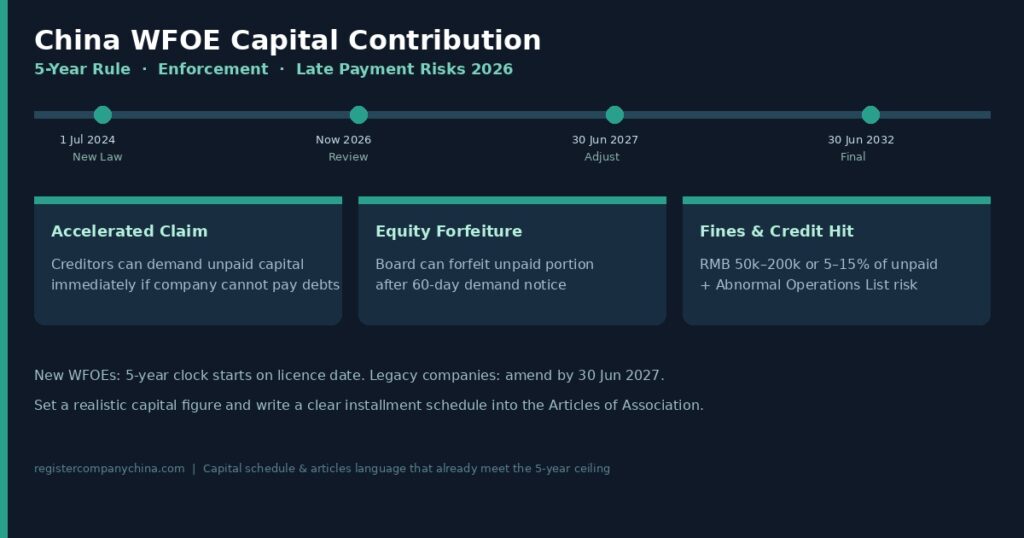
Article 47 of the revised Company Law requires that the capital subscribed by all shareholders of a limited liability company be paid in full within five years from the date the company is established, according to the schedule written in the articles of association. The five-year ceiling cannot be extended by private agreement.
Two separate regimes apply:
- Companies established on or after 1 July 2024 — the five-year clock starts on the business-licence issue date. There is no transitional grace period. The final payment date in the articles of association must fall within those five years.
- Companies established on or before 30 June 2024 — a transition framework applies. If the remaining contribution period would still exceed five years measured from 1 July 2027, the company must amend its articles by 30 June 2027 so that the remaining period is brought within five years. In practice the outer payment deadline for many legacy companies is 30 June 2032.
The contribution schedule itself (installment amounts and dates) is set in the articles of association. The law allows staged payments, but the last instalment cannot fall outside the statutory window.
What Counts as Payment
Cash contributions must be transferred into the company’s bank account. Non-cash contributions (equipment, intellectual property, land-use rights, qualifying equity or claims) require valuation by a qualified appraisal firm and formal transfer of ownership within the same five-year window. Incomplete or fictitious contributions are treated as unpaid.
Public disclosure is mandatory. Paid-in capital amounts, contribution methods and any changes must be reported through the National Enterprise Credit Information Publicity System. Failure to disclose accurately can place the company on the Abnormal Operations List.
Enforcement Mechanisms and Late-Payment Consequences
The law gives the company and its creditors several tools when a shareholder misses a scheduled payment.
1. Board demand and equity forfeiture
When a shareholder fails to pay on the date set in the articles, the board of directors must issue a written demand giving the shareholder at least 60 days to pay. If the shareholder still does not pay after that grace period, the board may resolve to issue a forfeiture notice. From the date of the notice the shareholder loses equity rights corresponding to the unpaid portion. The forfeited equity must be transferred or cancelled through a capital reduction within six months.
2. Accelerated contribution when the company cannot pay its debts
Article 54 is the provision that most concerns foreign shareholders. If the company is unable to pay its debts as they fall due, the company itself or a creditor whose claim is already due can demand that shareholders pay their subscribed but still unpaid capital immediately — even if the original contribution schedule has not yet expired. This accelerates the entire unpaid balance. Under the old law creditors generally had to wait for bankruptcy or liquidation; that protection is gone.
3. Administrative fines and credit consequences
Failure to contribute on schedule can trigger an order to rectify and a fine of RMB 50,000–200,000, or 5–15 % of the unpaid amount in serious cases. Responsible directors or officers can face personal fines of RMB 10,000–100,000. Persistent non-compliance can lead to listing on the Abnormal Operations List and, in extreme cases, separate administration by the registration authority.
4. Director liability for failing to enforce
Directors have a positive duty to check contribution status and to issue the demand letter. If they fail to act and the company suffers loss, the responsible directors can be held personally liable. Foreign legal representatives and directors of WFOEs therefore carry personal exposure if they ignore overdue capital.
Practical Risks for Foreign Shareholders in 2026
- Setting registered capital far higher than realistic funding capacity creates a hard five-year cash-flow obligation that cannot be postponed indefinitely.
- An unpaid balance becomes an immediate claim if the company faces any material creditor pressure (supplier, tax, employee or loan default).
- Legacy WFOEs that have not yet amended their articles face a congested filing window in the first half of 2027; last-minute amendments risk delay or rejection.
- Transferring shares that still carry unpaid capital does not fully eliminate the original shareholder’s exposure; the transferor can retain supplemental liability if the new shareholder fails to pay.
How to Reduce Exposure
For new WFOEs the safest approach is to set a registered capital figure that the shareholder can realistically fund within five years, write a clear installment schedule into the articles of association, and treat the first contribution as part of the incorporation budget rather than a future option.
For existing WFOEs the immediate tasks are:
- Review the current contribution schedule against the 30 June 2027 adjustment deadline.
- Amend the articles if the remaining period would still exceed five years from 1 July 2027.
- If the subscribed amount is unrealistically high, consider a formal capital reduction (subject to creditor notification and SAMR registration) rather than waiting for enforcement.
- Ensure every actual contribution is properly recorded, disclosed and supported by bank evidence.
City practice on capital-reduction filings and schedule amendments varies. Shanghai and Beijing tend to require fuller documentation; some southern cities process straightforward amendments more quickly. Early filing is preferable to waiting until the 2027 rush.
Next Step
If you are incorporating a new WFOE, decide the capital figure and the payment schedule before the articles are finalised. If you already operate a WFOE with a large unpaid subscription or an open-ended schedule, map the remaining period against the 2027 adjustment deadline and decide whether amendment or reduction is required.
Register Company China prepares capital schedules and articles language that already incorporate the five-year ceiling and the disclosure requirements. For existing companies we can review the current articles against the transition rules and prepare the necessary amendment or reduction filings. A short review of your current capital position against the 2027 deadline usually identifies the exact action needed.
Frequently Asked Questions
Does the five-year rule apply to every WFOE?
Yes. Limited liability companies formed as WFOEs fall under the same Article 47 regime as domestic companies. There is no foreign-investor exemption.
Can I still use a long contribution schedule if the articles say so?
No. Any schedule that places the final payment beyond five years from establishment (or beyond the transitional outer date for legacy companies) is inconsistent with the law and will need to be corrected.
What happens if the company has no cash pressure but a shareholder simply misses the date?
The board must still issue the demand letter. Continued non-payment can lead to forfeiture of the corresponding equity. Creditors are not required for that internal enforcement path.
Is capital reduction a realistic option if I set the figure too high?
Yes, provided the proper shareholder resolution, creditor notification and SAMR registration steps are followed. During the transition period a simplified route exists for reducing only unpaid subscribed capital in some cases. Professional handling is strongly recommended.
When does the 2027 adjustment deadline actually bite?
Companies established on or before 30 June 2024 whose remaining contribution period would still exceed five years measured from 1 July 2027 must amend their articles by 30 June 2027. After that date non-compliant schedules can attract public annotation and further administrative measures.