A China WFOE is bound by its chops more often than by a wet-ink signature. Once the business licence is issued, an authorised Public Security Bureau engraver cuts the seals. Those stamps, not the passport of a director sitting overseas, are what banks, tax offices, landlords and counterparties treat as the company’s will.
This 2026 guide sets out the chop types a typical wholly foreign-owned enterprise actually uses, which ones are mandatory, how custody should be split, what electronic seals change, and what to do when a seal is lost, held hostage or used without approval.

Why Chops Still Matter After Digital Filing
Under Chinese practice, a document stamped with a registered company chop is treated as an act of the company. Courts and counterparties look first at the seal impression, then at whether the user had apparent authority. A foreign parent’s board resolution that never reached a chop is weak evidence in a local dispute.
Electronic seals now have the same legal effect as physical seals when they meet the Electronic Signature Law tests and the 2025 Electronic Seal Management Measures: exclusive control of the creation data, detectable alteration, and a retained audit trail. Government portals, e-fapiao platforms and many bank channels already use digital seals. Physical chops have not disappeared. SAMR change filings, many bank specimen cards, lease originals and customs packs still expect red ink on paper.
Chops are carved after the licence. They must show the full registered Chinese name and are filed with the Public Security Bureau. The finance chop and legal-representative chop are also deposited as specimens with the company’s bank. Unregistered or “shadow” duplicates are a governance failure, not a shortcut.
Chop Types a WFOE Actually Uses
There is no statute that lists a fixed number of seals. In practice a new WFOE carves a short set and adds others only if the business needs them.
| Chop | Chinese name | Usual role | Mandatory? |
|---|---|---|---|
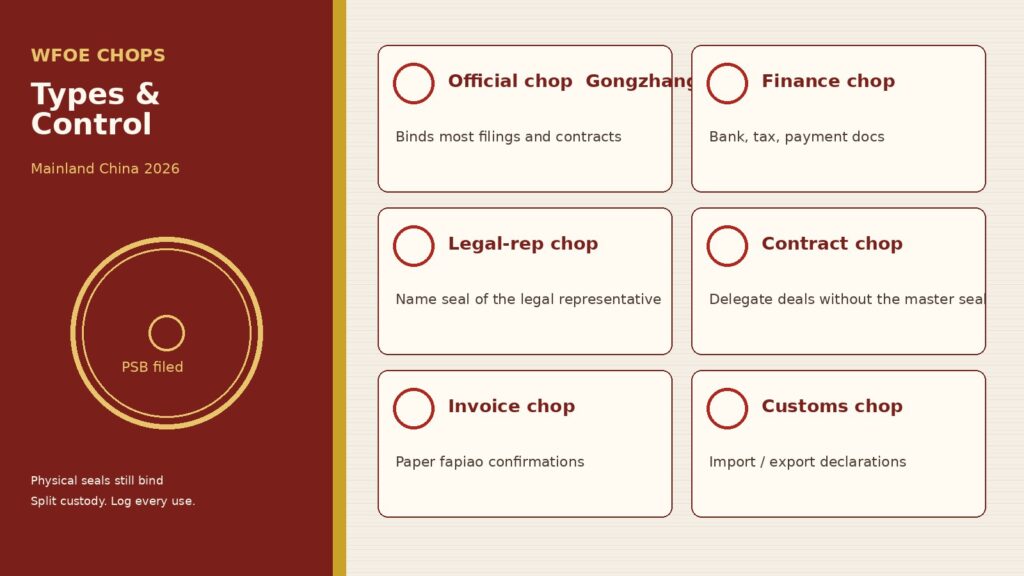
| Official company chop | 公章 | Contracts, government filings, letters, most corporate acts | Yes |
| Finance chop | 财务专用章 | Bank account work, payment instructions, tax and bookkeeping papers | Yes |
| Legal representative chop | 法定代表人章 | Stands in for the legal representative’s signature, especially at the bank | Yes |
| Invoice chop | 发票专用章 | Paper fapiao and some invoice confirmations | Yes if paper invoices are still used |
| Contract chop | 合同专用章 | Commercial contracts without releasing the official chop | Optional but useful |
| Customs chop | 报关专用章 | Import and export declarations | Yes for trading or manufacturing with cross-border goods |
Official company chop. Round, red, full Chinese name. It can stand in for most other seals except customs and, in many cities, the invoice chop. That breadth is why it should never sit in the same drawer as the finance chop.
Finance chop. Square or rectangular. Banks match it against the specimen card when the account is opened and when payment authority changes. Combining it with the official chop and an online-banking token in one person’s hands is how funds leave without a second pair of eyes.
Legal representative chop. Square, carrying the legal representative’s Chinese name. It is destroyed and recarved when that person changes on the SAMR register. Keep it with the person named on the licence or with a trustee who reports to the shareholder, not with the general manager by default.
Invoice chop. Still required on some paper confirmations. The legal invoice in 2026 is the electronic fapiao issued through the State Taxation Administration platform. Buyers verify the record in the tax system. Do not treat a red stamp on a PDF as proof that VAT was issued.
Contract chop. Lets sales or operations bind ordinary commercial deals without access to the master seal. Write the delegation into internal rules: value caps, prohibited clauses, and a log.
Customs chop. Needed once the WFOE files as a foreign-trade operator and clears goods. It is recorded with customs, not only with the PSB.
Department or HR chops exist in larger companies. They do not replace the official chop on filings that SAMR, the tax bureau or a bank will reject without the master seal.
How Chops Are Made and Registered
Only a PSB-authorised engraver may cut the official set. The usual sequence after the licence:
- Take the original business licence and the legal representative’s passport to the designated shop or police window.
- Carve the official, finance and legal-representative chops; add contract, invoice and customs seals if the scope needs them.
- File specimens with the PSB. Keep the filing receipt with the corporate records.
- Deposit finance and legal-representative specimens with the bank when the basic RMB account is opened.
Replacement of a lost seal follows the same shops, but only after a police report and, in most cities, a public invalidation notice. You cannot lawfully recarve a “spare” official chop because the first one is inconvenient to share.
Chop carving sits in the same post-licence block as company registration and bank account opening. The licence alone does not let you sign a lease addendum or move money.
Control Rules That Prevent the Usual Failures
Foreign shareholders lose companies in China more often through chop custody than through a vote on paper. A general manager who holds every seal can sign leases, hire staff, instruct the bank and file SAMR changes while the parent is still circulating an English resolution.
Working controls that survive an audit or a buy-side due diligence:
- Split custody. Official chop with one custodian, finance chop with another, legal-representative chop with the legal representative or a shareholder trustee. Never one person for all three.
- Keep online-banking tokens and UKeys away from the finance chop holder who also prepares payments.
- Maintain a usage log: date, document, counterparty, approver, custodian. Photograph the stamped page for high-value items.
- Ban pre-stamped blank letterhead and stacks of “spare” contract pages.
- Write chop rules into the articles or a board resolution so a later dispute is not a swearing contest.
- On staff exit, collect seals the same day and record the handover. Change passwords and e-seal certificates in the same window.
- For JVs, do not leave the official chop with the local partner as a courtesy. Deadlock cases in 2026 still start with a locked safe and a frozen account.
When you buy an existing WFOE, chop handover is a closing condition. Confirm each physical seal, compare impressions to PSB and bank specimens, and recarve if any history of shadow chops appears.
Lost, Stolen or Misused Seals
Act on the day you notice the gap. Delay lets a holder stamp new obligations that counterparties can enforce in good faith.
- Record last known location, last logged use and who had access.
- File a police report for loss or theft. Keep the receipt.
- Publish an invalidation notice in a newspaper the local PSB accepts, naming the company, Unified Social Credit Code and the seal type.
- Notify the bank in writing if the finance or legal-representative chop is involved, and freeze or reset payment limits.
- Apply to recarve and refile with the PSB once the waiting period in that district ends.
- Review recent contracts, tax filings and transfers. Preserve CCTV, emails and the seal register.
If a departing manager or JV partner refuses to return seals, changing the legal representative at SAMR first is usually required before the new representative can declare the old official chop lost and recarve. That filing itself often needs a chop or a court-supported process. Build the contingency into the articles before there is a fight.
Forgery of a registered chop is a criminal matter. Civil recovery of money already wired is slower than prevention.
Electronic Seals in 2026
Qualified electronic seals are legally equivalent to physical chops for most civil documents. They do not retire the physical set. A WFOE still needs the carved official and finance chops for bank specimens and for filings that the local window has not moved online.
Treat e-seal certificates like chops: named holder, multi-factor access, revocation on exit, and a system log. A stolen USB certificate plus a weak password is the digital version of a missing official chop.
What Founders Should Do in the First Month
Carve the core set as soon as the licence is in hand. Open the bank file with the finance and legal-representative specimens. Write a one-page custody matrix before the first employee asks to “just stamp this.” Keep the official chop off the road. Use a contract chop for routine sales if volume justifies it.
If the legal representative lives outside China, appoint a documented custodian and a backup. Pair chop control with the same people who handle tax registration and ongoing compliance, so usage logs and filings stay in one file.
Frequently Asked Questions
Is a signature enough without a chop?
For most mainland commercial and government documents, no. Banks and counterparties look for the registered seal. A signature can support the record; it rarely replaces the official or finance chop.
Can one chop replace the others?
The official chop covers a wide range of acts, but customs and invoice use are specialised. Banks still want the finance and legal-representative specimens on file. Using one seal for everything concentrates risk.
Who should hold the official chop?
A senior custodian named in writing, not automatically the general manager. Shareholders of a WFOE often keep it with a trusted finance or admin officer who does not also initiate payments.
Do electronic fapiao remove the invoice chop?
The legal invoice is the STA electronic record. The invoice chop remains relevant for residual paper processes. Do not delay tax registration while waiting for a stamp shop.
What if we only have English directors?
The legal-representative chop shows that person’s name as registered in Chinese characters on the licence. Plan the name rendering at incorporation so the seal, the bank card and the licence match.
Control of the chops is control of the WFOE. Carve them through the PSB channel, split who holds them, log every use, and treat a missing seal as an emergency rather than an admin errand.