
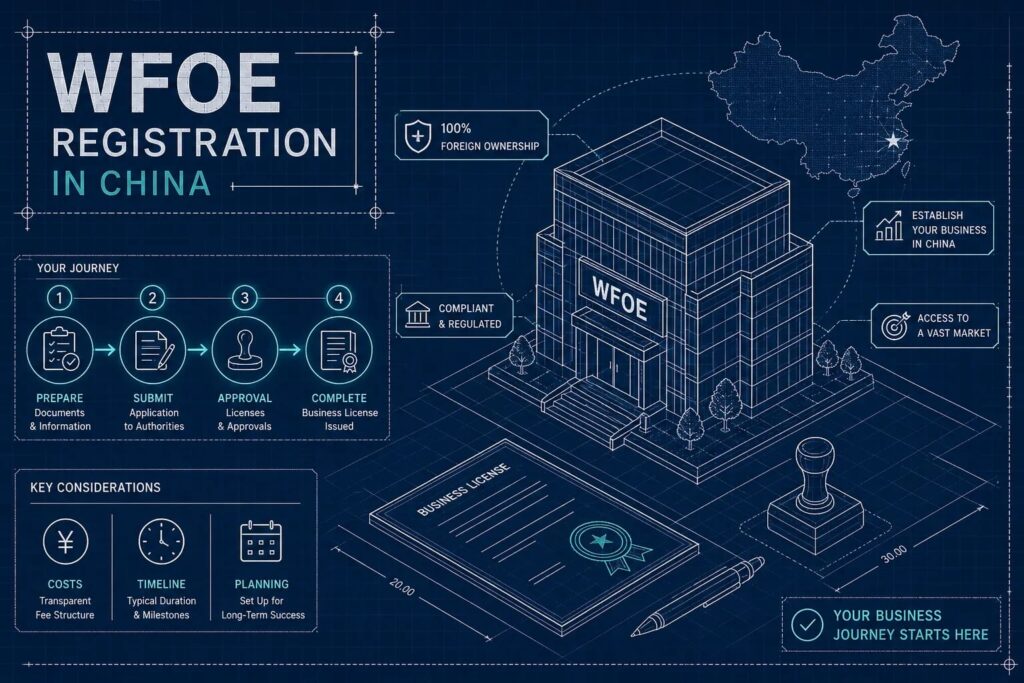
Most foreign investors assume WFOE registration is the complicated part. It isn’t. The business license from SAMR typically takes five to fifteen working days once a complete application reaches the registrar, roughly one to three weeks. What actually slows people down is document preparation before filing and bank account opening after. At Register Company China, our firm has walked US-based founders, SMBs, and e-commerce sellers through this process entirely remotely, and the pattern is always the same: investors who finish fastest are the ones who understand the full sequence before they start. This guide gives you that sequence, plus a clear-eyed look at timelines, costs, and the compliance obligations that begin the day your license arrives.
Is a WFOE the Right Entity for Your China Business?
A Representative Office cannot sign contracts, issue fapiao (invoices), or conduct revenue-generating business operations. A Joint Venture requires a Chinese partner, and ownership and control arrangements vary, some sectors impose foreign ownership caps that make a local partner legally mandatory. A Wholly Foreign-Owned Enterprise gives you 100% foreign ownership, full operational authority, and the ability to hire local staff, issue fapiao, and remit profits abroad. For most US-based businesses that want to operate independently in China, the WFOE is the default answer.
China uses a negative list system: anything not on the list is open to full foreign ownership. Manufacturing is fully open. Remaining restrictions cluster around finance, telecom, media, education, and healthcare. Prohibited sub-sectors include online news and publishing services, domestic express mail, film production, and rare earth mining. Before you do anything else, confirm whether your specific business scope lands on the restricted or prohibited side of that list. A prohibited sector means no WFOE, period. A restricted sector may mean a foreign ownership cap or a mandatory Joint Venture structure.
If you’re still testing the China market, a Representative Office costs less to set up and carries lighter compliance obligations. If your scope requires a Chinese operating license tied to a local partner, a Joint Venture may be unavoidable. Understanding which structure fits your situation saves months of rework later.
Documents to Prepare Before You File Anything
Notarization and Apostille Checklist
If your investor is a US company, you’ll need notarized and apostilled copies of the certificate of incorporation, articles of association, and a board resolution authorizing the China entity. Individual investors need notarized passport copies and personal identification documents. China joined the Apostille Convention in November 2023, which removed the need for consular legalization in most cases, but you still need to get the apostille completed correctly in your home jurisdiction before anything goes to SAMR. Document preparation typically adds one to four weeks before the China company registration filing even begins.
Registered Address Requirements
Your WFOE needs a physical registered address that meets SAMR standards: a valid commercial lease agreement plus the landlord’s property ownership certificate. Residential addresses are routinely rejected. Many foreign investors use a compliant serviced office address as their registered address, which satisfies the WFOE registered capital and address requirements without committing to a long-term lease. Getting this wrong is one of the most common reasons SAMR returns an application.
Your Articles of Association need to be drafted in Chinese and match the business scope you’re registering. The scope description must be specific enough to cover your actual activities but not so narrow that it restricts future operations. Overly broad or vague scope descriptions also create problems at SAMR. Getting both documents right before submission is the step that determines whether your application moves through cleanly or bounces back for revision.
WFOE Registration Steps, in Order
The process starts with name reservation. You submit a few candidate names, commonly two to five proposed Chinese company names, to the local SAMR office for review. Name approval typically takes one to three business days. The name must be in Chinese and follow specific structural rules around industry descriptor and geographic identifier placement. If all submitted names are rejected, you’ll need to propose a new set before proceeding.
Once your name is approved and your full incorporation package is ready, you submit everything to SAMR. For a clean, complete application, WFOE registration business license issuance typically takes five to fifteen business days. The business license is the legal birth certificate of your WFOE. Every step that follows depends on it.
After the license, you carve your company chops, the official seals used to authorize documents and contracts in China. Then you register with the tax bureau, obtain your fapiao authorization, and complete any SAFE-related filings if you’re injecting foreign capital. Social insurance and housing fund registrations follow. These post-license steps typically add one to four weeks to your total timeline, and several can run in parallel. With that full picture in mind, the next section breaks down how those steps translate into realistic end-to-end timelines by entity type and city.
WFOE Registration Timeline by Entity Type and City
A consulting or trading WFOE in a major city runs four to eight weeks end to end when documents are properly prepared. A manufacturing WFOE is a different category: environmental impact assessments and sector-specific approvals can push the total timeline to three to six months. If you’re planning a manufacturing setup, budget time accordingly and don’t expect a license in the same window as a service entity.
Government processing times are broadly consistent across Shanghai, Beijing, Shenzhen, and Guangzhou. Business license issuance after a complete SAMR filing runs five to fifteen business days in all four cities. The difference between cities is less about government speed and more about local district requirements, address market availability, and bank relationships.
Bank account opening is consistently the slowest step in the entire foreign invested enterprise registration process, commonly adding two to eight weeks after your license arrives. Banks run their own due diligence on the foreign investor, the business scope, and the beneficial ownership structure. Factor bank account opening into your operational go-live date, not your license issuance date. Choosing the right bank for your business type and having your corporate documentation organized significantly reduces this delay. Banks with established FIE experience, Bank of China, ICBC, China Merchants Bank, HSBC China, and Standard Chartered, are the most accessible for foreign-owned companies.
WFOE Registration Costs and Fees in 2026
China’s government charges for WFOE registration are negligible. Business license issuance costs effectively RMB 0 to 500. The real budget sits in professional service fees, which range from USD 2,500 to 8,000 for a standard service or trading WFOE. More comprehensive packages that include banking support, chop management, and post-registration compliance setup can reach USD 8,500 to 15,000.
There’s no statutory minimum registered capital for most WFOEs. In practice, consulting and service entities commonly use RMB 100,000 to 500,000. Trading WFOEs typically land in the RMB 300,000 to 3,000,000 range depending on inventory and logistics scope. Manufacturing entities run higher, often RMB 1 million and above. Regulated sectors like financial services and telecom carry statutory minimums that are dramatically higher and rarely relevant to standard foreign investor setups.
Registered address services typically cost RMB 6,000 to 15,000 per year depending on city and provider. Notarization, apostille, and certified translation of your foreign investor documents add another USD 100 to 2,500 depending on the complexity of your shareholder structure. These costs are separate from professional service fees in most proposals, so read your fee quote carefully before signing.
Post-Registration Compliance You Can’t Ignore
The moment your WFOE has its business license, it’s a Chinese legal entity subject to Chinese tax law. Monthly VAT filings are due by the 15th of the following month. Quarterly provisional Corporate Income Tax filings follow each quarter-end. Annual obligations include three fixed deadlines: a statutory audit by a licensed Chinese CPA firm, annual CIT reconciliation due by May 31, and an AMR annual report due by June 30. Missing any of these filings triggers penalties and creates problems for bank account maintenance, contract execution, and eventual profit repatriation.
Your company chops are the operational heartbeat of a China entity. The legal representative chop, finance chop, and invoice chop are each used for different purposes, losing control of them is a serious compliance and legal risk. Fapiao must be issued through an authorized system and reconcile with your tax filings. US-based founders managing a WFOE remotely need a clear protocol for who controls the chops and how invoices are issued and stored.
Use this checklist as your reference tracker through the entire WFOE registration process:
- Negative list check and business scope confirmed
- Company name reserved with SAMR
- Foreign investor documents notarized and apostilled
- Registered address secured and lease documentation ready
- Articles of Association drafted in Chinese
- SAMR filing submitted and business license received
- Company chops carved
- Tax registration and fapiao authorization completed
- Corporate bank account (RMB and/or foreign currency) opened
- Monthly accounting and tax filing process established
- Annual audit and annual report process documented
Register Company China manages every item on this list for foreign investors, entirely remotely, with fixed-price packages. Contact our team for a fixed-price proposal specific to your setup, no travel required, no local partner needed.
The Bottom Line
Establishing a Wholly Foreign-Owned Enterprise in China is genuinely achievable for US-based businesses without travel, without a local partner, and without months of confusion, provided you understand the sequence. The business license itself is the fast part. Document preparation, address sourcing, and bank account opening are where time and money actually go.
Match your entity type to your business scope before you do anything else. Get your investor documents apostilled before you need them. Build the post-registration compliance cadence into your launch plan from day one. Plan your WFOE registration timeline around those three variables, and the difference between a WFOE that opens on schedule and one that stalls in avoidable delays comes down to preparation.
Frequently Asked Questions About WFOE Registration
What is WFOE registration?
WFOE registration is the process of incorporating a Wholly Foreign-Owned Enterprise in China, a legal entity that is 100% foreign-owned, with no requirement for a Chinese partner. The process runs through China’s State Administration for Market Regulation (SAMR) and includes name reservation, document filing, business license issuance, chop carving, tax registration, and bank account opening.
How long does WFOE registration take?
A consulting or trading WFOE in a major Chinese city typically takes four to eight weeks end to end when investor documents are properly prepared. The SAMR business license itself takes five to fifteen business days for a complete filing. Document preparation before filing and bank account opening after add the most time to the overall timeline.
What are the WFOE registered capital requirements?
Most WFOEs have no statutory minimum registered capital. Consulting and service entities commonly register RMB 100,000 to 500,000. Trading WFOEs typically use RMB 300,000 to 3,000,000. Manufacturing entities often start at RMB 1 million and above. Regulated sectors such as financial services and telecom carry higher statutory minimums set by sector-specific regulators.
Can I complete WFOE registration without traveling to China?
Yes. The WFOE registration process can be completed entirely remotely with the right professional support. Investor documents are apostilled in the home jurisdiction and submitted through a registered agent in China. Register Company China handles this process for foreign investors without requiring any travel to China.