A WFOE business scope in China is not a marketing tagline. It is the list of activities printed on the business licence. Banks, the tax bureau, customs, and counterparties all read that list before they accept a contract, a fapiao, or a payment.
Founders still treat the wording as boilerplate. Six months later they try to invoice for work the licence does not cover. The usual fix is a scope amendment, extra weeks of delay, and revenue that cannot be booked in the meantime.
This guide explains how a WFOE business scope works in 2026, how it sits against the Foreign Investment Negative List, how to draft general items versus licensed items, and what it costs to change the wording after the licence is issued.
What a WFOE business scope actually is
The Chinese term is jingying fanwei (经营范围). SAMR reviews the draft against the national industry classification and the Business Scope Standards Catalogue, then prints the approved text on the licence. The same text is public on the National Enterprise Credit Information Publicity System.
In practice the scope decides three things:
- What the company may legally sell and invoice
- Which post-licence filings are required (customs, food, telecom, medical devices, and similar permits)
- How tax officers classify VAT items and how banks review the purpose of inbound funds
Operating outside the printed scope is not a grey area. It can block special VAT invoices, delay customs clearance, and, in serious cases, trigger administrative penalties.
Negative List first, then the catalogue
Before you write a single clause, check whether the activity is open to 100 percent foreign ownership. The Foreign Investment Access Negative List (2024 edition, still the national baseline through 2025–2026) splits activities into prohibited and restricted. Everything else is treated as permitted for a WFOE.
The 1 November 2024 update removed the last nationwide manufacturing ownership caps. Restricted or closed space still includes parts of value-added telecom, domestic media and publishing, some education segments, selected financial services, and a small set of natural-resource activities. Pilot openings in Beijing, Shanghai, Guangzhou and Shenzhen can be wider than the national list. Confirm the city you will register in, not only the national document.
A separate Market Access Negative List applies to all investors, foreign or domestic. Licensed items on that list need a permit before the activity is live, even if foreign ownership itself is allowed.
General items versus licensed items
SAMR wording now splits most scopes into two buckets.
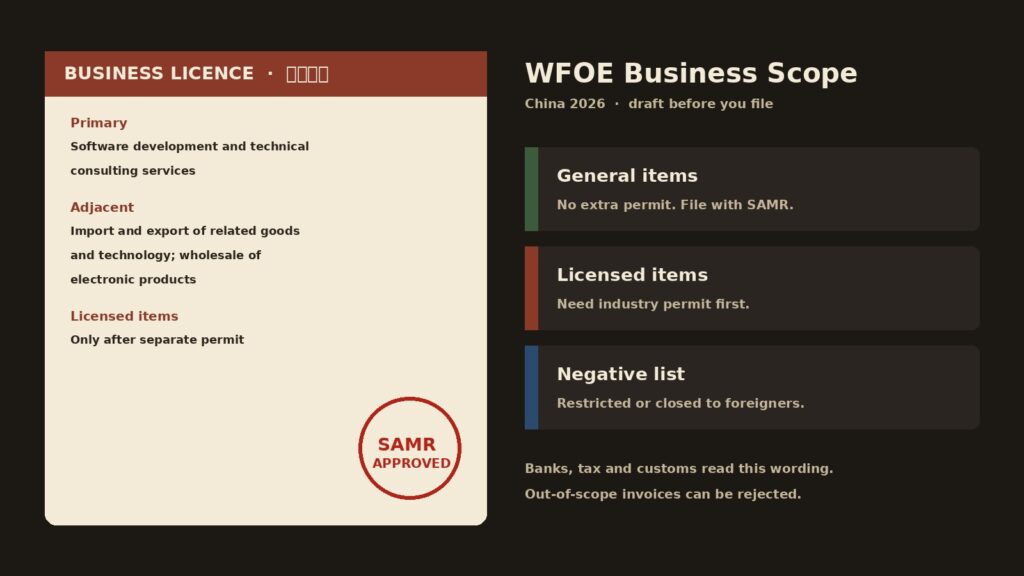
General business items do not need a pre-approval permit. Typical examples: management consulting, software development, information technology services, wholesale of ordinary goods, technology transfer.
Licensed business items need a sector permit before you can operate them. Food operation, certain medical devices, value-added telecom, some education products, and hazardous chemicals fall here. The licence can list the item with a note that it applies only after the permit is granted. Listing the item does not replace the permit.
Keep licensed items off the first draft unless you already know you will apply for the permit in year one. An unused licensed line can invite extra questions from the tax bureau and from banks.
How WFOE types follow the scope
Company Law does not create official “types” of WFOE. Local practice still groups companies by what the scope allows.
| Practical type | Typical scope language | Extra filings | Usual setup feel |
|---|---|---|---|
| Consulting / services | Technical services, software, management consulting, R&D | Usually none beyond tax and bank | Lightest path |
| Trading (FICE) | Wholesale, retail, import and export of named goods | Customs registration, often general VAT taxpayer | Longer post-licence work |
| Manufacturing | Design, production, assembly, sale of self-made goods | Environmental and workshop checks in many cities | Longest path |
A service company that will also ship hardware should put import and export of related goods in the first draft. Adding trading later is possible, but customs and tax updates sit on top of the SAMR amendment.
How to draft the wording
Use the catalogue phrases, not a free-form English pitch. SAMR clerks match Chinese text to standard items. A clean 2026 draft usually has three layers:
- Primary activity: what you will invoice in the first year
- Adjacent activity: work you reasonably expect within 12–24 months
- Licensed items only if a permit is already on the plan
Example for a technology WFOE:
Software development; technology research and development; information technology consulting services; computer system integration; import and export of goods and technology; wholesale of electronic products.
Example for a trading WFOE:
Wholesale, retail, and import and export of [named product categories]; after-sales service; technology consulting and technology development related to the above products.
Do not list every industry you might one day like. An inflated scope is a common reason for SAMR pushback and for tax officers to question why the company has no revenue in half of the listed lines. Do not copy a competitor’s licence either. Their licensed items may not be available to you, and their product categories may not match your customs plan.
Company name and scope do not have to be identical, but they should not contradict each other. A name that signals “education” with a scope that is only wholesale of toys will slow name pre-approval.
What happens if the scope is wrong
Common failures after incorporation:
- The tax bureau will not open a VAT item code for an activity missing from the licence
- A Chinese customer’s legal team refuses to sign because the supplier’s scope does not cover the contract
- The bank holds a cross-border payment because the underlying contract sits outside the registered activity
- Customs will not register an importer of record whose scope has no import and export language
Advisors who handle volume WFOE work still cite scope mismatch as one of the first problems that appear after a “cheap and fast” filing.
How to amend a WFOE business scope in 2026
You can change the scope. It is not free in time.
- Pass a shareholder decision (a sole-shareholder written resolution for most WFOEs)
- Amend the Chinese articles of association
- File the change at SAMR and collect a reprinted licence
- Update the tax registration so new VAT item codes can be used
- Update the bank, and customs or SAFE if trading or capital flows change
Industry guides in 2026 put a simple general-item amendment at roughly 4–8 weeks end to end, with professional fees often in the USD 1,500–4,000 range. Licensed additions take longer because the permit comes first. Some free-trade-zone desks allow a faster self-declaration for general items; that shortcut does not apply to licensed sectors. Treat published day-counts as local practice, not a statute you can enforce.
During the amendment window you usually cannot issue special VAT invoices for the new activity. That lost billing time is often more expensive than the filing fee.
Questions to answer before you file
- What will the first 12 invoices actually describe?
- Will you import goods, even as samples or equipment for self-use?
- Do any lines sit on the Negative List or need a sector permit?
- Does the registered address support the activity (workshop versus virtual office)?
- Is registered capital consistent with a trading or manufacturing story if banks and SAMR read the scope that way?
Scope, WFOE registration, address, and capital should be drafted as one package. Changing one after the licence is issued often forces changes to the others.
FAQ
Can a consulting WFOE sell physical goods?
Not if the licence only lists services. Add wholesale and import/export language, or amend later.
How long can the Chinese text be?
There is no useful English word-count. Clerks expect catalogue phrases. Over-long custom essays get cut or rejected.
Does the 2024 Company Law change how scope is written?
It did not replace the catalogue system. It did tighten capital contribution timing, which banks and officers read together with a trading or manufacturing scope.
Can I use English on the licence?
No. The governing text is Chinese. Keep a controlled translation for contracts, but file the catalogue Chinese.
Who should draft it?
Someone who will also handle tax item codes and, if relevant, customs. Scope written in isolation is the usual source of the first amendment.
Next step
Map the first two years of revenue, check the Negative List for that city, and draft primary plus adjacent items before name pre-approval. If you want the wording reviewed against SAMR and tax practice, use the quote form on our services page. Remote filing is the standard path for most foreign shareholders.