Every Wholly Foreign-Owned Enterprise in China needs a registered address before the market regulator will issue a business licence. That address appears on the licence, sets which SAMR office and tax bureau supervise the company, and is the place banks and inspectors expect to find when they knock. A cheap mailbox sold as a virtual office is still one of the most common reasons a 2026 filing stalls after the name check.
This guide covers what China WFOE registered address requirements look like in practice: which premises SAMR will accept, when a cluster or incubator address is enough, when you need a real lease, the papers to prepare, and the downstream problems that show up at the bank, tax bureau, and work-permit desk.
What a registered address is, and what it is not
Under the PRC Company Law, a company must have a domicile. For a WFOE that means a commercial place of business that can receive official mail, support tax registration, and survive an on-site check. You register one principal address. Operating from a second site is often possible, but many cities require a filing or public disclosure of the actual workplace.
It is not a PO box, a hotel room without a qualifying commercial licence, or a residential flat. A handful of cities allow limited home registration for tightly defined individual businesses. That exception almost never covers a foreign-invested limited company.
The 2025 Company Registration Measures (SAMR Order No. 95, in force from 10 February 2025) still govern 2026 filings on two points: the address must be verifiable, and intermediaries who submit false address papers share liability with the applicant. Spot checks against empty-shell companies continue.
Address types that usually pass
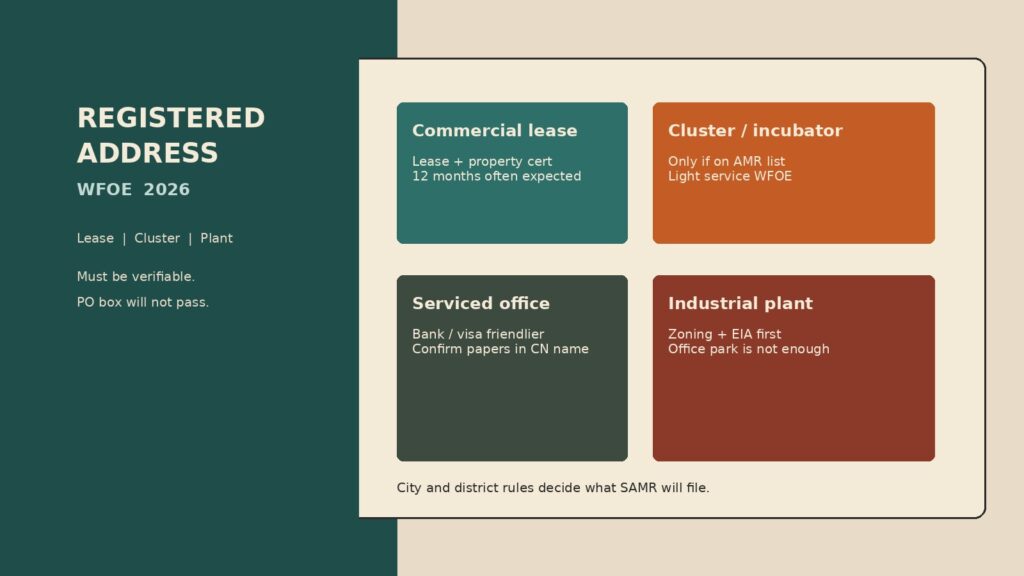
| Address type | Typical proof | Fits which WFOE | Main caveat |
|---|---|---|---|
| Leased commercial office | Lease plus property ownership certificate; some districts want a filed lease | Consulting, trading, most service companies | Many bureaus want at least 12 months remaining on the lease |
| Owned commercial unit | Ownership certificate in the WFOE or shareholder name | Any, if zoning matches the scope | Changing later still needs a full SAMR amendment |
| Government-listed cluster or incubator | Hosting agreement plus the park's cluster-registration filing | Light service or holding entities in cities that run the programme | Must be on the local approved list, not a private shared desk |
| Serviced office in a commercial building | Operator lease or sub-lease the bureau accepts | Companies that also need a bank site visit or work permits | Confirm the operator can issue papers in the WFOE's Chinese name |
| Industrial plant | Industrial lease, zoning papers, often an environmental impact assessment | Manufacturing WFOEs | An office park does not replace a factory site |
Cluster registration (集中登记地) is the only form of so-called virtual office that many Shanghai and Shenzhen districts still accept for a WFOE. Beijing remains tighter in most districts. A private co-working desk with no AMR filing is not the same thing.
Can the registered address differ from the operating address?
Often yes, with a filing. Many early-stage consulting WFOEs register at an approved cluster address and work from a flexible workspace or from overseas. That split creates friction later:
- Banks in Shenzhen and other tier-one cities have tightened KYC. Several still send staff to the registered address before they open a basic RMB account.
- General VAT taxpayer status, invoice quota increases, and export tax refunds frequently trigger questions about the actual workplace.
- Food, medical device, warehousing, offline retail, and many import-export scopes expect the registered and operating sites to match, because inspectors visit the premises.
- Work-permit sponsorship in many cities needs a real office the labour bureau can inspect.
If you expect any of those steps in the first year, budget for a genuine commercial lease instead of the cheapest hosting product.
City and district differences that actually matter
National law sets the principle. District AMR offices decide the file. Shanghai and Shenzhen still run relatively large cluster and incubator programmes, especially in free-trade and park zones. Beijing districts more often ask for dedicated space. Guangzhou and other provincial capitals sit in between and change the list of approved buildings without much notice.
The city you pick also sets your tax bureau, social-insurance office, and, for trading companies, the customs house you deal with. Do not choose an address only because the annual hosting fee is low. Confirm three things before you sign:
- The exact building is accepted by the district AMR for your proposed business scope.
- At least one bank you want to use will visit that building for corporate account opening.
- If you plan to hire or sponsor a work permit, the local labour and exit-entry offices treat the address as a real workplace.
Founders on the ground in Shenzhen still report the same sequence: pre-clear the address with tax and a bank manager, then sign the lease. Doing it the other way around is how people pay rent on a unit that cannot complete bank account opening.
Documents you should expect to collect
Packages vary by city and landlord. A normal WFOE file includes some mix of:
- Lease, sub-lease, or address-use / hosting agreement in the WFOE's future Chinese name, or a clause that assigns the lease once the licence is issued.
- Property ownership certificate or equivalent title document for the premises.
- Landlord ID or the landlord company's business licence.
- Proof the premises may be used for the stated activity (commercial zoning, park filing, or industrial use papers).
- District commitment or cluster-registration certificate where that programme exists.
Ask for a break clause if the WFOE application is rejected. A 12-month remaining term is a common local expectation even when the national rules do not spell it out.
Costs and the cheap-address trap
Industry quotes in 2026 still put compliant hosting or serviced-office addresses in a wide band, often roughly USD 1,000 to 6,000 a year in tier-one cities, with a real floor in a Grade A building costing more. The fee is not the risk. The risk is an address that gets the licence printed and then fails the bank visit, the tax on-site check, or a later licence application.
If mail sent to the registered address is returned, or inspectors find an empty shell, the company can be moved onto the abnormal operations list. That record is public on the national enterprise credit system and will slow banking, bidding, and any later change filing.
How to choose without overbuilding
Match the address to the first 12 to 24 months of work, not to a brochure.
- Holding or light consulting entity, no China staff, no special licence: an approved cluster or incubator address in a district that still runs the programme can be enough.
- Trading company that will apply for general taxpayer status or export refunds: prefer a stable commercial lease the tax bureau can visit.
- Company that will sponsor a founder visa or hire locally: plan on inspectable office space.
- Manufacturing: industrial zoning and environmental papers first, then the licence. An office address will not carry a plant.
Changing the registered address later is a SAMR amendment plus tax and bank updates. It is doable. It is slower and more expensive than choosing once.
What to do next
Lock the city and district against clients, tax administration, and banking, then test the candidate address against AMR, the tax bureau, and one bank before you pay a deposit. If you need a compliant commercial address as part of a remote WFOE setup, registered address support sits alongside licence filing and ongoing accounting and annual compliance.
FAQ
Can I use a virtual office for a China WFOE in 2026?
Only if it is a government-approved cluster or incubator address the district AMR has already filed. A correspondence-only mailbox or an unlisted co-working desk is not accepted in most cities.
Can I use a home or apartment?
Almost never for a WFOE. Residential use is a limited local exception for certain individual businesses, not for a foreign-invested limited company.
Will the bank accept a cluster address?
Sometimes. Many banks still inspect. If account opening is on the critical path, ask the target bank about that building before you file with SAMR.
Do registered and operating addresses have to be the same?
Not always. Split addresses are common for service companies, but regulated scopes, export refunds, work permits, and some bank KYC reviews push you toward one inspectable site.
What happens if nobody is at the registered address?
Returned official mail and failed spot checks can put the company on the abnormal operations list and block routine filings until you correct the address.