
From the outside, setting up a wholly foreign-owned enterprise in China looks like a black box. Unfamiliar government agencies, documents that need notarization and apostilling, filings in Mandarin, and a process that runs on the other side of the world in a completely different time zone. For most US investors, the opacity is the biggest barrier, not the complexity itself.
Here’s the reality: China WFOE formation follows a clear, linear sequence. Every step has a defined input and a defined output. Tens of thousands of US companies complete it every year without traveling to China, often by working with remote formation specialists who manage the local filings on their behalf. The process isn’t mysterious once you see the full picture.
This guide walks you through every stage of China WFOE formation, from choosing your business scope to achieving full operational readiness. You’ll get realistic timelines, 2026 cost benchmarks, and a clear view of the post-registration compliance obligations that come after your license is issued.
Why most foreign investors choose a WFOE over other China entity types
What sets a WFOE apart from a representative office or joint venture
A WFOE gives the foreign investor 100% ownership and full operational control of the China entity. That means the ability to hire local staff directly under Chinese labor contracts, issue fapiao (official Chinese tax invoices), collect revenue in RMB, and sign commercial contracts in China’s legal system. No Chinese partner required, no shared governance, no divided decision-making.
A Representative Office sits on the opposite end of the spectrum. It can’t generate revenue, can’t sign commercial contracts, and is limited to liaison and market research activities. A Joint Venture requires a Chinese partner holding equity, which means shared control and a more complex governance structure from day one. For any investor who wants to sell, manufacture, or source goods in China, a WFOE is the only structure that supports full commercial operations.
Which industries most commonly use WFOE structures
The most common WFOE sectors for US investors are consulting, IT and software development, trading, e-commerce sourcing, and light manufacturing. These industries have straightforward scope classifications, clear capital benchmarks, and relatively fast formation timelines in major cities like Shanghai, Shenzhen, and Beijing.
Not every business activity is open to a WFOE, though. China maintains a Foreign Investment Negative List that designates certain sectors as restricted or prohibited for foreign-owned entities. Restricted sectors require prior government approval before SAMR issues a business license. Prohibited sectors aren’t available to foreign-invested enterprises at all. Internet news, postal delivery, domestic express mail, and most telecommunications services are among the activities currently closed to WFOEs. For consulting, trading, and most service businesses, the scope clears the Negative List without complication. Knowing your industry’s status is the first decision that has to happen before anything else moves forward.
China WFOE formation step 1: Nailing your business scope and registered capital before you file
Why the business scope decision shapes everything downstream
The business scope is what SAMR registers on your license. It determines which tax categories apply, whether sector-specific approvals are needed before filing, and what registered address type you’ll need. A scope that’s too broad, or one that inadvertently touches a restricted activity, creates delays at the filing stage that can add weeks to your timeline.
For regulated industries like food, financial services, or telecommunications, the sector approval must be obtained from the relevant regulator before SAMR issues the business license. Food operations require a Food Operation License from the local market supervision bureau. Financial services require approval from the National Financial Regulatory Administration. Telecom and online services require an ICP license or Value-Added Telecom Services license from MIIT. Getting scope right before you file avoids discovering these requirements halfway through the process.
How to set a registered capital figure that works for banks, regulators, and your business
There’s no universal statutory minimum for most WFOE types, but market practice creates de facto ranges that matter. Consulting and IT WFOEs typically register between RMB 100,000 and 500,000. Trading WFOEs generally sit at RMB 300,000 to 1,500,000. Manufacturing WFOEs range from RMB 600,000 to several million depending on scale and premises. These aren’t arbitrary figures, they reflect what local authorities, banks, and landlords expect to see from a business of a given type.
The most practical structuring approach is to set registered capital at roughly 12 to 24 months of startup operating costs. Under current Chinese Company Law, the subscribed amount must be fully paid within five years of establishment, which makes a staged contribution schedule both legal and common. Paying everything upfront at incorporation isn’t required, and most foreign investors structure their contributions in tranches as the business ramps up.
Step 2: Preparing your foreign documents and reserving the company name
The name reservation process with SAMR
You submit three to five Chinese name options to the local SAMR or AMR office. In major cities, approval typically takes one to five working days. The name must include the city or province, a distinctive identifier, the business nature, and the company type designation. SAMR won’t approve names that are too generic, conflict with existing registrations, or use prohibited terms.
This is also the stage where the registered address gets confirmed. The address must meet SAMR’s requirements for the business type, and an address that fails review is one of the most common causes of licensing delays. Virtual offices and serviced office arrangements work for many WFOE types, but the specific address must be verified as acceptable before the name reservation advances. If you’re not leasing your own commercial premises, a compliant registered address solution typically costs USD 1,000 to 6,000 per year.
Notarizing and apostilling your US parent company documents
Foreign-sourced documents required for WFOE registration include the US parent company’s certificate of incorporation, a recent board resolution authorizing the China investment, identity documents for the legal representative and directors, and the articles of association or bylaws. Each of these documents needs to go through a two-stage authentication process before SAMR will accept them.
For US documents, the process works like this: the document is notarized by a licensed US notary public, then an Apostille is obtained from the relevant Secretary of State in the state where the notarization was performed. China accepts Apostille authentication from US states under the Hague Apostille Convention, so the old Chinese consulate legalization step is no longer required. This stage takes one to three weeks depending on document volume and state processing times. It’s the single most common delay point for overseas investors, almost always because the apostille process was started too late, so get it moving on day one.
China WFOE formation step 3: Filing for the business license and getting operational
Submitting the formation package to SAMR and obtaining the license
The full filing package includes the approved company name, finalized business scope, registered address proof, registered capital details, executive appointments, and all notarized and apostilled foreign documents. Once submitted, SAMR typically approves and issues the business license within 3 to 15 working days in major cities. If the scope triggers a sector-specific approval, that approval from the relevant industry regulator must be obtained first, adding two to eight weeks for regulated industries.
The business license is the foundational document. Without it, nothing else in the post-registration sequence can proceed. That’s why scope clarity, address confirmation, and document preparation all have to be locked in before the filing date. A complete, clean submission moves fast. An incomplete one stalls until every missing item is resolved.
Post-license activation: chops, tax, and bank accounts
The day the business license arrives, a new sequence begins. The first task is carving the official company chops (seals) through a police-registered seal engraver, this takes one to two working days, and the chops are required for virtually every official document the company will sign going forward. Without them, the entity can’t operate, so this step can’t be deferred.
Tax registration with the local tax bureau follows, typically within one to five working days. After that comes RMB bank account opening, which takes one to two weeks under normal conditions but often runs longer due to bank KYC requirements for foreign-owned entities. Bank of China and ICBC are the most commonly accessible banks for WFOEs, with China Merchants Bank a solid alternative for SMEs and tech-oriented businesses. SAFE registration for capital injection and foreign exchange reporting is completed in parallel or shortly after the bank account is active.
China WFOE formation costs and timeline (2026)
Realistic cost ranges broken down by component
Government filing fees in China are nominal, usually RMB 0 to 1,000 (roughly USD 0 to 150). The real budget goes to professional service fees, document authentication, and address costs. Here’s how the components break down for 2026:
- Professional service fees: USD 2,500 to 8,000 for consulting or IT WFOEs; USD 5,000 to 10,000 for trading WFOEs; USD 8,000 to 15,000 for manufacturing WFOEs
- Notarization and apostille: USD 500 to 2,500 depending on document volume and state
- Registered address: USD 1,000 to 6,000 per year for a compliant serviced-office arrangement
- Bank account setup support: USD 0 to 500, sometimes bundled into formation packages
All-in setup budget excluding registered capital runs USD 5,000 to 15,000 for a standard service or trading WFOE and USD 18,000 to 30,000 or more for manufacturing. Registered capital is a separate funding commitment to the company, not a service fee, so it belongs in a different budget line from formation costs entirely.
Timeline benchmarks from name reservation to operational readiness
A well-prepared consulting or trading WFOE in a major Chinese city completes end-to-end in six to twelve weeks. Manufacturing WFOEs or those requiring sector-specific approvals run eight to twenty weeks. The three most common delay drivers are starting the apostille process late, submitting an address that fails SAMR review, and extended bank KYC for foreign-owned entities.
For full operational readiness, meaning business license issued, chops carved, tax registration complete, and bank account active, plan on eight to ten weeks in a standard case. Build your China market entry timeline around that figure, not the minimum theoretical timeline.
How remote formation specialists handle every stage for overseas clients
What “remote WFOE formation” actually means in practice
A full-service remote formation specialist manages every stage on the ground in China on behalf of the overseas client. That includes name reservation, registered address provision, document review and filing coordination, SAMR liaison, chop procurement, tax setup, and bank account introduction. The client never needs to travel to China or interact directly with a Chinese government agency at any point in the process.
Register Company China is built around exactly this model. Every stage is managed in China by formation specialists who communicate in English and work across US business hours. The process is designed specifically for foreign investors who need a compliant, predictable path into China without the time and cost of multiple trips. For US entrepreneurs, e-commerce sellers, and SMBs planning a China entry in 2026, that remote capability removes one of the biggest practical barriers to getting started.
Why fixed-price packages matter for overseas investors
The biggest concern US investors have about China company formation is cost unpredictability: surprise fees, scope creep, and services that weren’t included in the original quote. A fixed-price package eliminates that uncertainty and lets you budget the full formation before committing. You know what you’re paying, what’s covered, and what the timeline looks like before any work begins.
Register Company China offers transparent, all-in pricing that covers the formation process through to post-registration compliance setup. Once the WFOE is operational, ongoing obligations include monthly tax filings by the 15th of each month, quarterly corporate income tax prepayments, the annual CIT reconciliation due by May 31, the AMR annual report due by June 30, and SAFE foreign exchange reporting. Most generalist formation providers hand you the keys and step back. That handoff approach consistently falls short for a US investor managing a China entity across time zones. Having a single specialist team handle both formation and ongoing compliance isn’t a luxury, it’s the only arrangement that reliably works.
Putting it all together
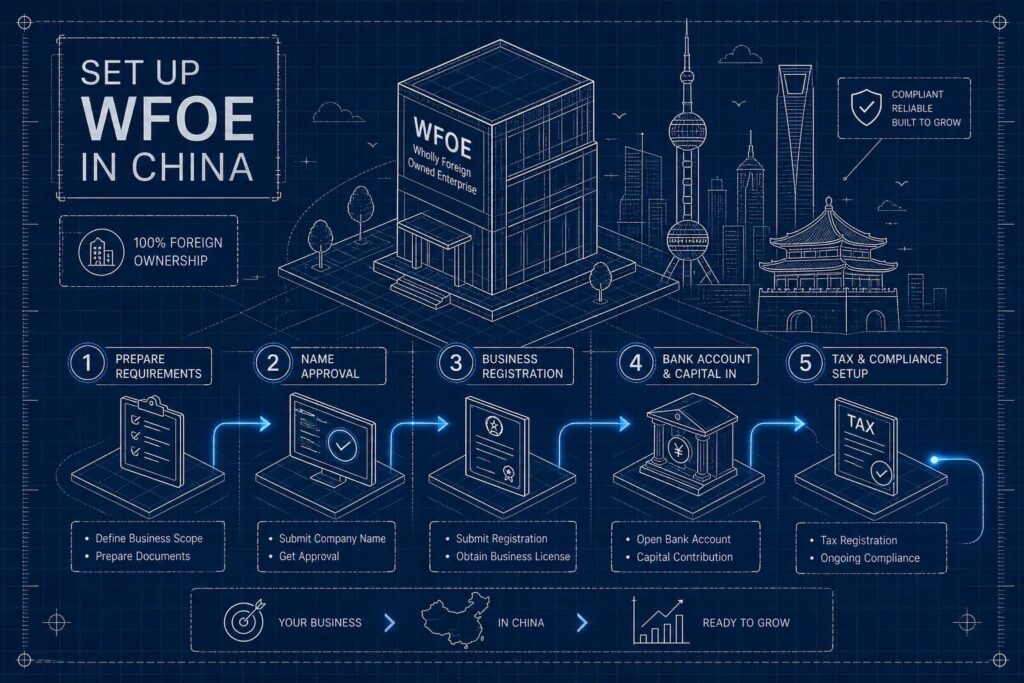
The full China WFOE formation sequence runs in a clear order: confirm business scope and registered capital, reserve the company name and lock in the registered address, prepare and apostille US parent company documents, file the formation package with SAMR, receive the business license, carve the official chops, complete tax registration, and open the RMB bank account. Each step has a defined output that feeds directly into the next one. The process is linear and completable in six to twelve weeks for most service and trading WFOEs.
The biggest factor in how smoothly China WFOE formation proceeds is preparation. Having the right business scope confirmed before filing, the right documents authenticated before the SAMR submission date, and a local partner managing the filings on the ground eliminates the delays that derail timelines. The investors who run into problems are almost always the ones who start the apostille process late or discover their scope is restricted after they’ve already filed.
For overseas investors who want a remote, fixed-price process with no travel required, working with a specialist addresses the two biggest barriers at once: uncertainty about what it costs and uncertainty about what comes next. If you’re planning a China entity setup in 2026, get in touch with the Register Company China team to walk through your scope, capital structure, and timeline before you start the clock.