
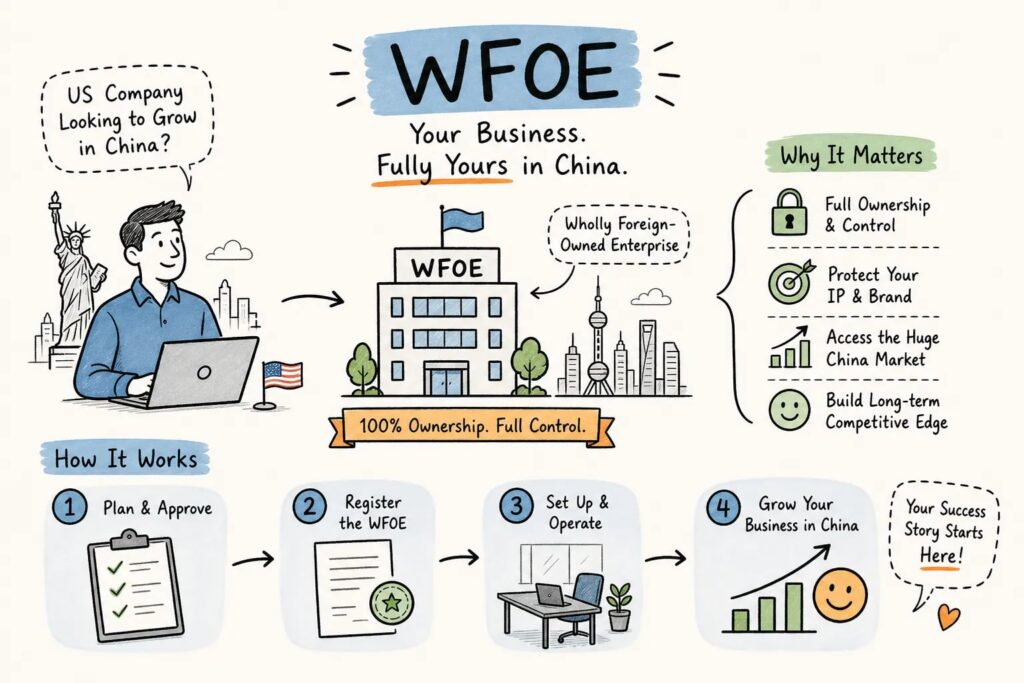
US companies entering China face one structural question above all others: do you own it fully, or do you share control? For most US founders and executives, the answer leads to a Wholly Foreign-Owned Enterprise, commonly called a WFOE. If you’ve been asking what is a WFOE and how does it work for US companies, the short answer is this: a WFOE is a 100% foreign-owned limited liability company incorporated in mainland China, giving the US parent full ownership and direct operating authority without a Chinese partner involved. What many founders don’t realize is that the legal framework governing this structure changed fundamentally in 2020, which means a large portion of what you’ll find online is now outdated.
One misconception worth clearing up early: setting up a China subsidiary no longer requires anyone to board a plane. While PRC law imposes no physical presence requirement on foreign investors during incorporation, bank account opening can vary, some banks and branches require an in-person interview, depending on the city and institution. In most cases, though, a specialist formation service can handle the process remotely from document preparation through post-registration compliance. This article covers the structure, costs, and compliance obligations, on both sides of the Pacific, that US founders need to understand before committing to a China entity.
What a WFOE Actually Is Under Current Chinese Law
Before January 1, 2020, a WFOE was a distinct legal category with its own governing statute. The Foreign Investment Law (FIL), which took effect that year, repealed the old WFOE-specific legislation and folded all foreign-invested enterprises into the same framework as domestic Chinese companies. “WFOE” is now commercial shorthand, not a statutory category. Practically, it describes a 100% foreign-owned limited liability company governed by the FIL and the Company Law.
Four legal features define how this structure operates:
- 100% foreign ownership, one or more foreign investors hold the entire equity stake with no Chinese partner required.
- Limited liability, shareholders’ exposure is capped at their subscribed capital contributions.
- Independent legal person status, the China subsidiary is a separate legal entity, distinct from its US parent.
- Direct business authority, the entity can sign contracts, hire employees, issue Chinese tax invoices (fapiao), and maintain RMB corporate accounts within its approved business scope.
Together, these features explain why many US companies with real operational ambitions in China choose this path over the alternatives.
One constraint worth understanding: foreign investors still can’t freely enter every sector. China maintains a “negative list” of restricted and prohibited industries. If your intended activity falls in a restricted sector, additional conditions apply; if it’s outright prohibited, this structure isn’t an option. Many common activities, manufacturing, trading, consulting, and e-commerce support, fall outside the national negative list, though local licensing requirements and business-scope specifics can still affect registration complexity. Verifying your sector against current negative list guidance is an early and essential step.
WFOE vs. Joint Venture vs. Representative Office
A Representative Office (RO) is the lightest footprint a foreign company can maintain in China. It cannot generate revenue, sign commercial contracts in its own name, or issue fapiao. The RO is legally limited to market research, relationship maintenance, and liaison activities. For any US company with actual operational intent, an RO carries real legal risk if the business activity creeps beyond those limits, for example, by generating revenue, issuing invoices, or hiring staff beyond liaison roles. It becomes a compliance liability the moment operations outgrow what the structure legally permits.
A Joint Venture (JV) brings a Chinese partner into the ownership structure. In certain restricted sectors, a JV is required because full foreign ownership isn’t permitted. Outside those regulatory requirements, many advisors and founders prefer a wholly-owned structure because shared governance, profit-sharing obligations, and the complexity of managing a Chinese co-investor introduce friction that sole ownership avoids. Where foreign ownership is unrestricted, the cleaner path is almost always a foreign-invested enterprise with 100% foreign ownership.
Why Control Matters
The core advantage of the WFOE structure is control. The US parent company can set company policy, hire staff directly, repatriate profits through a defined legal channel, and make decisions without a local partner’s consent. For US companies building operations around manufacturing, sourcing, distribution, or professional services, that autonomy is the operational foundation everything else rests on.
The WFOE Registration Process: Steps, Documents, and Timeline
The registration sequence follows a clear dependency chain: name pre-approval with the local market regulator (AMR/SAMR), then preparation and submission of the full incorporation package, then business license issuance, company seal production, tax registration, and corporate bank account opening.
Typical timelines, which can vary by city, district, and business scope, break down roughly as follows. Name pre-approval generally takes one to two weeks. Document preparation runs two to three weeks. The business license typically issues two to three weeks after filing. Post-license steps, company chops, tax registration, and bank account setup, add another two to three weeks, bringing a straightforward setup to six to ten weeks in total. Regulated business scopes or complex ownership structures can extend that window.
Documents and Authentication
For a US company acting as the investor, the standard document set includes the certificate of incorporation, articles of association or bylaws, a board resolution authorizing the China investment, and a certificate of good standing. One practical update many formation guides haven’t caught up to: China joined the Apostille Convention in 2023, which means US public documents no longer need to go through the old consular legalization chain. An apostille from the competent US authority is now accepted directly, cutting document preparation time significantly. Individual officers, including the legal representative, directors, and supervisor, will also need passport copies and, in some jurisdictions, additional identity materials.
Remote Formation: What’s Possible and What to Verify
No PRC law requires a foreign investor to be physically present in China to register a China subsidiary. Document preparation, AMR filings, and chop management can generally be handled through a specialist formation service. Bank account opening is the step most likely to require in-person attendance, depending on the bank and branch, this is worth confirming with your formation advisor before assuming a fully remote path. Register Company China manages the end-to-end process for US founders, including the registered address requirement and the post-registration compliance handoff.
Registered Capital, Setup Costs, and What US Companies Typically Budget
China removed most statutory minimum registered capital requirements in its 2014 company law reforms, but that doesn’t mean any number works. In practice, the registered capital should reflect the scale of the intended business and look credible to both the local AMR and the bank where you’ll open accounts. Based on current AMR expectations and common formation practice, typical ranges are roughly RMB 100,000 to 500,000 for consulting or service-oriented entities, RMB 500,000 to 1,500,000 for trading or e-commerce, and RMB 1,000,000 or more for manufacturing. Regulated industries, including banking, insurance, and securities, still carry statutory minimums well above these figures.
Registered capital doesn’t have to be injected all at once. The investor may contribute in installments, with the schedule set out in the articles of association. China’s Company Law establishes a five-year contribution window, so the headline registered capital figure should reflect what the company can realistically contribute over that period. Cash contributions flow through the company’s foreign exchange capital account and must follow SAFE procedures.
For ongoing running costs, a typical China subsidiary, covering bookkeeping, tax filings, and the mandatory annual statutory audit, generally runs USD 5,000 to 15,000 per year. The annual audit alone typically costs USD 1,500 to 5,000 depending on transaction volume and complexity, though higher-volume operations can push audit fees above that range. A registered address solution, payroll administration, and chop management add to that total.
Taxes, Profit Repatriation, and What the IRS Expects from US Owners
A WFOE is taxed as a Chinese resident enterprise. The standard corporate income tax (CIT) rate is 25% on taxable profits. Entities in certain high-tech or government-encouraged industries can qualify for a reduced 15% rate. VAT applies to revenue from sales and services: 13% for most goods, 9% for transport and utilities, and 6% for most services. Local surcharges, urban maintenance and construction tax, education surcharge, and local education surcharge, are calculated as a percentage of VAT payable.
Withholding Tax and Profit Repatriation
Beyond domestic taxes, moving profits back to the US introduces a separate set of considerations. When a China subsidiary distributes profits to its US parent, China withholds tax on the outbound dividend. The domestic withholding rate is 10%, and the US-China tax treaty does not provide a reduced parent-subsidiary rate below that figure. The 10% treaty rate applies when the US parent is the beneficial owner and meets the treaty’s eligibility conditions.
Transfer pricing is a separate but equally critical issue: intercompany transactions between the China entity and the US parent, including management fees, royalties, and intercompany services, must be priced at arm’s length. Chinese tax authorities can adjust the taxable base before any dividend clears China if related-party pricing doesn’t hold up to scrutiny.
US Reporting Obligations
Owning a Chinese subsidiary creates federal reporting obligations that some first-time China entrants overlook. A US company that owns a foreign corporation must generally file Form 5471 annually with the IRS. US persons with signature authority over or a financial interest in the entity’s Chinese corporate accounts, both the RMB basic account and the foreign currency capital account, may also need to file an FBAR (FinCEN Form 114) if the aggregate balance exceeds the threshold. These are reporting requirements, not additional taxes, but penalties for failure to file are significant. It’s worth confirming these obligations with a US tax advisor before the entity goes live.
Ongoing Compliance Obligations After Registration
Receiving a business license is the beginning of a recurring compliance cycle, not the finish line. Monthly filings include VAT returns and individual income tax withholding for employees. Quarterly filings cover corporate income tax prepayments. After year-end, the company must complete an annual CIT reconciliation and submit audited financial statements prepared by a PRC-licensed CPA firm. Missing monthly deadlines triggers penalties; missing annual deadlines can result in license suspension. Most US owners engage a local accounting firm or a compliance-integrated formation service to handle these filings on a recurring basis.
The annual statutory audit feeds directly into both the CIT reconciliation and the annual corporate report filed with the AMR. That annual corporate report is a compliance declaration confirming the company is still operational and in good standing. Failing to file it puts the entity on a risk blacklist that can affect banking relationships and the ability to process foreign exchange transfers out of China.
If the entity employs staff, payroll administration and social insurance contributions are mandatory. Covered funds include pension, medical, unemployment, work injury, and maternity, with contribution rates that vary by city and change periodically. Company seals carry equal legal weight: a China entity’s official chops carry legal authority, and misuse or loss of a chop creates serious contractual and regulatory exposure. For US-based owners managing a China entity remotely, a clear protocol for chop custody and authorized usage is a legal necessity, not an administrative detail.
Getting the Structure Right from the Start
Understanding what is a WFOE and how it works for US companies comes down to a straightforward trade-off: full ownership and direct operating authority in exchange for a defined compliance load on both sides of the Pacific. In China, that means CIT, VAT, annual audits, payroll, and chop management. In the US, it means Form 5471 and potentially FBAR. Neither side of that equation is unmanageable, but both require attention from day one.
The practical reality is that US founders no longer need to navigate this in person. The registration process for a China subsidiary is fully executable remotely in most cases, and with the right formation partner, the setup timeline, costs, and ongoing obligations are predictable from the outset. Register Company China handles the entire process remotely, on a fixed-price basis, so there are no surprises on cost or timeline as you build your China presence. If you’re ready to move from research to action, reach out to the team to discuss your specific situation.