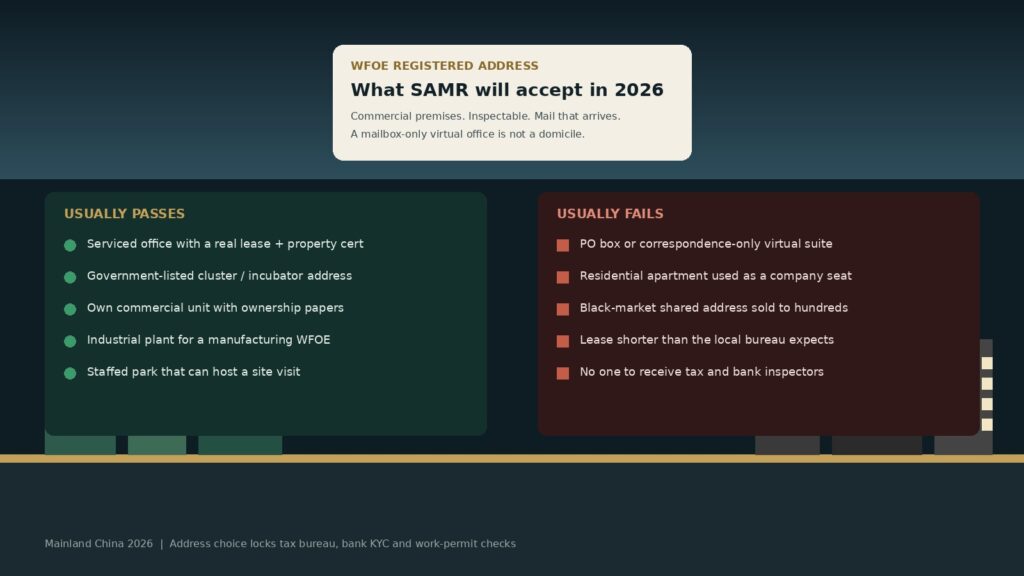
A China WFOE cannot be licensed without a registered domicile. That address appears on the business licence, sets which SAMR office and tax bureau supervise the company, and is the place banks and inspectors expect to find when they knock. A cheap mailbox sold as a “virtual office” is the most common reason a 2026 filing stalls after the name check.
This guide separates what a registered address actually is from marketing language, what documents SAMR still asks for, where cluster or incubator seats work, and which virtual-office setups put the licence, bank account and work permits at risk.

What a Registered Address Is Under Current Rules
Under the PRC Company Law every company must maintain a domicile. For a wholly foreign-owned enterprise that domicile is a commercial premises the local Administration for Market Regulation can verify. Proof is usually a lease plus the landlord’s property-ownership certificate, or an equivalent use-right document issued by a government-listed park.
The 2025 Company Registration Measures (SAMR Order No. 95, in force from 10 February 2025) tightened two points that still govern filings in 2026. The address must be verifiable. Intermediaries who submit false address papers share liability with the applicant. Spot checks against empty-shell companies, already common after 2023–2024 enforcement rounds, continue.
Residential flats, hotel rooms without a qualifying commercial licence, post-office boxes and correspondence-only “virtual suites” are not a domicile. Some cities allow limited home registration for tightly defined individual businesses. That exception almost never covers a foreign-invested LLC.
Address Types That Usually Pass
| Address type | Typical proof | Fits which WFOE | Main caveat |
|---|---|---|---|
| Leased commercial office | Lease plus property certificate; some districts want a filed lease | Consulting, trading, most service companies | Many bureaus want at least 12 months remaining on the lease |
| Owned commercial unit | Ownership certificate in the WFOE or shareholder name | Any, if zoning matches the scope | Changing later still needs a full SAMR amendment |
| Government-listed cluster or incubator | Hosting agreement plus the park’s cluster-registration filing | Light service or holding entities in cities that run the programme | Must be on the local approved list, not a private shared desk |
| Serviced office in a Grade A building | Operator lease or sub-lease that the bureau accepts | Companies that also need a bank site visit or work permits | Confirm the operator can issue papers in the WFOE’s Chinese name |
| Industrial plant | Industrial lease, zoning papers, often an EIA | Manufacturing WFOEs | Office parks do not replace a factory site |
Cluster registration (集中登记地) is the only form of “virtual office” that many Shanghai and Shenzhen districts still accept for a WFOE. The park, not the tenant, holds the pre-approval with the local AMR. Beijing districts are tighter. Several still want evidence of actual workspace even inside a park.
A serviced office is not the same product as a mailbox. If staff can sit there, mail is received, and the landlord can produce ownership papers, banks and visa offices treat it as a real seat. If the product is only a prestigious street line and a scanning app, treat it as correspondence, not a registered address.
Virtual Office Risk in Practice
Foreign founders usually meet the problem in one of four places, not at the first name-reservation screen.
- SAMR rejects the address pack because the property is residential, already overloaded, or missing from the cluster list.
- The licence issues, then the tax bureau visits and finds no one to receive notices. The company lands on the operating-anomaly list (经营异常名录). Banks freeze online banking. Fapiao quota applications stall.
- The corporate bank sends a clerk to photograph a nameplate. A shared cubicle with twenty other licences on the door is a common refusal point.
- Work-permit or residence-permit officers require an inspectable office. A cluster seat that cannot show a desk for the applicant fails that check even if SAMR accepted it months earlier.
Cheap addresses sold online often reuse one suite number for hundreds of companies. Periodic AMR sweeps blacklist those buildings. A WFOE sitting on a blacklisted address can lose the licence. The legal representative can be restricted from holding that role again for a period set by the local bureau.
Registered address and operating address can differ in many cities if the split is disclosed where local rules require it. The split is a poor idea for food, medical devices, warehousing, manufacturing, offline retail and export-tax-refund businesses, because those files trigger on-site inspections. Trading companies that later apply for a higher VAT invoice quota are often asked to explain where goods actually move.
City Patterns, Not a National Template
Policy is district-level. Confirm the current list with the bureau that will issue the licence, not with a national brochure.
- Shanghai. Several districts still accept approved incubator and serviced-office seats for service WFOEs. Pudong and some FTZ parks publish hosting providers. A mailbox in Lujiazui with no inspectable room does not qualify.
- Shenzhen and other Greater Bay cities. Qianhai-style business-secretary addresses are visible on many licences. They are cluster products, not private virtual offices. Parks outside the approved list are treated as ordinary leases and must stand on their own papers.
- Beijing. Many districts still prefer a dedicated commercial suite. High-tech parks and selected pilots are the usual exceptions, not Chaoyang apartments.
- Second-tier cities. Some industrial parks sell inexpensive hosting. Check whether the same address will survive a later bank KYC or a move of the tax file. Changing city or even district is a new filing, not a sticker on the licence.
Lease length, whether the landlord must accompany the clerk, and whether a foreign legal representative must appear in person for the address check all vary. Build those points into the setup calendar next to apostille timing.
Documents to Collect Before Name Approval
Most bureaus want the address pack before or with the licence application. A typical 2026 file includes:
- Lease or address-use agreement in the proposed Chinese company name or a clause that assigns the lease to the WFOE on incorporation.
- Property-ownership certificate or the park’s collective certificate.
- Landlord business licence if the lessor is a company.
- Cluster-registration filing certificate when the seat is a listed incubator.
- Floor plan or unit number that matches the licence text exactly.
Ask for a clause that voids the lease if SAMR rejects the WFOE. That avoids paying rent on a room you cannot use. Manufacturing sites need zoning and environmental papers in the same window, not after the licence.
Address work sits with name approval, capital and scope in the same pre-filing block as WFOE registration and a China corporate bank account. Changing the address later means a SAMR amendment, tax-file move, bank-specimen update and often a new site visit.
How to Choose Without Overpaying
Match the seat to the next twelve months, not to a skyline photo.
- Holding or light consulting with no staff in China: a listed cluster or a small serviced office in a bureau that still accepts hosting.
- Team on the ground, work permits, or frequent bank and tax visits: a real suite with a nameplate and a person who can open the door.
- Trading with export refunds or warehousing: keep registered and operating addresses aligned and commercially zoned.
- Factory: industrial land first. An office cluster does not carry an EIA.
Annual hosting for an approved cluster seat commonly sits well below a central Grade A lease. Published ranges for address products in 2026 often fall between about USD 1,000 and USD 6,000 a year depending on city and whether a desk is included. Treat those figures as market observations, not a quote. The cost of a rejected address is a second round of apostille, translation and idle months, not the monthly fee.
FAQ
Can a WFOE use a virtual office as its registered address in 2026?
Only if the product is a government-listed cluster or an inspectable serviced office that the local AMR accepts. A correspondence mailbox is not enough.
Can the registered address differ from where people actually work?
Often yes for ordinary service companies, if local disclosure rules are followed. Banks, tax officers and visa offices can still demand the operating site. Regulated scopes should keep the two aligned.
Will a bank open an account at a cluster address?
Some will if the park is known to that branch and a clerk can complete a site photo. Many will not. Confirm the branch before you lock the lease.
How hard is an address change?
Inside the same district it is an amendment. Across districts or cities it is closer to a relocation filing. Tax, bank, customs and social-insurance records all move with it.
What happens if mail or inspectors find an empty room?
The company can be listed as operating abnormally. Invoice rights, bidding and bank services suffer until the address is cured and the listing is removed.
Next Step
Pick the city and the WFOE type first, then test the address with the same bureau and bank you intend to use. If you need a licence plus a bankable seat without travelling for the first filing, use the remote setup path on Register Company China and send the proposed district, scope and whether work permits are in the first-year plan.