
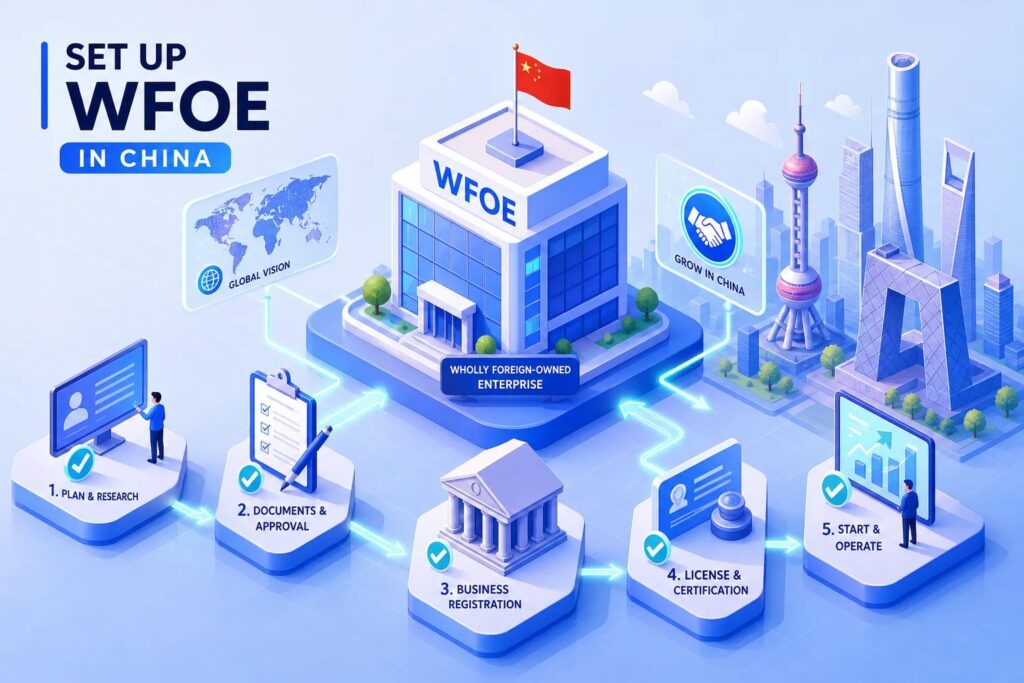
How do I set up a wholly foreign-owned enterprise in China? It’s one of the most common questions foreign investors ask, and for good reason. A wholly foreign-owned enterprise (WFOE) gives you 100% ownership, full operational control, and the legal standing to generate revenue in China without a local partner. As a type of foreign-invested enterprise (FIE) in China, the WFOE is the preferred structure for founders who want to keep decision-making entirely in their own hands. But the registration process has more moving parts than most guides admit: entity selection, document preparation, registered capital decisions, sector-specific approvals, and a bank onboarding process that can run longer than the registration itself.
This article resolves every question you need answered before you can move forward with confidence. It covers whether a WFOE is the right fit for your situation, what documents you need and how to prepare them, registered capital rules under the updated 2024 Company Law, the step-by-step filing sequence with realistic timelines, which authorities and permits apply to your sector, what the actual costs look like in 2026, and what compliance obligations kick in after you receive the business license. Working with a specialist like Register Company China, founders based overseas can handle the core WFOE formation steps remotely, without ever boarding a flight to China.
Is a WFOE actually the right entity for your situation?
Before you prepare a single document, confirm the entity type is correct for your goals. A WFOE lets the foreign investor own 100% of the China entity, sign contracts directly, issue fapiao, hire staff on the payroll, and repatriate profits through proper channels. A Representative Office, by contrast, can only do liaison work: it cannot generate revenue, invoice clients, or sign commercial contracts. A Joint Venture requires a Chinese partner and comes with shared governance, which adds complexity and negotiation cost that most early-stage founders don’t need.
For most foreign investors who want to manufacture, sell, consult, or source in China, the WFOE is the correct structure. A JV makes sense when your target sector sits on the Foreign Investment Negative List and still permits partial foreign ownership, or when a local partner provides a material commercial advantage that genuinely changes the business model, for example, when regulatory access, distribution networks, or licensed technology are tied to the partner relationship.
The business scope on your license matters just as much as the entity type. A consulting WFOE cannot legally engage in trading or manufacturing. A trading WFOE needs a separate import/export registration code after the license is issued. Get the scope right before you file, because changing it after registration is possible but costs time and money.
What documents and registered capital you need before filing
For a corporate shareholder, the core document set includes the certificate of incorporation, articles of association, a board resolution authorizing the China entity, and sometimes a bank reference letter. For an individual investor, a notarized passport copy is the starting point. All overseas-issued documents must be notarized in the home country and then legalized at the Chinese embassy or consulate, or apostilled where the home country’s apostille framework applies. Certified Chinese translations are required for all foreign documents submitted to Chinese authorities.
Management appointments also require their own paperwork. The legal representative, director, and supervisor each need identity documents and appointment resolutions. A signed lease agreement and property ownership certificate are required to confirm your registered address, per local Market Regulation Bureau standards. Document preparation typically takes one to four weeks and is consistently the first real bottleneck in the process, particularly when notarization queues or embassy appointments cause delays.
Registered capital rules under the 2024 Company Law
Registered capital has no universal statutory minimum for most WFOEs, but the amount must be credible for the business model. In practice, consulting and service WFOEs typically register between RMB 100,000 and 500,000; trading WFOEs between RMB 500,000 and 1,500,000; light manufacturing between RMB 1,000,000 and 3,000,000. Regulated sectors carry hard statutory minimums: labor dispatch requires RMB 2,000,000, and financial leasing can require significantly more.
Under the 2024 Company Law, in effect since November 1, 2024 and still governing WFOE formation in 2026, the full subscribed registered capital must be paid into the company within five years of incorporation. This replaced the older convention many guides still reference, where a partial initial contribution was common. Build this five-year commitment into your cash flow planning from day one, because the timeline is now embedded in your articles of association.
How do I set up a wholly foreign-owned enterprise in China: the step-by-step process
The core filing sequence follows eight practical stages:
- Confirm the structure. Lock in the investor structure, business scope, and registered capital amount before any paperwork is prepared.
- Prepare and authenticate documents. Apostille or notarize all foreign-issued documents; arrange certified Chinese translations.
- Reserve the company name with SAMR. The standard approved format is City + Brand + Industry + Co., Ltd. Pre-approval takes one to ten working days depending on the city.
- Secure a registered address. The address must meet local Market Regulation Bureau requirements and be supported by a verified lease or ownership certificate.
- Draft the Articles of Association and related materials. This includes the business scope statement and all executive appointment documents.
- File the incorporation package. Submit the full file to the local Market Regulation Bureau to obtain the business license, typically three to ten working days once the complete package is received.
- Carve the company chops. The legal representative chop, company seal, and finance chop are all required. Chop carving takes one to five working days.
- Complete post-registration filings. Tax registration, SAFE and foreign exchange registration, and social insurance setup each need to be finalized, budget one to two weeks for this stage.
Bank account opening follows registration and is consistently the slowest single step. The bank reviews the business license, chops, lease, articles of association, and KYC materials, then conducts a site visit to verify your registered office. The legal representative typically attends an in-person interview. A basic RMB account takes two to six weeks in a straightforward case; add another one to two weeks for the foreign-currency capital account and SAFE linkage.
Realistic timelines for WFOE formation in 2026
When planning your schedule, use these benchmarks as your baseline:
- Document prep and apostille: one to four weeks
- Name pre-approval: one to ten working days
- Business license issuance: three to ten working days after full file submission
- Chop carving: one to five working days
- Tax, SAFE, and social insurance setup: one to two weeks
- Bank account opening: two to eight weeks
End-to-end, from document preparation through bank onboarding, plan for two to four months. A straightforward service WFOE in Shanghai or Shenzhen can come in closer to eight to twelve weeks when documents are clean and the registered address is verified quickly.
Which authorities approve your WFOE and when do you need special permits?
For most WFOEs outside restricted sectors, SAMR handles name approval and business license issuance. MOFCOM involvement has been reduced to a foreign investment information report for most cases since the Foreign Investment Law replaced the old pre-approval regime. NDRC approvals apply to regulated investment projects, not to ordinary service or consulting entity formation. The practical sequence is: check the sector, complete any required project filings, register with SAMR, and complete post-registration filings.
Special permits and industry licenses apply based on what your WFOE will actually do. Trading and manufacturing WFOEs need Customs registration and an import/export code after the business license is issued. Telecom-related businesses require MIIT approval. Food, pharma, and medical device companies face their own sector regulators. Manufacturing projects that trigger environmental review need an Environmental Impact Assessment before construction begins. Polluting operations may also need a Pollutant Discharge Permit. Each of these permits is applied for after the business license is in hand, but your timeline planning must account for them: each can add two to six weeks or more.
Before drafting your business scope, check the current Foreign Investment Negative List. The 2024 edition, in effect since November 1, 2024 and still operative in 2026, contains 29 restricted or prohibited sectors concentrated in telecom, internet and media, education, healthcare, transport, natural resources, tobacco, and certain cultural content activities. Restricted sectors may still permit WFOE formation but with added conditions. Prohibited sectors cannot be wholly foreign-owned at all. This check is not optional: a business scope that conflicts with the Negative List will cause the registration to fail.
What WFOE registration actually costs in 2026
Government registration fees at SAMR are largely nominal in major cities, often RMB 0 to 1,000 for the core filing. The actual setup cost is driven by third-party expenses. Budget for the following:
- Professional agent or formation service fees: RMB 15,000 to 80,000 for full-service packages, depending on complexity and provider.
- Registered address or virtual office: RMB 6,000 to 40,000 per year, with city and district driving significant variation.
- Notarization, legalization, and translation: RMB 3,000 to 20,000 depending on your home jurisdiction and document volume.
- Company chop carving: RMB 500 to 1,500, a one-time cost.
- Bank account setup assistance: RMB 500 to 5,000, sometimes included in service packages.
Registered capital is a company funding commitment deposited into the business bank account, not a government fee. A lean consulting WFOE in a major city can come in around RMB 20,000 to 60,000 in third-party costs excluding registered capital, when documents are straightforward and the address is simple. A more typical full-service setup in Shanghai ranges from RMB 60,000 to 150,000. Trading and manufacturing WFOEs should budget more: import/export licensing, customs registration, and environmental compliance work add meaningful cost that consulting WFOEs don’t face.
Post-registration compliance and running your WFOE from overseas
Receiving the business license is step one. Running the company compliantly is what every month after demands. A WFOE must file monthly or quarterly tax returns, issue fapiao through the tax bureau system, maintain bookkeeping under Chinese accounting standards, submit an annual report through the SAMR national credit information system by June 30 each year, and complete the annual corporate income tax reconciliation by May 31. Missing these obligations triggers fines, credit record penalties, and in serious cases, license suspension.
Most WFOEs also need a statutory annual audit completed by a PRC-licensed CPA firm before the CIT filing deadline, plus ongoing social insurance contributions, individual income tax withholding for local employees, and SAFE-related annual reporting if capital accounts are active. The compliance calendar is not complicated, but it requires a local presence to execute: someone must manage the chops, attend to tax bureau correspondence, and submit filings through Chinese government systems.
This is precisely where overseas founders hit a wall. Managing a China entity remotely requires a trusted local partner for chop custody, tax filings, and regulatory correspondence. Specialists like Register Company China operate on this model, fully remote for the formation steps, fixed-price, and continuing into ongoing accounting, tax filing, annual report management, and chop custody after the license is issued. For investors who want a legal, compliant China entity without building a local administrative team from scratch, this kind of specialist partnership is usually the most practical path forward.
Ready to move forward?
Setting up a wholly foreign-owned enterprise in China is the right structure for most foreign investors who want full operational control. The registration sequence runs two to four months end-to-end when properly planned, registered capital must reflect your actual business model and be fully paid within five years under the 2024 Company Law, and sector restrictions need to be confirmed before your business scope is drafted. None of this is beyond reach for an overseas founder, provided the process is handled by the right specialist.
If you’re ready to start your wholly foreign-owned enterprise registration without leaving your home country, get in touch with the team at Register Company China. They handle the formation steps remotely, on a fixed-price basis, with a transparent scope and no surprise charges at the end.