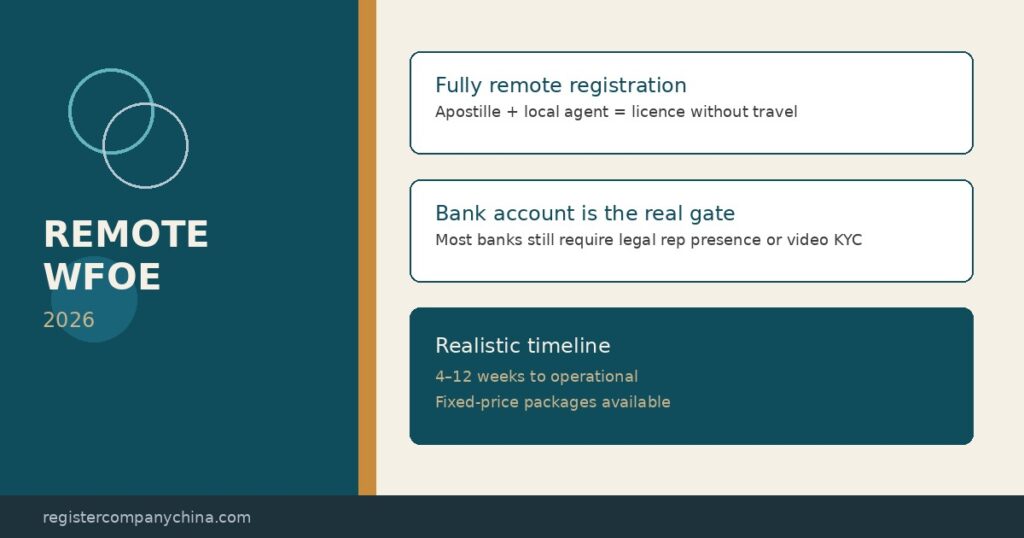
Yes, you can complete most of a China WFOE registration without flying to the mainland in 2026. Name pre-approval, business licence issuance, company chops, tax registration and even capital contribution planning can all be handled through a local agent under power of attorney once your documents are properly apostilled. The step that still trips most foreign founders is the corporate bank account.
This guide focuses on what is actually remote-capable today, where the hard stops remain, realistic timelines and costs, and how to choose a service provider that does not over-promise.
What “Remote WFOE Registration” Really Covers in 2026
Under current SAMR practice and the Apostille Convention (China joined in November 2023), a foreign shareholder can stay outside China for the core company formation sequence:
- Chinese company name reservation
- Business scope drafting and Negative List screening
- Articles of Association and supporting filings
- Business licence issuance (the unified social credit code document)
- Company chop engraving and Public Security Bureau registration
- Tax bureau registration and basic fapiao setup
- SAFE-related foreign-exchange registration preparation
Everything above can be executed by a qualified local agent with a properly executed power of attorney and apostilled shareholder documents. You do not need to appear at the Administration for Market Regulation window.
The practical limit is the bank. Almost every mainland commercial bank still requires the legal representative (or in some cases a designated finance person) to complete KYC in person or via a tightly controlled video process. Until the basic RMB account and capital account are open, the company cannot receive registered capital, pay salaries or issue invoices in a usable way. That single step turns a “fully remote” claim into a partial one.
Documents You Must Prepare Before Any Filing
Remote registration adds an authentication layer that in-person filings can sometimes skip. For individual shareholders the core pack is:
- Passport copy (notarised then apostilled)
- Proof of residential address
- Signed power of attorney for the China agent
- Appointment letters for legal representative, director/supervisor and general manager
For corporate shareholders add:
- Certificate of incorporation / good standing
- Register of directors and members
- Board resolution authorising the China investment
- UBO chart through to natural persons
All foreign-sourced documents must carry an apostille from a Hague Convention authority (or the older notarisation-plus-consular legalisation route if your country is not a party). Starting this chain late is the most common reason remote projects slip by three to six weeks.
Registered address documentation (lease or approved cluster/hosting agreement) is also required before the licence can issue. A pure residential address or unregistered co-working desk will be rejected.
Realistic Timeline When Everything Is Done Remotely
Once apostilled documents and a compliant address are in hand, a clean service or light trading WFOE typically follows this sequence:
- Name pre-approval: 1–5 working days
- Licence filing and issuance: 5–15 working days (city-dependent)
- Chops, tax registration, social insurance unit file: 1–2 weeks
- Bank account opening: 2–8 weeks (the variable that dominates the calendar)
End-to-end from first document request to a usable bank account usually lands between 6 and 14 weeks for straightforward cases. Manufacturing, food, education or other licensed scopes add extra pre-approvals and can stretch beyond that. Cities such as Shanghai and Shenzhen generally move faster on standard files than many inland jurisdictions.
Cost Range for a Remote Setup in 2026
Government fees themselves are minimal. The real numbers sit in professional services, address, authentication and first-year compliance:
- Professional / agent fees (name through licence + chops + tax file): typically USD 2,500–8,000 for a standard service WFOE; higher when trading rights, customs or sector licences are required
- Apostille, notarisation and certified translation: USD 300–1,500 depending on number of documents and jurisdiction
- Registered address (cluster or serviced): RMB 6,000–15,000 per year in tier-one cities
- Bank account support and related coordination: often included in full packages, sometimes charged separately
- First-year bookkeeping and tax filing: RMB 2,000–6,000+ for a low-activity entity
All-in first-year cash outlay for a simple consulting WFOE commonly falls in the USD 5,000–15,000 range before any registered capital injection. Transparent fixed-price packages that clearly state what is included (and what is not) reduce the risk of later invoices.
How to Choose a Remote Registration Service
Many providers advertise “fully remote.” Ask three concrete questions before you sign:
- Exactly which steps require the legal representative’s physical presence or video verification under the banks you actually work with?
- Who holds the company chops after licence issuance and what is the custody arrangement?
- Is the quoted price a fixed package covering name approval through bank account coordination, or does the bank step sit outside the fee?
Also confirm the provider has recent experience with your nationality’s apostille route and with the specific city and district you intend to use. Local practice still varies more than national rules suggest.
Register Company China specialises in remote-first WFOE, JV and Representative Office setups for foreign individuals and overseas companies. The process is managed under fixed-price packages with clear scope, so you know the cost before work begins. Post-registration accounting and annual compliance support are available as a continuation of the same engagement.
If you already have a target city, business scope outline and shareholder structure, the fastest next step is a fixed-price quote that maps the remote path and the remaining in-person requirements for your case.
View our WFOE registration services or request a tailored quote. Related reading: How to Set Up a WFOE, Registered Address Requirements 2026, and WFOE Registration Process 2026.
FAQ
Can I register a WFOE in China without ever visiting?
The business licence and most post-licence filings can be completed remotely. Opening the corporate bank account almost always requires the legal representative (or an accepted substitute) to complete bank KYC in person or by video. Plan for that step.
Do I need a Chinese partner?
No. A WFOE is 100% foreign-owned. The Negative List still restricts or prohibits certain sectors; everything outside the list is open to full foreign ownership.
How long does apostille take?
In most Hague Convention countries, 3–15 working days once the notary step is finished. Start early; it is the most common cause of remote-project delay.
Is a virtual office enough for the registered address?
Only if it is an officially recognised cluster or incubator address accepted by the local SAMR. Ordinary co-working desks or pure mailbox services are frequently rejected and later cause bank and tax problems.
What happens after the licence is issued?
You still need the bank accounts, tax activation, social insurance unit registration (if you will hire), and ongoing monthly/quarterly filings. A clean remote formation only gets you the legal entity; operations require the banking and compliance layer.