A China business licence does not let a WFOE issue invoices or file tax. Tax registration, taxpayer status and e-fapiao access have to be switched on after the licence is issued. Until that happens, Chinese customers cannot treat a payment as a deductible purchase, and the company cannot complete a clean VAT or corporate income tax return.
This guide covers what tax registration actually means in 2026, the 30-day deadline, how small-scale and general VAT taxpayer status differ under the VAT Law that took effect on 1 January 2026, how e-fapiao now works, and the filings that start even when revenue is still zero.

What Tax Registration Means After the Business Licence
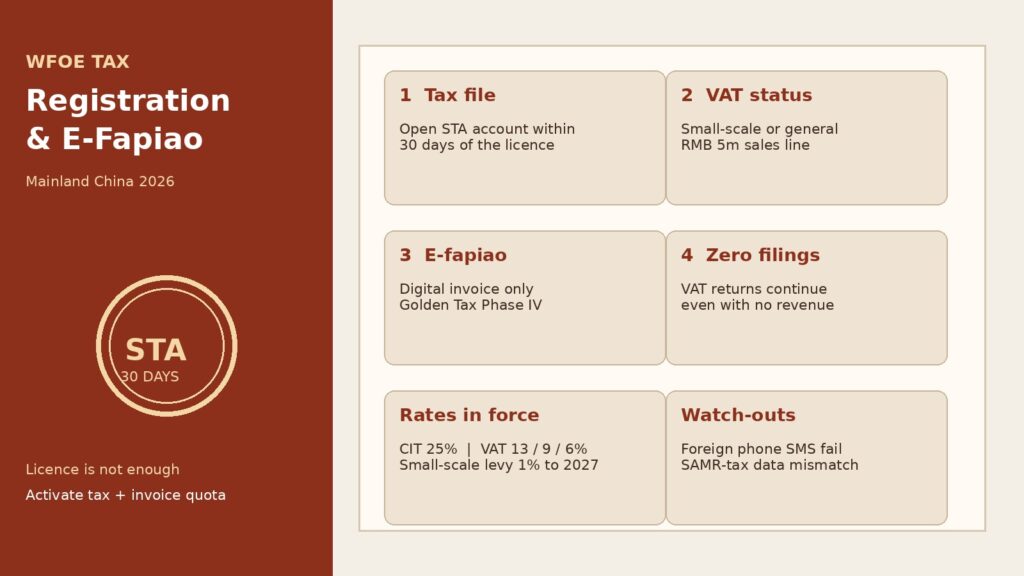
The Unified Social Credit Code on the licence already functions as the taxpayer identification number. That does not finish the job. The company still has to open its file with the State Taxation Administration (STA) through the local tax bureau, activate the electronic tax bureau account, name a finance contact, choose VAT taxpayer status, and enable invoice issuance.
Under the Administration Law on the Collection and Administration of Tax, a newly licensed enterprise should apply within 30 days of receiving the business licence. In practice many cities complete the basic tax file in one visit or through the e-tax portal once the licence data has synced from SAMR. The delay is usually the sync itself, not the form.
Tax registration is separate from corporate bank account opening. Banks and the tax bureau both need the licence and chops, but they do not wait for each other. You can start the tax file while the legal representative is still booking the bank interview.
Small-Scale Taxpayer or General VAT Taxpayer
The VAT Law in force from 1 January 2026 defines a small-scale taxpayer as an enterprise whose annual VAT-taxable sales do not exceed RMB 5 million. Above that line, general-taxpayer registration is mandatory except in narrow non-enterprise cases.
A new WFOE usually starts as a small-scale taxpayer unless it applies early for general status. The commercial choice matters more than the form.
Small-scale taxpayer. VAT is calculated on a simplified levy. A temporary policy in force through 31 December 2027 reduces the payable rate on most taxable sales (other than certain real-estate items) from 3 percent to 1 percent, and monthly sales not exceeding RMB 100,000 (or quarterly sales not exceeding RMB 300,000) can stay below the VAT threshold. Input VAT on purchases cannot be credited. Many first-year service WFOEs stay here because it is simpler and cheaper while revenue is low.
General taxpayer. Output VAT is charged at the statutory rates of 13 percent (most goods), 9 percent (certain transportation, construction and property-related items) or 6 percent (most modern services). Input VAT on qualifying purchases can be credited. Chinese enterprise buyers that want a special VAT fapiao for their own deduction almost always insist on a general-taxpayer supplier. Trading and manufacturing WFOEs that sell to other companies usually apply for general status in the first months, even if they are still under the RMB 5 million line, provided bookkeeping is complete.
STA Announcement No. 2 of 2026 restated how general-taxpayer registration takes effect and abolished the old guidance period management from 1 January 2026. If you expect B2B buyers to demand special fapiao, apply once the books and bank account can support the file. Do not wait until a large contract is already signed.
How E-Fapiao Works in 2026
Fully digital e-fapiao is now the legal invoice format. Paper tax-control disks and the old hardware UKey workflow have been retired in ordinary commercial use. Invoices are issued through the electronic tax bureau or an approved platform, numbered by the STA and matched in near real time under Golden Tax Phase IV.
Two invoice types still matter:
- Special VAT fapiao — the buyer that is a general taxpayer can use it to claim input VAT.
- Ordinary VAT fapiao — sufficient for many B2C sales and for buyers that do not need an input credit.
A small-scale taxpayer can issue ordinary fapiao and, in defined cases, special fapiao through the STA platform. The levy rate on those sales does not become 13 or 6 percent just because a special fapiao was issued.
Invoice quotas start low. A brand-new company often receives a modest monthly cap until the tax bureau sees consistent filings and matching bank receipts. Asking for a large quota in month one without contracts or capital in the account is a common reason the quota stays frozen.
The invoice chop still exists and is used on some paper confirmations, but the legal invoice is the electronic record. Buyers verify it in the STA system, not by staring at a red stamp.
Documents and Access You Need on Day One
Local checklists vary, but the working set is short:
- Business licence (paper and electronic) and company chop
- Legal representative passport and contact details
- Finance supervisor or authorised tax filer identity
- Registered address consistent with SAMR data, including a six-digit postcode
- Bank account details once the basic RMB account exists, for tax withholding links
- A Chinese mobile number and a working electronic tax bureau login
Foreign legal representatives often cannot receive the STA SMS codes on an overseas number. A local finance agent or a China-resident director with a mainland number is the usual workaround. Mismatched employee-count or address fields between SAMR and the tax system also block online changes; those fields have to be corrected at the source registry first.
Filings That Start Before the First Sale
Zero revenue does not mean zero filings. A WFOE that misses consecutive VAT zero-declarations can be marked tax-abnormal. That status blocks new fapiao, some registration changes and, in worse cases, a clean deregistration later.
Typical cadence after the tax file is live:
- VAT return monthly or quarterly, including a zero return when there were no taxable sales
- Corporate income tax prepayments on the same cycle; annual reconciliation by 31 May for the previous calendar year
- Individual income tax withholding once staff are on payroll
- Surcharges that follow VAT in most cities (education surcharge and local levies)
- Annual report to SAMR and the foreign-investment information report
Corporate income tax remains 25 percent for a standard resident enterprise. Preferential 15 percent rates exist for qualifying High-and-New Technology Enterprises and for certain encouraged activities in places such as Hainan Free Trade Port and selected FTZ programmes. Those rates are not automatic at incorporation; they need a separate qualification file.
Bookkeeping should follow a Chinese chart of accounts from the first bank movement. Capital injection, rent, agency fees and the first supplier invoices all need evidence that will survive the annual CIT settlement.
Problems That Delay Fapiao and Tax Status
Founders and local accountants keep hitting the same blocks. The licence is issued but SAMR data has not reached the tax bureau, so the e-tax account will not open. The registered address on the tax screen still shows a blank postcode or a staff count of zero. The legal representative cannot pass identity verification because the only phone on file is foreign. A buyer asks for a special fapiao while the company is still small-scale and has not applied for general status. Three zero VAT filings are skipped because we have not started trading.
Golden Tax Phase IV compares invoice data with bank flows and customs records. Issuing fapiao that do not match contracts, or buying fapiao to inflate costs, is now easier for the bureau to flag and harder to unwind at deregistration.
What to Do Next
Treat tax registration as part of China company setup, not an afterthought once the first customer appears. Activate the e-tax account inside the 30-day window, decide taxpayer status against the buyers you actually have, and put a bookkeeper on the monthly calendar before capital arrives.
If you need the licence, address, bank file and tax account handled as one package, the remote process on the services page covers registration plus ongoing accounting and tax filing.
FAQ
How long does China WFOE tax registration take in 2026?
The statutory window is 30 days from the business licence. Once SAMR data has synced, many local bureaus finish the basic tax file in one to five working days. E-fapiao quota and general-taxpayer approval can take longer.
Can a new WFOE issue fapiao immediately?
Only after the tax account is active and an invoice quota exists. A licence alone is not enough. Quotas for a new company are often small until filings and bank activity look consistent.
Should a service WFOE apply for general taxpayer status at once?
Only if Chinese enterprise customers need special VAT fapiao to claim input tax. Otherwise small-scale status is usually cheaper in year one while annual sales stay under RMB 5 million and the temporary 1 percent levy still applies through 2027.
Does a WFOE with no revenue still file tax returns?
Yes. VAT zero-declarations and CIT prepayments still run. Repeated missed filings can put the company into tax-abnormal status and stop fapiao issuance.
Is the tax identification number different from the business licence number?
No. The 18-digit Unified Social Credit Code is the taxpayer number. Separate tax certificates from the old five-certificate era are no longer issued as standalone IDs.