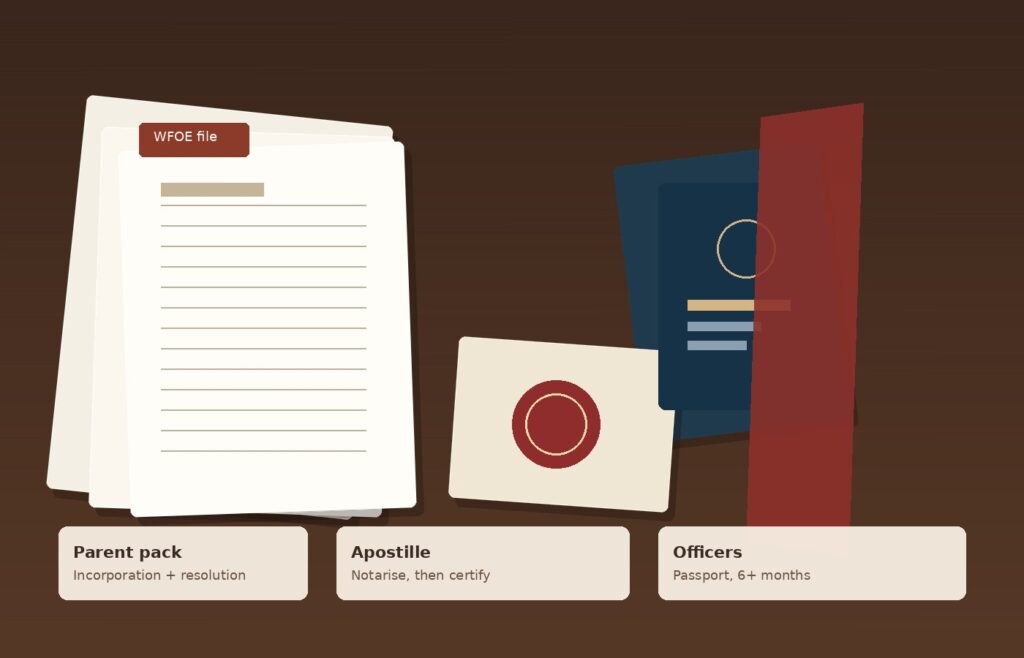
A standard wholly foreign-owned enterprise filing needs three document groups: an authenticated shareholder pack from the home country, identity papers for the people named on the licence, and a China-side address and articles package. The market regulator does not accept a foreign certificate of incorporation on its own. Since 7 November 2023, investors from Hague Apostille Convention countries authenticate that pack with a notary and an apostille. Investors from non-member countries still need consular legalisation. The whole filing can be handled remotely. The step that usually sets the calendar is document work in the shareholder’s own country, not the licence counter in China.
Register Company China prepares the China-side forms, coordinates certified translation, and files with the local Administration for Market Regulation under a fixed-price package, so the foreign investor does not travel for the licence. If you already know the city, shareholder type, and business scope, request a fixed-price quote and we will return a file-specific document list rather than a generic checklist.
What the regulator actually wants
Local practice varies by city and district, and a bank will later ask for more than the licence file. As of 2026, a clean service or trading WFOE application still clusters around the same items.
Corporate shareholder
- Certificate of incorporation, or a commercial register extract. Many districts expect it to be recent, often issued within three to six months of filing. Confirm the window before you pay for the apostille.
- Certificate of good standing or incumbency, where the home registry issues one.
- Articles, bylaws, or equivalent constitutional documents, if that city asks for them.
- Board or shareholder resolution authorising the investment, naming the city, and appointing the legal representative, director, and supervisor.
- Passport of the authorised signatory, with more than six months of validity remaining.
- Register of directors, if the certificate of incorporation does not show current officers.
Individual shareholder
- Passport copy, notarised, with more than six months of validity.
- Proof of address, if the district or the later bank file asks for it.
People named on the WFOE
- Passport copies for the legal representative, each director, and the supervisor.
- Contact details, and in some districts a short proof of address.
Police clearance is a common rumour. For a standard corporate WFOE licence it is often not required. It can appear later for a work permit or for a bank that is uncomfortable with the file. Do not start an FBI or national police certificate unless the city or the bank has actually asked for it.
China-side papers are not apostilled abroad
These are prepared in China and do not go through a foreign notary:
- Chinese company name pre-approval.
- Articles of association, including the capital contribution schedule. Under the current Company Law, subscribed capital is generally due within five years of establishment.
- Registered address proof: a commercial lease and the landlord’s property ownership certificate. A residential lease is a frequent rejection.
- Appointment letters matching the resolution.
Business scope wording belongs in this pack. A scope that is too narrow blocks later contracts. A scope that drifts into a restricted activity triggers a different approval path. The WFOE setup guide covers how scope, capital, and officer choices fit together before you notarize anything.
Apostille, consular legalisation, or Hong Kong attestation
Mainland China has applied the Hague Apostille Convention since 7 November 2023. Canada has applied it since 11 January 2024. For a shareholder in a member country, the usual chain is notarisation in the place of issue, then an apostille from the competent authority in that place. Consular legalisation at a Chinese embassy is no longer the route for those documents.
| Shareholder documents issued in | Route that Chinese authorities expect |
|---|---|
| Apostille member, including the United States, the United Kingdom, most of the EU, Australia, and Canada | Notarisation, then apostille. No Chinese consular legalisation. |
| Non-member country | Notarisation, foreign-ministry authentication, then legalisation by the Chinese embassy or consulate. |
| Hong Kong | Attestation by a China-Appointed Attesting Officer. A foreign apostille is not the substitute. |
An apostille confirms the notary or official signature. It does not confirm that the resolution says the right things. Vague resolutions are a leading content rejection: the text should authorise this investment, this city, the officer appointments, and signing of the articles. Multi-layer groups are often asked for the direct shareholder only, and sometimes for one tier above if ownership is not obvious.
Have the certified Chinese translation done after authentication, normally in China. A translation prepared before the apostille is a common reason a file is sent back.
What delays the file
Home-country work often takes two to four weeks. State or provincial apostille queues can run longer, and that clock sits outside anyone in China. US investors commonly spend a few hundred dollars on notarisation and apostille for a standard pack. Exact fees depend on the state and how many originals the district wants.
Other repeat failures:
- Good-standing certificate older than the district’s window by the time it reaches China.
- Apostille placed on a photocopy the notary did not properly certify.
- Passport inside the six-month validity line.
- Embassy legalisation used when an apostille was the correct route, or the reverse.
- Bank KYC mixed into the licence checklist. Banks often want a reference letter, a funds narrative, and a beneficial-ownership chart. A private-equity cap table has stalled otherwise clean files for months. Treat the bank pack as a second list, not as a substitute for the SAMR list.
The licence itself is often issued within a few weeks of a complete filing. End to end, including apostille work and a corporate account, most service or trading files land in the 8 to 16 week range. The WFOE registration process breaks that sequence into the licence phase and the banking phase so the two are not quoted as one week.
Remote filing is normal
You do not need to be in China to sign or file a standard WFOE. Originals or properly certified copies are couriered. The legal representative does not have to sit at the market regulator for a routine licence. Banks are stricter: some still want a video interview or a visit, and that is a separate decision from whether the documents were accepted.
A useful agent sends the exact list for your city and shareholder type before you book the notary, drafts the resolution so it matches the articles, and does not sell embassy legalisation to an Apostille-country client. Compare that with how the firm prices the China filing. Why clients use a fixed package is the practical test: one scope for name approval, articles, SAMR filing, chops, and address coordination, with post-licence accounting available if you want the first year handled as well. Service scope is listed on the registration services page.
Questions investors ask before they notarise
Can the document pack be completed without travelling?
Yes for a standard file. Notarisation happens where the documents are issued. Filing in China is handled remotely. Travel becomes relevant only if a chosen bank insists on an in-person legal-representative meeting.
How should I choose a registration agent?
Ask for the city-specific list, who drafts the resolution, whether translation is included, and what happens if the district requests one extra page. A fixed price that already covers a normal extra request is more useful than a low filing fee that re-quotes every bounce. Avoid firms that still describe consular legalisation as mandatory for US or EU documents.
What causes the longest delays?
A stale certificate, a resolution that does not appoint the officers, an apostille on the wrong copy, and bank ownership questions after the licence. Starting the home-country pack before the Chinese name is approved is usually safe if the resolution leaves the final Chinese name to be inserted once pre-approval lands, but only if your notary and the district will accept that wording. When in doubt, lock the name first.
Do representative offices use the same pack?
No. A representative office is not a limited company and cannot invoice in its own name. The parent documents overlap, but the filing and the bank path do not. If the goal is to contract and get paid in China, the WFOE list above is the relevant one.
What to send for a file-specific list
Send the shareholder’s country, whether the investor is a company or an individual, the intended city, and a one-line description of the activity. That is enough to separate an apostille pack from a legalisation pack and to flag address or scope issues before anyone pays a notary.
Get a fixed-price quote for your WFOE setup. The quote includes the document list for your file, the China-side filing, and the point at which bank KYC starts.