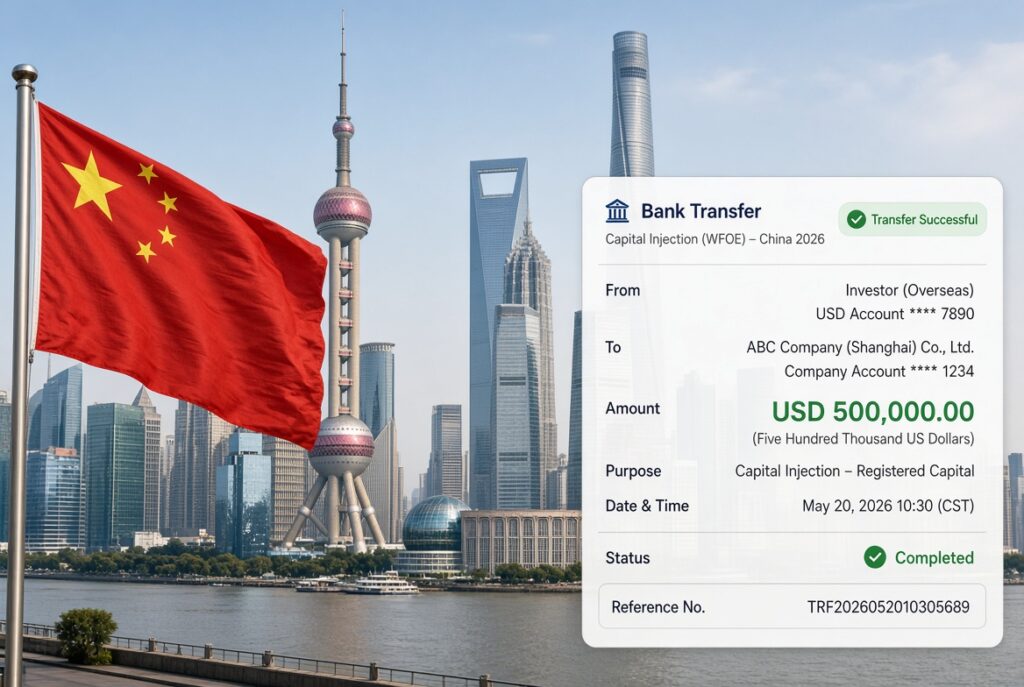
Injecting Registered Capital into a Chinese WFOE

Foreign founders inject registered capital into a Chinese WFOE by transferring funds from the overseas shareholder’s own bank account directly into the WFOE’s foreign-currency capital account at a Chinese bank after the business licence is issued and SAFE registration is completed through that bank. The full subscribed amount must be paid in within five years of incorporation under the 2024 Company Law, and the money can then be converted to RMB and used only for genuine business activities within the company’s scope.
Step-by-Step Process in 2026
- Open the capital account. After receiving the business licence, the WFOE opens an RMB basic deposit account for daily operations and a separate foreign-currency capital account. The bank handles the foreign direct investment registration with SAFE on the company’s behalf. No separate preliminary expense registration is required under SAFE Hui Fa [2025] No. 43 for qualifying pre-establishment remittances.
- Prepare and remit the funds. The foreign shareholder transfers the capital from its own overseas account. Banks require clear documentation of the source of funds, the shareholder’s identity, and matching of the remitter to the registered investor. Mismatched senders commonly cause delays.
- Convert and use the capital. Funds sit in the capital account until converted to RMB. Conversion is permitted for authentic, self-use business expenditures inside the registered scope. Under the updated negative list, capital and its RMB proceeds cannot be used for prohibited activities, securities investment (except limited low-risk products), or lending to non-affiliates.
- Meet the five-year deadline and public disclosure. Shareholders must fully pay the subscribed capital within five years according to the schedule in the articles of association. Paid-in capital is disclosed publicly. Companies incorporated before 1 July 2024 have a transition window that ultimately requires full payment by 30 June 2032.
Key Practical Points for Foreign Founders
- There is no general statutory minimum registered capital for most sectors. Choose an amount the parent can realistically fund within five years; excessively low figures can signal weak substance to banks and partners, while high figures create a hard legal obligation.
- Each injection is recorded. Capital verification reports are no longer universally required for every payment, but banks and SAFE track cumulative contributions.
- SAFE Hui Fa [2025] No. 43 also removed registration requirements for domestic reinvestment of capital or converted RMB and allows reinvestment of legitimate foreign-exchange profits, reducing steps for subsequent internal transfers.
- Bank KYC in 2026 includes enhanced beneficial-owner identification. The legal representative often needs to appear in person or via verified video for account opening.
Common Pitfalls
Sending money from a third-party or personal account instead of the registered shareholder’s account is the most frequent cause of rejection. Spending capital outside the business scope or on prohibited uses triggers SAFE inquiries. Missing the five-year payment schedule can expose shareholders to liability under the Company Law and affect the company’s credit standing.
Once the capital account is open and the first transfer is accepted, subsequent injections follow the same path. Keep the articles of association contribution schedule realistic and update the bank and tax authorities after material changes to capital.