Virtual Office vs Compliant Registered Address for China WFOE: Bank and SAMR Rejection Risks in 2026
A pure virtual office address that passes initial SAMR filing can still freeze your bank account, block fapiao, or land the company on the abnormal operations list within months. In 2026 the gap between a cheap “virtual” address and a government-recognised commercial registered address has widened. Banks run tighter KYC, and local market regulators conduct more physical or correspondence checks after the 2025 Company Registration Measures took effect.
If you are setting up a WFOE and want the company usable for trading, hiring, or capital injection, choose an address that both SAMR and the bank will accept. The difference is not theoretical. It is the single most common reason an otherwise complete WFOE stalls after the business licence is issued.
What “Virtual Office” Actually Means in China in 2026
Two things get mixed up. A mailing address is simply where letters arrive. A registered address (住所) is the official domicile on the business licence. SAMR and the tax bureau treat them differently.
Most foreign founders looking for a low-cost solution are offered one of three options:
- Cluster registration (集中登记) or incubator address inside a government-approved park. These can work if the operator holds the proper filing and the lease or use agreement is properly documented.
- Serviced office or hot-desk package that includes a real commercial unit and mail handling.
- Cheap “virtual address” or residential flat repackaged as commercial. These fail physical verification and later bank or tax checks.
The 2025 Company Registration Measures (SAMR Order No. 95, effective February 2025) reinforced that the address must be verifiable and that intermediaries bear responsibility for the accuracy of materials they submit. Local offices have increased spot checks and correspondence verification. An address that cannot be reached or that is already flagged as abnormal gets the company listed on the National Enterprise Credit Information Publicity System. Banks and counterparties see that status immediately.
Why Banks Reject Non-Compliant Addresses Faster Than SAMR Does
SAMR filing is largely documentary. Once the licence is issued, the bank’s KYC is the real filter. Under the customer due diligence rules that took effect on 1 January 2026, banks must verify the purpose of the account and the real operating model. Many branches still require:
- Lease or address-use agreement plus property certificate or equivalent.
- Photos of the premises, nameplate, and business licence on the wall.
- Occasionally a site visit or video confirmation.
A pure virtual or high-density cluster address without actual workspace frequently triggers “abnormal address” or “cannot verify operating premises.” The account is refused or later frozen. Capital cannot be injected, salaries cannot be paid, and fapiao quotas stay locked. Foreign legal representatives already face extra scrutiny; an unverifiable address multiplies the rejection rate.
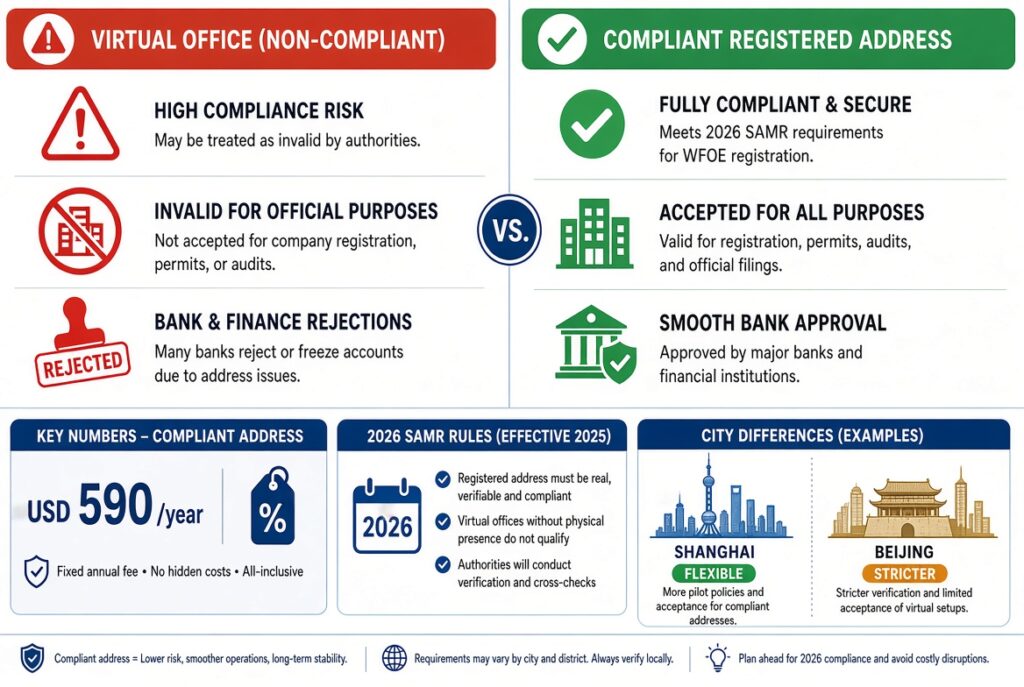
Practical cost range for a compliant commercial or approved cluster address in Shanghai, Shenzhen, Beijing or Guangzhou starts around USD 590–1,500 per year. Dedicated serviced space for work-permit or inspection purposes runs higher. The cheap alternative that saves a few hundred dollars often costs months of delay and a later address change.
City Differences That Matter Right Now
Shanghai remains relatively flexible. Several districts and Free Trade Zone parks accept government-recognised incubator or cluster addresses for service and trading WFOEs, provided the operator is pre-approved and can support mail and basic verification. Lin-gang and certain Qianhai-style arrangements in other cities add local incentives, but the address still needs to survive bank KYC.
Beijing is stricter. Many districts expect a dedicated commercial lease rather than a shared virtual solution, especially for foreign-invested companies. High-tech parks offer limited exceptions.
Shenzhen and Hainan Free Trade Port continue to market cluster and park addresses. Acceptance still depends on the specific operator’s filing status and whether the bank branch has previously accepted that address. Always obtain written confirmation from both the address provider and the intended bank before you file with SAMR.
For regulated scopes (food, medical devices, warehousing, education) or any company that will sponsor a work visa, a real inspectable office is safer in every city. The standard cluster address that works for a light consulting WFOE often fails when the tax bureau or public security bureau visits for the work-permit inspection.
Common Rejection and Failure Points (and How to Avoid Them)
Two patterns appear repeatedly:
- SAMR accepts, bank refuses. The address was sufficient for the licence but fails the bank’s physical or documentation check. Fix: confirm bank acceptance in writing before filing. Have the address provider ready to supply extra photos or a short site visit support letter.
- Address later marked abnormal. Mail is returned, no one answers the registered phone, or a spot check finds no activity. The company is listed on the abnormal operations list. Fapiao and banking freeze. Fix: choose a provider that actively handles mail and can respond to verification letters. Plan a real operating presence or clear explanation of remote operations within the business scope.
Residential addresses are almost never accepted for WFOE registration. Unlicensed virtual packages that cannot produce a property certificate or government filing document are high risk. Changing an address later is possible but requires a new SAMR filing, tax coordination if you cross districts, and a bank update—typically two to six weeks and extra cost.
Decision Table: Virtual vs Compliant Address for a Standard WFOE
| Factor | Cheap / Pure Virtual | Government-Approved Cluster or Serviced Address |
|---|---|---|
| SAMR acceptance (2026) | Often rejected or later flagged | Usually accepted when operator is licensed |
| Bank account opening | High rejection or freeze risk | Higher success when bank pre-cleared |
| Annual cost (tier-1) | USD 200–600 (high failure rate) | USD 590–2,500+ |
| Work visa / inspection support | Rarely sufficient | Possible with dedicated desk option |
| Risk of abnormal operations list | High | Low if mail and verification are handled |
For most foreign founders starting a service or trading WFOE, the compliant address is the faster route to a usable company. The total first-year difference is small compared with the cost of a stalled bank account or a forced address change.
Practical Next Steps
Lock the address before you finalise the Chinese name and articles. Ask any provider for:
- Proof that the address is filed with the local AMR for company registration.
- Sample lease or use agreement and property documents they will supply.
- Written confirmation that the specific bank branch you intend to use has previously accepted their addresses.
- Mail handling process and contact person who will respond to official letters.
We regularly arrange government-recognised commercial addresses in Shanghai, Shenzhen, Beijing and other major cities as part of the full remote WFOE package. The address is chosen so that both SAMR filing and subsequent bank KYC are realistic. If you already have a preferred city or bank, we check acceptance before you commit.
Related reading on the site: WFOE Registration Process in China 2026, China WFOE Setup Cost 2026, and the guide to opening a corporate bank account once the licence is in hand.
FAQ
Can I register a WFOE with a virtual office in China in 2026?
Only if the address is a government-recognised commercial or cluster registration address with proper documentation. Pure virtual or residential addresses are rejected or later create abnormal status.
Does the bank always visit the registered address?
Not always, but many branches request photos or a visit, especially for foreign-owned companies or higher-risk scopes. Pre-clear the address with the bank.
What happens if the address is later marked abnormal?
The company appears on the public abnormal operations list. Fapiao issuance, banking, and contracts are affected until the issue is cleared, usually by changing to a compliant address.
Is a Shanghai Free Trade Zone cluster address safer?
Generally yes for service and trading companies, provided the park operator maintains the filing and can support verification. Still confirm with your intended bank.
The address decision is one of the few that cannot be easily reversed without cost and delay. Get it right before you file.