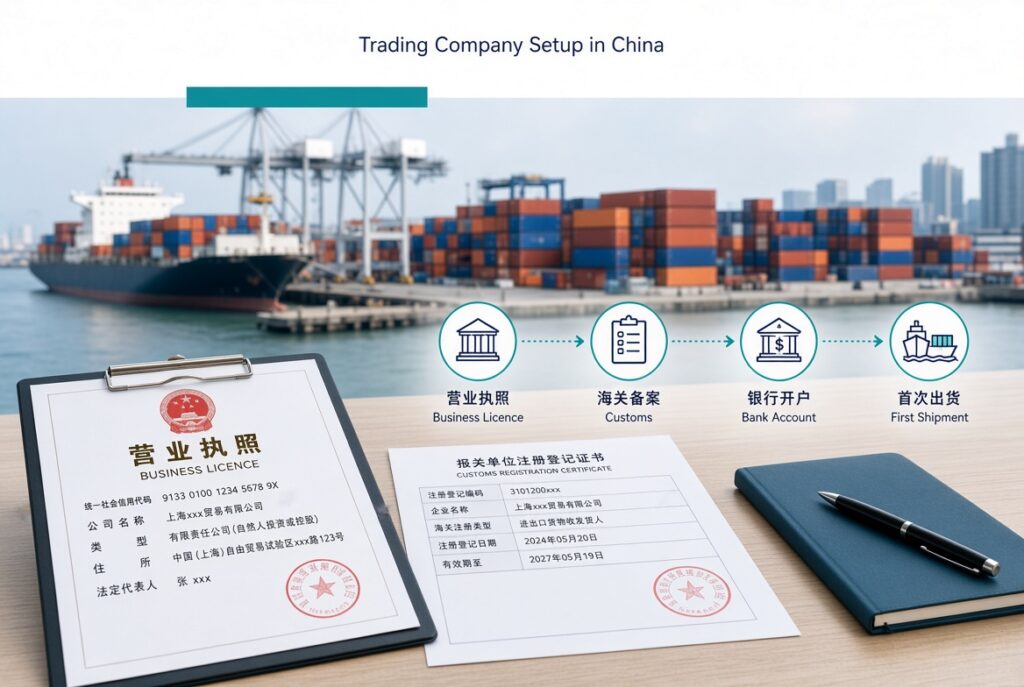
How to Set Up a Trading Company in China as a Foreign Investor
A foreign investor who wants to buy, sell, import or export goods in China normally sets up a wholly foreign-owned enterprise (WFOE) with a trading or commercial business scope. This structure, still often called a foreign-invested commercial enterprise (FICE) in practice, lets the company sign contracts in its own name, issue Chinese tax invoices (fapiao), open RMB and foreign-currency accounts, and clear customs under its own registration code.
As of November 2026, wholesale and retail trading is open to 100 percent foreign ownership in most product categories under the current Foreign Investment Negative List. Restrictions remain only for specific products such as tobacco, certain publications, and online sales of pharmaceuticals or medical devices. The company itself is formed under the Company Law as a limited liability company; the older separate WFOE approval system no longer applies.
Who this structure fits
- Overseas buyers who want their own Chinese entity to pay suppliers in RMB and consolidate shipments.
- Foreign brands that plan to sell into the Chinese market or hold inventory.
- Sourcing and quality-control operations that need to issue fapiao and employ local staff.
- Importers and exporters that prefer to clear customs in their own name rather than rely on a third-party trading house.
A pure consulting or service WFOE can handle many support activities, but it cannot legally trade goods or clear customs without a scope change and the additional registrations described below.
Core requirements before you file
Three decisions shape the rest of the process:
- Business scope wording. The Chinese-language scope must include import and export of goods (and technology if relevant), wholesale, and retail if you intend domestic sales. Product categories should be drafted with enough precision that later customs and tax filings match. A vague scope often forces a later amendment.
- Registered capital. There is no statutory minimum for ordinary trading. Under the Company Law effective 1 July 2024, the amount you subscribe must be paid in within five years. Local market regulators and banks still expect a commercially realistic figure for trading activity—commonly in the range of RMB 500,000 to 1,500,000 or higher depending on expected volume and city. Setting the number too low can trigger questions; setting it unrealistically high creates a future payment obligation.
- Registered address and legal representative. The address must be a genuine commercial premises that both the Administration for Market Regulation (AMR / SAMR) and the bank will accept. The legal representative can be a foreign national. Most cities allow the licence to be obtained without the person travelling to China, but bank account opening almost always requires the legal representative to appear in person for KYC.
Investor documents (passport for an individual, or certificate of incorporation plus good-standing documents for a foreign company) normally need apostille after China joined the Apostille Convention, plus certified Chinese translation.
Step-by-step process that actually works
- Name pre-approval and scope drafting. Submit several Chinese name options to the local AMR. Confirm the exact scope language with your agent before filing.
- Document legalisation and articles of association. Complete apostille work in the home country and prepare the five-year capital contribution schedule inside the articles.
- Business licence issuance. File with the local AMR. Foreign investment information is reported through the same system. The licence contains the unified social credit code.
- Chops and tax registration. Carve the company, finance and legal-representative chops. Activate tax registration and decide whether to apply for general taxpayer status (needed for proper VAT input credits on goods).
- Customs registration. Register with the General Administration of Customs as a consignor/consignee of imported and exported goods. This is done through the China International Trade Single Window (singlewindow.cn) after the business licence and tax registration are live. You receive a customs registration code. The former foreign-trade operator record-filing was abolished and has not been reinstated.
- Electronic port and related activations. Complete e-port / Single Window user setup so declarations can be filed.
- Corporate bank accounts. Open the RMB basic deposit account and the foreign-currency capital account. Trading companies often add a foreign-currency settlement account. This step is the most common delay.
- Foreign-exchange and first capital injection. Complete the necessary SAFE-related bank filings so registered capital can be received. Only then can you pay suppliers or fund operations cleanly.
Customs registration and e-port activation typically add two to four weeks after the licence. The first shipment cannot clear until these steps are finished. Product-specific licences (food, cosmetics, medical devices, etc.) sit on top of the general process and can extend the timeline significantly.
Realistic timeline and cost ranges
End-to-end, from document preparation to a bank account that can receive capital and a customs registration that allows the first shipment, most ordinary trading files take 8 to 16 weeks. The licence itself is rarely the long pole; apostille work, address verification, bank KYC and customs sequencing are.
Professional service fees for a standard trading WFOE registration package commonly fall in a higher band than a pure consulting entity because of the additional customs and scope work. Government licence fees themselves remain low or waived in major cities. Registered capital is a separate commitment that must be funded over five years. Annual compliance (bookkeeping, tax filings, statutory audit and SAMR annual report) is an ongoing cost that trading companies with real transaction volume should budget from the first year.
For a detailed breakdown of setup and first-year costs across service, trading and manufacturing scopes, see our guide on China WFOE setup cost ranges.
Remote registration realities
Name approval, document filing and business-licence issuance can usually be completed without the foreign shareholder or legal representative travelling to China, provided apostilled documents and a compliant address are ready. Bank account opening is the practical exception. Most mainland banks still require the legal representative to attend in person with the original passport. A power of attorney rarely substitutes for that interview. Plan the trip once the licence is issued rather than assuming every step is fully remote.
For more detail on the legal representative role and bank requirements, read WFOE legal representative requirements.
Common points that delay trading company setups
- Business scope that omits “import and export of goods” or is too narrow for the products that will actually move.
- Registered address that the bank later rejects, forcing a change of address filing.
- Registered capital set too low relative to expected trading volume, prompting bank or regulator questions.
- Assuming the business licence alone allows the first shipment—customs registration must still be completed.
- Underestimating the time needed for the legal representative to complete bank KYC in person.
Next step
If you are evaluating a trading or import-export entity in China, the useful first conversation covers your product categories, expected volume, preferred city, whether the legal representative can travel for the bank interview, and the capital figure you can actually inject within five years. That information lets us prepare a fixed-price registration package that includes scope drafting, filings, chops, tax activation and coordination of the customs and bank steps.
We provide remote assistance for the registration process itself and ongoing post-registration support for bookkeeping, tax filings and annual compliance. Bank account opening still requires the legal representative’s personal attendance in most cases; we coordinate the document pack and bank introduction but do not control the bank’s KYC timeline or decision.
Discuss your China trading company setup or request a fixed-price WFOE registration quote through our services page. You can also review the full WFOE registration process for the shared steps that apply to both service and trading entities.
Contact us to map the exact sequence and cost for your product scope and ownership structure.