You’ve just received the business licence for your China WFOE. Everything looks finished until you try to open the corporate bank account and the branch tells you no. This happens more often than the official guides admit, especially when the legal representative holds a foreign passport and lives outside China.
The policy itself does not prohibit foreign legal representatives. Banks still open accounts for WFOEs every week. The rejections usually come from how the branch applies the 2026 anti-money-laundering rules, not from a national ban. Here’s what actually causes the “no” and what you can do about it before you lose more weeks.
The Main Reason Banks Say No: The Legal Representative Must Appear
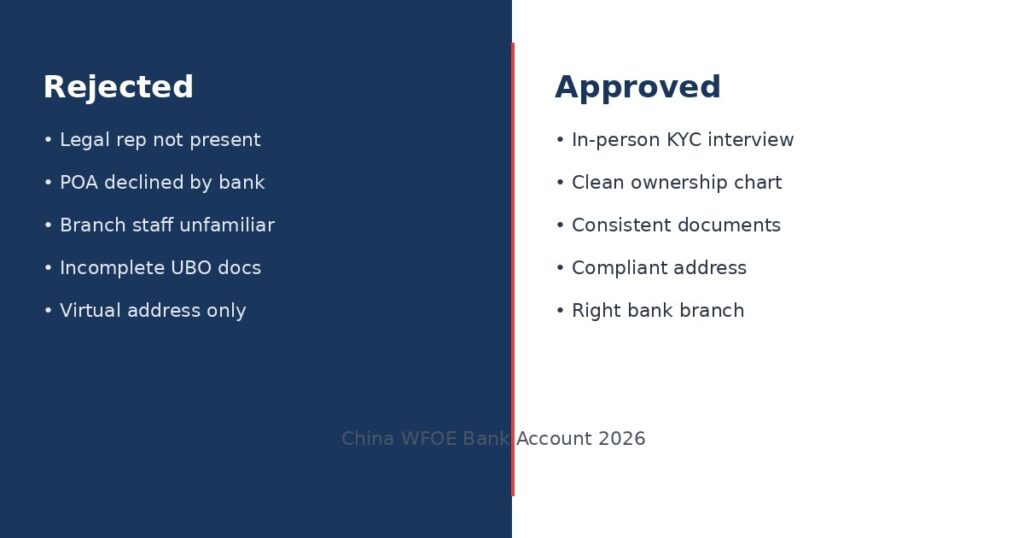
Most mainland banks still want the legal representative to sit in the branch for the KYC interview. A power of attorney almost never replaces that visit. MSA Asia and several other practitioners have seen the same pattern: the CEO tries to handle everything from overseas, the bank declines twice, and only after the person flies in does the account open.
Under the updated customer due diligence measures that took effect in January 2026, banks must verify identity, beneficial ownership, and the purpose of the account more carefully. Many branches simply default to “the legal representative must come in person” because their staff have never processed a foreign passport case before. One founder described walking into three different branches of the same bank and receiving three different answers.
If your legal representative cannot travel, you have two practical options: appoint a China-based person as legal representative before you file the licence, or accept that the bank step will require a short trip. Changing the legal representative later means another SAMR filing and more delay. Plan this before incorporation, not after the licence arrives. More detail on the role itself is in our note on WFOE legal representative requirements in 2026.
Other Common Rejection Triggers in 2026
Even when the legal representative can attend, applications still fail for a few repeat reasons:
- Incomplete beneficial ownership picture. Banks must now penetrate every layer and identify the natural-person ultimate beneficial owners. A holding company in one country owned by another holding company elsewhere often triggers extra questions or a straight decline if the chart is unclear.
- Address that cannot be verified. A pure virtual office that SAMR accepted can still be rejected by the bank. Staff ask for photos, a visit, or proof of actual use. Cheap registered addresses without a real commercial space are a frequent cause of later stalls. See the practical difference between what passes registration and what passes the bank in our virtual office rejection note.
- Document mismatches. The business scope on the licence, the address on the lease, the capital contribution schedule, and the stated purpose of the account must line up. Small inconsistencies create compliance flags.
- Wrong branch or wrong bank for the profile. Some branches have never opened an account for a foreign legal representative. Others are more experienced with FIEs. Choosing on price or convenience instead of actual track record with similar ownership structures is a common mistake.
City practice still varies. Shanghai and Beijing branches are often stricter on address verification and in-person attendance. Shenzhen and some free-trade-zone locations can be more flexible, but the difference is branch-level, not city-level.
What You Should Prepare Before You Walk In
A clean file reduces the chance of an immediate rejection. Typical items banks ask for in 2026 include:
- Original business licence and certified copies
- Articles of association (with the five-year capital contribution schedule)
- Company chops (official, financial, and legal representative)
- Legal representative’s original passport plus a valid visa or residence permit (tourist visas are frequently refused)
- Shareholding chart down to natural persons, with supporting documents
- Lease or property documents for the registered address that the bank can verify
- Brief business plan or expected transaction profile
Capital injection and SAFE registration usually happen after the basic RMB account is open. Until that account exists, the WFOE cannot receive money or pay suppliers. Timelines for the bank step alone commonly run four to eight weeks once documents are ready; the licence itself is rarely the long pole. Full registration timelines and cost ranges are covered in our China WFOE registration timeline and cost for foreigners in 2026 and the more detailed setup cost breakdown.
How to Reduce the Risk of Rejection
Talk to the bank (or to someone who regularly opens accounts for foreign-owned WFOEs) before you finalise the legal representative and the registered address. Confirm whether that specific branch will accept a foreign passport holder and what verification method they will use. Do not assume a power of attorney will work.
Keep the ownership structure as simple as the business allows. Extra layers increase the chance of a beneficial-ownership query. Make sure every document uses the same address and the same description of the business. If you are operating fully remotely, choose an address provider who can already show successful bank openings for similar WFOEs, not just the cheapest option that passed SAMR.
If the first branch says no, try another branch of the same bank or a different bank before you change the company structure. Many founders succeed on the second or third attempt once they find staff who have handled foreign legal representatives before.
Frequently Asked Questions
Can the legal representative open the WFOE bank account without coming to China?
In most cases no. Banks generally require the person named on the licence to complete the KYC interview in person. Video verification is sometimes accepted for lower-risk files, but it is not the default for foreign legal representatives.
How long does the bank account step take after the licence is issued?
Plan on four to eight weeks for a clean file. Document collection, pre-screening, the interview, and compliance review all sit inside that window. Complex ownership or address questions add more time.
Does a virtual office cause bank rejection even if SAMR accepted it?
Yes, frequently. Banks apply their own substance checks. An address that is only a mailbox or a pure shared desk without verifiable commercial space is a common reason for delay or refusal.
What should I do if the bank has already rejected the application?
Ask for the specific reason if they will give one, then either supplement the missing documents or try a different branch. Changing the legal representative or the registered address requires additional filings and should be a last step, not the first reaction.
The bank account is the step that turns a registered company into one that can actually operate. Most rejections are avoidable if you treat the legal representative’s availability and the registered address as decision points early, rather than administrative details after the licence arrives. If you are preparing a remote WFOE setup and want the registration, address, and bank coordination handled together so these common stalls are reduced, that is the kind of support we provide.