How a US Citizen Can Register a WFOE in China
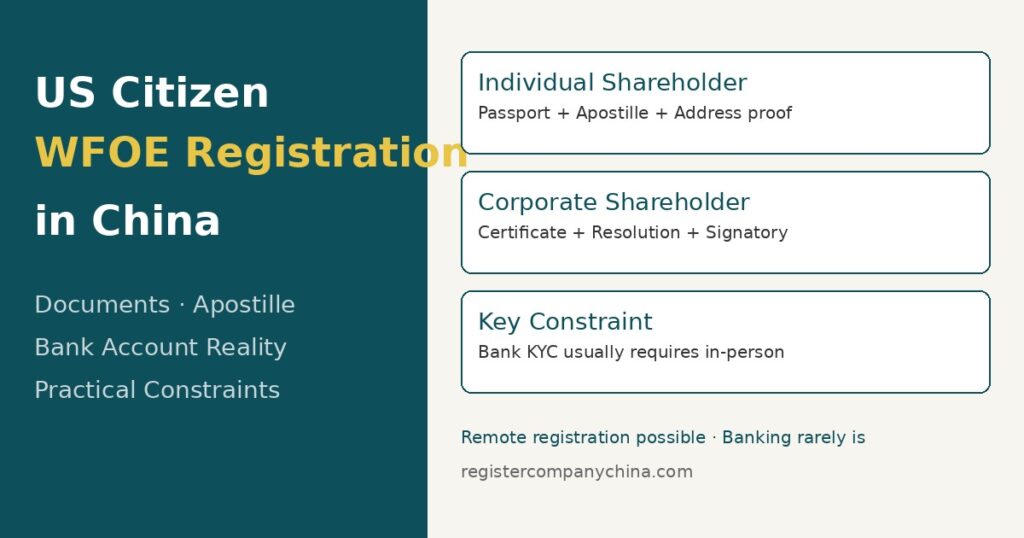
Yes. A US citizen can register and fully own a Wholly Foreign-Owned Enterprise (WFOE) in China for most business activities. No Chinese partner is required in sectors outside the Foreign Investment Negative List. Registration filings can usually be handled remotely. Opening a usable corporate bank account almost always requires the legal representative to appear in person at a mainland bank.
This guide covers the practical requirements, document steps, and real constraints a US citizen faces, based on current administrative practice as of November 2026.
Which Structure Works for a US Citizen?
The usual vehicle is a WFOE formed as a Chinese limited liability company under the Company Law and Foreign Investment Law. A US individual can be the sole shareholder.
- Full ownership is available in open sectors. Check the current Negative List (NDRC/MOFCOM) first. Manufacturing is largely open; certain telecom, media, and medical services remain restricted.
- You may serve as legal representative, executive director, or general manager. The role carries personal liability for specific company obligations, so some investors appoint a trusted China-based person instead.
- A supervisor is no longer universally mandatory under the revised Company Law, but local practice and bank expectations still affect the setup.
A Representative Office is an option only for pure liaison work. It cannot invoice, sign most commercial contracts, or generate revenue. Most US citizens who want an operating entity choose a WFOE.
Documents a US Citizen Must Prepare
Requirements differ slightly depending on whether the shareholder is the US citizen personally or a US company.
Individual shareholder (US citizen)
- Valid US passport (color scan + original for bank later).
- Notarized copy of the passport if required by the local SAMR.
- Proof of residential address (sometimes requested by banks).
- Appointment letters for the legal representative and any other officers.
Corporate shareholder (US company)
- Certificate of incorporation / good standing.
- Articles of association or equivalent.
- Board or shareholder resolution authorizing the China investment and appointing officers.
- Passport of the authorized signatory.
All foreign documents must be notarized in the United States and then apostilled. China joined the Hague Apostille Convention effective 7 November 2023. US documents therefore no longer need Chinese embassy legalization; an apostille from the competent US authority is sufficient. Certified Chinese translations are still required.
Apostille turnaround varies by state (commonly 1–4 weeks). Start this step as soon as the decision is made; incomplete or untranslated documents are a frequent cause of SAMR rejection.
Registered Address and Capital
Every WFOE needs a compliant registered address that the local SAMR will accept and that banks will later verify. Pure virtual offices frequently pass SAMR in some cities but are rejected by banks. Choose an address that can support inspection or has a documented commercial use.
There is no statutory minimum registered capital for most sectors. Under the 2024 Company Law (effective for new companies), subscribed capital must be fully paid within five years. Practical amounts used by active files are typically:
- Consulting / services: equivalent of USD 50,000–300,000
- Trading: USD 100,000–500,000+
The amount should be commercially reasonable for the business scope. Banks and tax authorities review it later.
Legal Representative and the Bank Account Reality
For the business licence itself, most cities accept remote filings through an agent with proper powers of attorney and apostilled documents. The licence can be obtained without the US citizen traveling.
Corporate bank account opening is the hard constraint. Most mainland banks still require the legal representative to attend in person for KYC. A power of attorney almost never replaces that visit. Until the basic RMB account is open, the company cannot receive capital or operate normally.
Options:
- Plan a short trip for banking.
- Appoint a China-resident legal representative (transfers control and liability).
- Explore foreign banks with China branches if an existing relationship exists (still often requires physical presence).
Bank account opening commonly takes 4–8 weeks after the licence and is frequently the longest step.
Realistic Timeline
- US document preparation and apostille: 2–6 weeks
- Name pre-approval + business licence: 1–3 weeks once the file is complete
- Chops, tax registration, post-licence steps: 1–3 weeks
- Bank account: 4–8 weeks
A clean service or trading WFOE often reaches operational status in 8–16 weeks end to end. Delays usually come from incomplete apostilles, address issues, or bank KYC.
Common Mistakes US Citizens Make
- Treating banking as remote because registration can be remote.
- Declaring capital without a realistic five-year contribution plan.
- Selecting an address that passes SAMR but fails bank verification.
- Drafting a business scope that is too narrow or too vague for planned revenue.
- Ignoring US tax reporting obligations (Form 5471 and related rules apply to controlled foreign corporations).
Next Steps
If you are a US citizen evaluating a China company, the practical path is to confirm your sector is open, prepare and apostille the correct documents, choose a bankable address, and plan for the legal representative’s bank appearance.
We assist foreign individuals and companies with remote WFOE registration, document coordination, registered address solutions, and post-registration bank account and compliance support. Packages are fixed-price. View our China company registration services, review typical setup cost ranges, or see the full registration process.
Request a fixed-price assessment for your US-to-China setup.