How to Get Customs Registration for a Trading WFOE in China
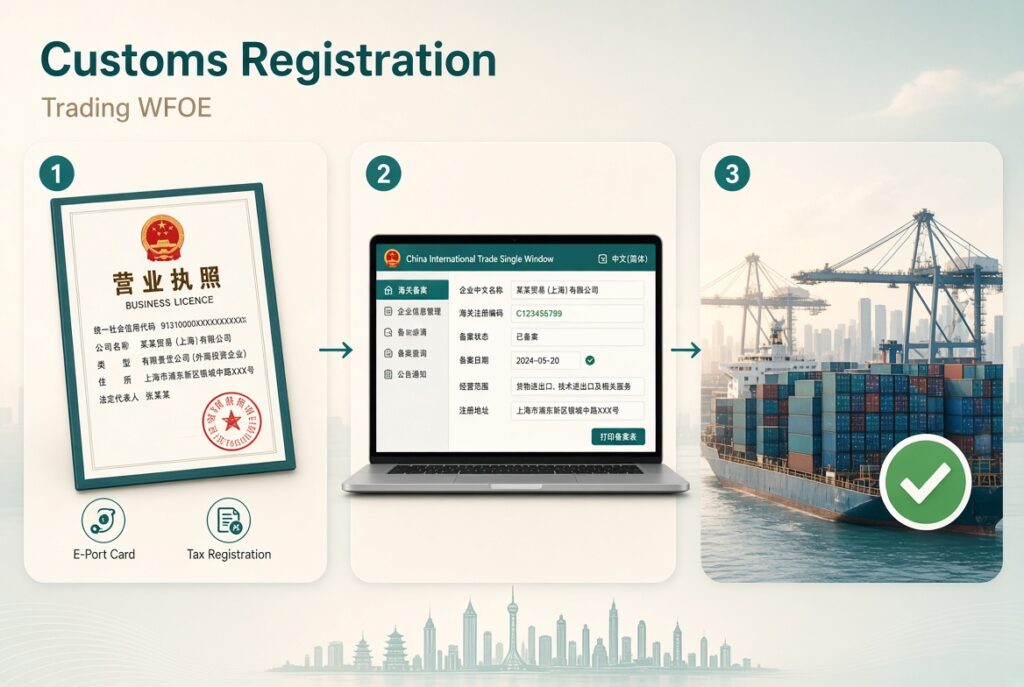
A business licence with an import-export scope is only the starting point. Your trading WFOE (still commonly called a FICE in practice) can sign contracts and issue fapiao once the licence is issued, but it cannot clear goods in its own name until it completes customs registration and related filings. As of November 2026, the former foreign-trade operator record-filing has been abolished and was not reinstated under the revised Foreign Trade Law. The practical sequence is now shorter but still requires coordinated post-licence steps.
This guide covers the realistic path foreign investors follow after the business licence is issued so the company can actually move goods.
Who Needs Customs Registration
Any wholly foreign-owned enterprise whose registered business scope includes import and export of goods (or technology) and that intends to declare shipments under its own name needs customs registration as a consignor/consignee. This applies to pure trading companies, sourcing operations that consolidate shipments, and brands that hold inventory in China. Companies that only use third-party trading houses for clearance do not need it, but most foreign investors set up a trading WFOE precisely to avoid that dependency.
Wholesale and retail trading of most goods remains open to 100% foreign ownership under the current Foreign Investment Negative List. Product-specific restrictions (tobacco, certain publications, online sales of pharmaceuticals or medical devices) still apply and may require extra licences before customs will accept the registration.
The Post-Licence Sequence That Actually Matters
Based on current administrative practice, the workable order is:
- Business licence with correct scope. The Chinese wording on the licence must include import and export of goods (货物进出口) or the equivalent for your model. Changing the scope later adds weeks. See the full trading company setup guide for scope drafting points.
- Company chops and tax registration. Chops are carved and recorded. Tax registration with the State Taxation Administration follows within 30 days. Decide whether to apply for general taxpayer status (needed for proper VAT input credits on goods). Small-scale status is possible initially for low volume.
- Customs registration. File with the General Administration of Customs as a consignor and consignee of imported and exported goods. This is normally done through the China International Trade Single Window (singlewindow.cn) after tax registration is live. You receive a customs registration code tied to your unified social credit code. Processing is commonly 1–3 weeks depending on the city and completeness of materials. This is the step that lets you declare shipments in the company name.
- Electronic Port (e-port) and Single Window activation. Enrol for the electronic port system and related cards or credentials so declarations can be filed online. Timing often overlaps with or follows customs registration.
- Export rebate and foreign-exchange readiness (if applicable). For companies that will claim VAT export refunds, additional tax-bureau filings are required. SAFE-related registration for the capital account is handled through the bank when you open accounts. Capital contribution itself is a separate five-year obligation under the Company Law, not a customs prerequisite.
The former MOFCOM foreign-trade operator filing is no longer required. Local commerce departments stopped processing it from the start of 2023, and the 2026 Foreign Trade Law did not bring it back. Guides that still list it as a mandatory step are outdated.
Realistic Timeline and What Delays It
From a clean business licence, the customs and e-port layer typically adds 2–4 weeks before the first shipment can clear under the company’s own code. End-to-end from document preparation in the home country to a fully operational trading WFOE (licence + customs + bank) is commonly 10–16 weeks. Common delay factors include:
- Incomplete or mismatched investor documents (apostille and Chinese translation must match exactly).
- Business scope that does not clearly cover the intended product categories or import/export rights.
- Registered address that fails later verification. Customs and tax bureaus can inspect; pure virtual addresses frequently cause problems for trading entities that claim refunds or high volume. A compliant commercial or approved cluster address is safer.
- Bank KYC for the foreign legal representative, which runs in parallel and can stretch the overall timeline even if customs itself is ready.
- Product-specific licences (food, cosmetics, medical devices, chemicals) that must be in place before certain goods can be imported.
For a broader view of the registration timeline, see the WFOE registration process guide.
Registered Capital and Cost Context
There is no statutory minimum registered capital for most trading scopes. In practice, banks, landlords and customs authorities treat the figure as a signal of substance. Most foreign-invested trading companies declare between RMB 500,000 and RMB 2,000,000. Under the revised Company Law, the full subscribed amount must be paid in within five years. An inflated number creates a real funding obligation rather than a stronger application.
Professional service fees for a trading WFOE (including customs preparation) commonly fall in a higher band than a pure consulting entity because of the additional filings. Address, chops, translations and bank coordination sit on top of the agent fee. For current market ranges, refer to the China WFOE registration cost breakdown.
What You Should Prepare
Before customs filing you will normally need:
- Business licence and unified social credit code.
- Tax registration confirmation.
- Company chops (especially the official company chop).
- Legal representative identification and, in many cities, real-name verification details.
- Lease or address-use documents that match the registered address.
- Articles of association and shareholder information already on file.
The exact local checklist varies by customs district. A local agent who regularly files trading WFOEs in your chosen city reduces rejection risk.
Common Mistakes Foreign Investors Make
- Treating the business licence as sufficient for import-export operations. The first shipment will sit if the customs code is missing.
- Using an address that passes initial SAMR filing but fails later physical or correspondence checks by tax or customs.
- Underestimating the five-year capital contribution obligation when choosing the registered capital figure.
- Assuming all steps can be completed without any presence. Licence and many filings can be remote; bank account opening and certain inspections often still require the legal representative or an authorised person in China.
Next Step
If you are setting up a trading WFOE so you can pay suppliers in RMB, consolidate shipments, or clear customs in your own name, the customs registration layer is where many files slow down. Register Company China handles the full sequence—scope drafting, SAMR filing, chops, tax registration, customs and e-port preparation, and bank account coordination—under a fixed-price package with clear scope and remote support where possible.
Why Choose Us for transparent fixed packages and post-registration support, or request a fixed-price trading WFOE registration assessment that maps your specific city, product categories and document path.
Contact us to discuss your China trading company setup and receive a clear quote before you commit.