










How to Open a Bank Account for a WFOE in China: Requirements, Timeline, and Common Rejection Reasons
How to Open a Bank Account for a WFOE in China: Requirements, Timeline, and Common Rejection Reasons Getting the business license for your Wholly Foreign-Owned Enterprise (WFOE) is a major milestone. Yet without a functioning corporate bank account, the company remains a paper entity. You cannot inject registered capital, pay Chinese suppliers, issue proper invoices, or handle tax payments. In 2026 the process is clearer than before, but banks apply stricter customer due diligence. Many foreign founders still encounter delays or outright refusals. This guide explains exactly what Chinese banks require, how long the process takes, which documents matter most, and the most common reasons applications get rejected. Why a Corporate Bank Account Matters for Every WFOE A Chinese company is legally required to open an RMB basic deposit account. This account is the only channel through which the company can withdraw cash, pay salaries, and settle tax obligations. In addition, most foreign investors need a foreign-currency capital account to receive the registered capital from overseas. Without these accounts the WFOE cannot complete capital contribution within the five-year window set by the 2024 Company Law, nor can it operate as a going concern. Banks treat the account-opening step as a high-risk onboarding event, so preparation is essential. Accounts a Typical WFOE Needs RMB Basic Deposit Account — Mandatory. Only one is allowed per company. Used for daily operations, tax, and payroll. Foreign Currency Capital Account — Needed to receive registered capital from the foreign shareholder. Linked to SAFE foreign-investment registration. General RMB or Settlement Accounts — Optional but useful for higher transaction volumes or multi-currency needs. Most service and trading WFOEs start with the basic RMB account plus the capital account at the same bank to simplify compliance. Who Must Appear in Person Under current People’s Bank of China (PBOC) customer due diligence rules, the bank must verify the legal representative’s (or authorized person’s) intent to open the account. In practice, almost every major bank still requires the legal representative to appear at the branch for face-to-face or video KYC. Remote or pure power-of-attorney openings have become rare after the January 2026 updates to customer due diligence and beneficial-owner identification rules. Planning at least one trip to China by the legal representative remains the safest approach. Required Documents Checklist (2026) Document lists vary slightly by bank and city, but the core package is consistent: Original business license (营业执照) and several certified copies Articles of Association filed with SAMR Company chops (official seal, financial seal, legal representative seal) Passport of the legal representative (original + copies) Board or shareholder resolution authorizing the account opening Proof of registered address (lease agreement + landlord property certificate) Tax registration confirmation or unified social credit code documents Beneficial owner declaration and supporting identity documents Business plan or expected transaction summary (some branches request this) For US or other Hague Convention investors, passport and corporate documents should carry an Apostille. China has accepted Apostille certificates since November 2023, which simplified the old consular legalization chain. Step-by-Step Process and Realistic Timeline Choose the bank and branch — Prefer branches with an international or foreign-invested enterprise desk (Bank of China, ICBC, China Merchants Bank, HSBC China, Standard Chartered China). Pre-screen the document package — Send a complete scan set to the relationship manager before booking the appointment. Legal representative visits the branch — Completes identity verification, signs forms, and answers KYC questions about business model, expected volumes, and source of funds. Bank internal review and PBOC registration — The bank registers the basic account with the local PBOC. Foreign-currency capital account and SAFE linkage — Opened after or together with the basic account. Online banking activation and tokens — Final step once the accounts are live. Clean files at experienced branches often finish in 2–4 weeks after the legal representative’s visit. Less prepared applications or high-risk profiles can stretch to 6–8 weeks. Common Reasons Banks Reject or Delay WFOE Account Applications Rejections are rarely random. The most frequent causes observed in 2025–2026 practice are: Incomplete or inconsistent documents — Mismatched names, missing Apostille, or unsigned resolutions. Legal representative cannot attend in person — Most branches will
WFOE Bank Account Opening Requirements for Foreign Legal Representative 2026
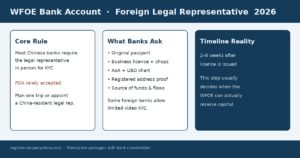
The business licence is not enough. Until a China WFOE opens its corporate bank accounts, it cannot receive registered capital, pay tax or salaries, or settle with local suppliers. In 2026 the banking step remains the usual choke point after incorporation — and the requirement that catches most foreign founders is the physical presence of the legal representative. This guide focuses on what Chinese banks actually require from a foreign legal representative, which documents must be ready, realistic timelines, and the practical options when the appointed legal representative cannot or will not travel to China. The Core Rule in 2026 Practice Most mainland commercial banks still require the legal representative to appear in person at the branch for KYC. The interview is short: the compliance officer asks about the business model, source of funds, expected transaction profile and cross-border flows. A power of attorney is rarely accepted as a substitute for that face-to-face verification. PBOC rules technically allow the bank to choose face-to-face or video verification based on customer risk. In practice, for a new foreign-invested company with a foreign legal representative, the overwhelming majority of Chinese banks still insist on the in-person visit. Some foreign banks operating in China (HSBC, Standard Chartered, Citi) occasionally accept video KYC or group-treasury relationship workarounds, but this is not universal and usually depends on an existing relationship. Documents the Bank Will Ask For Core pack for the basic RMB account and capital account: Original business licence (and certified copies) Articles of Association as filed with SAMR Full set of company chops (company, finance, legal representative) plus specimen seal card Legal representative’s original passport (tourist L-visa is often refused; a proper work or residence status is preferred where available) Board or shareholder resolution authorising account opening and naming authorised signatories Registered address lease or property certificate that matches the licence Ultimate beneficial ownership chart through to natural persons Foreign-investment information report / FDI filing receipt Description of expected counterparties, currencies and transaction volumes Incomplete UBO charts and mismatched English names on passports are two of the most common reasons a file is sent back. Timeline Reality After the licence is issued, bank account opening typically takes 2 to 8 weeks. The legal representative’s travel window and the bank’s internal review queue are the main variables. Treat the banking step as a separate project rather than an automatic follow-on to the licence date. Options When the Legal Representative Cannot Travel Appoint a China-resident natural person as legal representative (a trusted local general manager or professional director). This is the most reliable way to keep the banking process moving without an overseas founder’s trip. Plan one dedicated trip timed to the bank’s appointment once the licence and chops are ready. Explore foreign banks in China that may accept limited video verification — confirm this with the specific branch before relying on it. Changing the legal representative later is possible but involves a SAMR amendment, new chops in some cases, and a fresh bank KYC cycle, so the choice is better made at formation. How Register Company China Handles the Banking Step Register Company China manages remote-first WFOE setups for foreign individuals and overseas companies under fixed-price packages. The scope includes guidance on legal-representative appointment, document preparation for the bank file, and coordination of the account-opening process. Where an in-person visit is required, the team helps schedule and prepare the interview so the trip is productive. If you already have a licence or are about to file, the practical next step is a fixed-price quote that maps the remaining banking requirements for your structure and city. View our services or request a quote. Related reading: Remote WFOE Registration, Legal Representative Requirements, and WFOE Registration Process 2026. FAQ Does the legal representative have to be Chinese? No. A foreign passport holder can serve. There is no statutory residency requirement for the role itself. The practical constraint is bank KYC. Can a power of attorney replace the legal representative at the bank? Almost never for a first-time WFOE account at a Chinese bank. Some foreign banks are more flexible; most local branches are not. How long does
China Company Registration Agent for US Companies: How to Choose in 2026
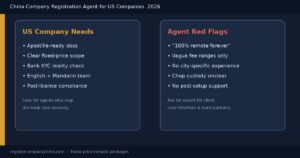
US companies looking for a China company registration agent face a crowded market of service providers, many of whom still oversell “fully remote” setups or quote incomplete packages. The right agent for an American founder or US-parented entity needs to handle apostille logistics from the US side, map the bank KYC reality honestly, deliver a fixed-price scope, and stay available after the business licence is issued. This guide is written for US decision-makers evaluating China registration agents in 2026. It covers what a competent agent actually does, the questions that separate useful partners from expensive intermediaries, realistic cost and timeline expectations, and the red flags that still appear in many proposals. What a China Registration Agent Does for a US Company Most foreign-invested companies do not file directly with SAMR. They appoint a local agent who prepares the Chinese-language package, coordinates name reservation, submits the incorporation file, obtains the business licence and company chops, handles tax registration, and supports the bank account opening process. For a US shareholder the agent’s value sits in three places: Document authentication guidance – which US documents need notarisation and apostille, in what order, and how to avoid the common rejections that delay filings by weeks. Scope and capital calibration – writing a business scope that matches the intended activity without triggering unnecessary pre-approvals, and setting registered capital at a level that banks and local AMR offices will accept. Bank and post-licence coordination – introducing the file to banks that still accept foreign legal representatives, preparing the UBO chart, and handing over a clean tax and social-insurance file. A pure “licence only” agent leaves the hardest parts (banking and first-year compliance) to the client. US companies usually need the fuller package. Questions Every US Company Should Ask Before Signing Exactly which steps require the legal representative to appear in person or complete video KYC with the banks you work with in Shanghai, Shenzhen or Beijing? Is the quoted fee a fixed package that includes name approval, licence, chops, tax registration and bank account coordination, or does the bank step sit outside the fee? Who will hold the company chops after issuance, and what is the written custody arrangement? Can you show two recent US-client timelines (from apostille request to usable bank account) in the target city? What ongoing accounting and annual compliance support is available after the licence is live? Agents who answer these questions with specific city and bank experience are usually safer than those who reply with generic “we handle everything remotely.” Realistic Cost and Timeline for US-Origin Files in 2026 Professional fees for a standard service or light trading WFOE typically range from USD 2,500 to 8,000 when the package runs from name reservation through bank coordination. Apostille, notarisation and certified translation for US corporate documents usually add USD 400–1,500. Registered address (approved cluster or serviced office) runs RMB 6,000–15,000 per year in tier-one cities. First-year bookkeeping often sits between RMB 2,000 and 6,000 for a low-activity entity. End-to-end time from first document request to a usable RMB account is commonly 6–14 weeks for clean files. The apostille chain and bank KYC are the two variables that most often push the calendar. Manufacturing or licensed scopes take longer. How Register Company China Works with US Clients Register Company China focuses on remote-first WFOE, JV and Representative Office setups for foreign individuals and overseas companies, including US parents and founders. Packages are fixed-price with a clear scope, so the cost is known before work starts. The team manages apostille guidance, SAMR filing, chops, tax registration and bank account coordination, and can continue into monthly accounting and annual compliance if required. If you already have a target city, draft business scope and shareholder structure, the practical next step is a fixed-price quote that maps the US-document path and the remaining in-person requirements for your case. View our services or request a quote. Related reading: Remote WFOE Registration in China 2026, How to Set Up a WFOE, and WFOE Registration Process 2026. FAQ Do I need a Chinese partner if I use an agent? No. A WFOE is 100% foreign-owned. The agent is
Remote WFOE Registration in China 2026: What Is Actually Possible Without Travel
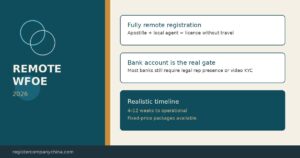
Yes, you can complete most of a China WFOE registration without flying to the mainland in 2026. Name pre-approval, business licence issuance, company chops, tax registration and even capital contribution planning can all be handled through a local agent under power of attorney once your documents are properly apostilled. The step that still trips most foreign founders is the corporate bank account. This guide focuses on what is actually remote-capable today, where the hard stops remain, realistic timelines and costs, and how to choose a service provider that does not over-promise. What “Remote WFOE Registration” Really Covers in 2026 Under current SAMR practice and the Apostille Convention (China joined in November 2023), a foreign shareholder can stay outside China for the core company formation sequence: Chinese company name reservation Business scope drafting and Negative List screening Articles of Association and supporting filings Business licence issuance (the unified social credit code document) Company chop engraving and Public Security Bureau registration Tax bureau registration and basic fapiao setup SAFE-related foreign-exchange registration preparation Everything above can be executed by a qualified local agent with a properly executed power of attorney and apostilled shareholder documents. You do not need to appear at the Administration for Market Regulation window. The practical limit is the bank. Almost every mainland commercial bank still requires the legal representative (or in some cases a designated finance person) to complete KYC in person or via a tightly controlled video process. Until the basic RMB account and capital account are open, the company cannot receive registered capital, pay salaries or issue invoices in a usable way. That single step turns a “fully remote” claim into a partial one. Documents You Must Prepare Before Any Filing Remote registration adds an authentication layer that in-person filings can sometimes skip. For individual shareholders the core pack is: Passport copy (notarised then apostilled) Proof of residential address Signed power of attorney for the China agent Appointment letters for legal representative, director/supervisor and general manager For corporate shareholders add: Certificate of incorporation / good standing Register of directors and members Board resolution authorising the China investment UBO chart through to natural persons All foreign-sourced documents must carry an apostille from a Hague Convention authority (or the older notarisation-plus-consular legalisation route if your country is not a party). Starting this chain late is the most common reason remote projects slip by three to six weeks. Registered address documentation (lease or approved cluster/hosting agreement) is also required before the licence can issue. A pure residential address or unregistered co-working desk will be rejected. Realistic Timeline When Everything Is Done Remotely Once apostilled documents and a compliant address are in hand, a clean service or light trading WFOE typically follows this sequence: Name pre-approval: 1–5 working days Licence filing and issuance: 5–15 working days (city-dependent) Chops, tax registration, social insurance unit file: 1–2 weeks Bank account opening: 2–8 weeks (the variable that dominates the calendar) End-to-end from first document request to a usable bank account usually lands between 6 and 14 weeks for straightforward cases. Manufacturing, food, education or other licensed scopes add extra pre-approvals and can stretch beyond that. Cities such as Shanghai and Shenzhen generally move faster on standard files than many inland jurisdictions. Cost Range for a Remote Setup in 2026 Government fees themselves are minimal. The real numbers sit in professional services, address, authentication and first-year compliance: Professional / agent fees (name through licence + chops + tax file): typically USD 2,500–8,000 for a standard service WFOE; higher when trading rights, customs or sector licences are required Apostille, notarisation and certified translation: USD 300–1,500 depending on number of documents and jurisdiction Registered address (cluster or serviced): RMB 6,000–15,000 per year in tier-one cities Bank account support and related coordination: often included in full packages, sometimes charged separately First-year bookkeeping and tax filing: RMB 2,000–6,000+ for a low-activity entity All-in first-year cash outlay for a simple consulting WFOE commonly falls in the USD 5,000–15,000 range before any registered capital injection. Transparent fixed-price packages that clearly state what is included (and what is not) reduce the risk of later invoices. How to Choose a Remote
China WFOE Setup Cost 2026 for Foreigners: Real Ranges, Hidden Items, and Budget Mistakes
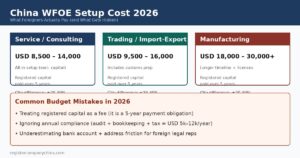
Foreign founders asking “how much does a China WFOE actually cost in 2026” usually get a single range that hides more than it reveals. The professional fee is only one line. Registered capital is a five-year payment obligation, not a one-time charge. Annual compliance starts immediately. Bank account and address requirements for foreign legal representatives add friction that many quotes ignore. This page breaks down the real numbers foreign investors face in 2026, what is typically missing from agency quotes, and the budget mistakes that still delay projects. Realistic All-in Setup Cost Ranges (2026) Figures below reflect current market practice for a standard service or trading WFOE owned by a foreign individual or overseas company. Manufacturing and regulated scopes run higher. Service / Consulting WFOE: USD 8,500 – 14,000 all-in setup (professional fees, document legalisation, chops, tax registration, basic bank support) Trading / Import-Export WFOE: USD 9,500 – 16,000 (adds customs-related preparation) Manufacturing WFOE: USD 18,000 – 30,000+ (longer timeline, additional licences, environmental steps) City variation is real. Shanghai and Beijing tend to sit at the higher end of the range; Shenzhen, Guangzhou and many tier-2 cities are often 15–25% lower for the same scope. What Is Usually Not Included in the Headline Number Most published ranges stop at the registration package. The items below frequently appear as extras or are left for the founder to discover later: Notarisation, apostille and certified translation of shareholder documents (USD 800 – 2,500 depending on home country and number of papers) Registered address that banks and SAMR will actually accept (USD 1,500 – 6,000 per year in tier-1 cities for a compliant commercial lease or approved cluster address) Bank account opening support when the legal representative is a foreign national who must appear in person First-year bookkeeping, tax filings and statutory audit (typically USD 5,000 – 12,000 for a small entity) Registered capital itself is not a fee. Under the current Company Law it must be fully paid in within five years of incorporation. The amount should be commercially credible for the business scope; SAMR and banks both look at it. Registered Capital: The Five-Year Reality There is no statutory minimum for most sectors. Practical 2026 ranges used by active formation practices are: Consulting / services: USD 100,000 – 500,000 equivalent Trading: USD 200,000 – 1,000,000 equivalent Manufacturing: significantly higher, often aligned with first-year capex and working capital Declaring a high number to “look substantial” creates a binding payment schedule. Under-declaring can cause problems at bank KYC or when applying for general taxpayer status and higher fapiao quotas. First-Year Total Cost vs Ongoing Cost A realistic first-year budget for a small service WFOE owned by a foreign founder typically looks like this: Setup package and legalisation: USD 8,500 – 14,000 Compliant registered address (year 1): USD 1,500 – 6,000 Bookkeeping + tax + statutory audit: USD 5,000 – 12,000 Registered capital first injection (if any is required early): variable From year two onward the recurring compliance line (accounting, tax, audit, annual report) remains. Founders who budget only the setup fee often face cash-flow pressure once the company is live. Common Budget Mistakes That Still Happen in 2026 Treating registered capital as a registration fee. It is a payment obligation over five years. Accepting the cheapest virtual address without checking bank and tax acceptance. Many low-cost addresses fail KYC or fapiao quota reviews. Assuming the legal representative can stay overseas for the entire process. Most mainland banks still require the legal representative in person for account opening. Ignoring the annual compliance cycle. Audit, CIT reconciliation (31 May) and SAMR annual report (30 June) are mandatory even for zero-revenue entities. City and Structure Differences That Affect Cost Shanghai and Beijing packages are usually the most expensive. Shenzhen and Guangzhou often offer faster processing and slightly lower professional fees for standard scopes. Free-trade zone locations (Lingang, Qianhai, Hainan FTP) can change the tax profile and sometimes the address options, but they do not remove the core setup and compliance costs. A single foreign individual can now be the sole shareholder of a WFOE. That structure is simpler on paper but does not reduce the
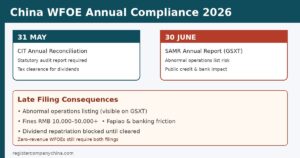
China WFOE Annual Audit and SAMR Annual Report 2026: Deadlines, Risks of Late Filing, and What Actually Happens
Every China WFOE must complete two connected year-end obligations: a statutory annual audit and the SAMR annual enterprise report. Miss either one and the company can land on the public abnormal operations list, face fines, lose the ability to issue fapiao cleanly, or find profit repatriation blocked at the bank. This guide focuses on the practical 2026 calendar, the real deadlines that matter, what happens when filings are late, and the decisions foreign founders still get wrong. The Two Deadlines That Actually Matter in 2026 China uses the calendar year for almost all companies. The financial year runs 1 January to 31 December. Two hard dates then follow: 31 May — Corporate Income Tax (CIT) annual reconciliation (汇算清缴). The statutory audit report is normally required as supporting material for this filing. 30 June — SAMR annual enterprise report submitted through the National Enterprise Credit Information Publicity System (GSXT / 国家企业信用信息公示系统). Foreign-invested enterprises also file related foreign investment information in the same window. These are not the same filing. Treating them as one interchangeable deadline is a common source of last-minute problems. What the Statutory Audit Actually Covers The annual audit must be performed by a licensed Chinese CPA firm. Overseas parent-company auditors are not accepted for this purpose. The audit covers the full calendar year of books kept under Chinese Accounting Standards. Even a dormant or zero-revenue WFOE still needs the audit. Banks and the tax bureau treat “no activity” claims as something that must be verified, not simply declared. Typical practical timeline many firms follow: January–February: finalise year-end books and reconciliations February–March: audit fieldwork Target by end of April: signed audit report ready By 31 May: CIT annual return filed using the audited figures Missing the audit does not only create a compliance gap. It blocks the downstream steps that matter to most foreign shareholders: tax clearance and outbound dividend remittance. SAMR Annual Report: What Must Be Disclosed Between 1 January and 30 June the company files its annual report on GSXT. Core sections include: Basic registration and contact information Shareholder and capital contribution details (including the five-year paid-in schedule under the current Company Law) Selected financial figures (often in ranges) Employee and social insurance information Website or online business details where relevant For foreign-invested enterprises, additional investment and operational data Failure to file by 30 June is one of the most common triggers for listing on the Catalogue of Enterprises with Irregular Operations (经营异常名录). What Happens If You Miss the Deadlines Consequences are progressive and public: Late or missing SAMR annual report → company can be placed on the abnormal operations list. This status is visible on GSXT and is checked by banks, counterparties, and government departments. Fines for non-filing or late filing typically range from RMB 10,000 to RMB 50,000, with higher amounts possible in serious or repeated cases. Prolonged non-compliance (commonly two consecutive years without rectification) raises the risk of business licence revocation proceedings. Tax side: late CIT reconciliation triggers daily late-payment surcharges (0.05% per day on any tax due) plus possible administrative fines. Tax credit rating can drop, which immediately affects fapiao quotas and customs processes. Banking and repatriation: most banks require a clean audit report and tax clearance before approving dividend or capital remittances. An abnormal status or missing audit can freeze that process for months. The abnormal operations listing is not a private administrative note. It is a public signal that counterparties and banks treat as a red flag. Common Practical Mistakes in 2026 Three patterns keep repeating: Assuming zero-revenue means no audit or no report is needed. It is still required. Leaving bookkeeping incomplete until March or April. Audit fieldwork then compresses and the 31 May CIT deadline becomes high-risk. Treating the SAMR report as a simple form. Capital contribution schedules, social insurance data and financial ranges must be consistent with tax filings. Inconsistencies trigger follow-up questions or rejection. City-level practice also varies. Some districts are stricter on supporting documents; others move faster if the file is clean. The national deadlines remain the same. What to Prepare Before the Window Opens Useful checklist items for a standard service or trading
