









China WFOE Social Insurance and Housing Fund for Foreign Staff in 2026
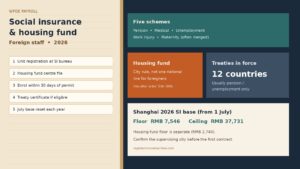
A licensed China WFOE can hire. It cannot skip social insurance for staff who hold a Foreigner's Work Permit. The five employee schemes are a statutory payroll item, not a perk the company and the founder can cancel with a waiver letter. The housing provident fund sits beside those schemes and follows a different rulebook, which is where most new entities get the cost model wrong. This 2026 guide covers employer registration after incorporation, what foreign staff must join, which countries can claim a partial exemption, how contribution bases work in the major cities, what the September 2026 housing-fund amendment changed, and how departing foreigners close accounts. What the WFOE Must Open First Social insurance and the housing fund are paid by a Chinese employer that already has a unified social credit code, tax registration and, in practice, a working RMB payroll path. The company registers as a contributing unit with the local social insurance agency and, separately, with the municipal housing provident fund centre. For a newly formed WFOE the usual sequence is licence, chops, tax file, bank account, then employer social-insurance and housing-fund accounts. Cities publish slightly different clocks. Housing-fund rules that took effect on 20 September 2026 still expect a new unit to complete contribution registration within 30 days of establishment and to open employee accounts within 20 days after that registration. Missing the unit file is now more expensive: after a rectification order, the fine range for failure to register or to open employee housing-fund accounts rose from RMB 10,000–50,000 to RMB 50,000–300,000. A company that has not finished the corporate bank account and tax file will struggle to remit even if the bureau accepts the paper registration. Treat payroll setup as part of post-licence work, not as an optional extra after the first hire. Five Insurances for Foreign Staff The operating text is the Interim Measures for Foreigners Employed in China Participating in Social Insurance (MOHRSS Decree No. 16, in force since 15 October 2011 and revised on 23 December 2024). A foreign national who is lawfully employed in the mainland and holds a work permit, a qualifying employment credential or permanent residence, must join the five employee schemes: Basic pension insurance Basic medical insurance Unemployment insurance Work-related injury insurance Maternity insurance (merged into medical insurance in some cities, including Shanghai) Registration for the individual is due within 30 days of the work permit or other employment document being issued. That clock is the same one used for Chinese staff. A one-page “I waive social insurance” addendum does not change the public-law duty. Labour-arbitration files still treat unpaid statutory contributions as a ground for the employee to resign and claim economic compensation. The contribution base is the employee’s average monthly wage from the prior year, clamped between the city floor and ceiling (commonly 60 percent and 300 percent of the local average wage). Most cities reset that range on 1 July, not 1 January. Shanghai’s 2026 social-insurance base, announced in August 2026 and applied from 1 July 2026, sits at RMB 7,546–37,731 a month. Differences for July and August payrolls were to be settled by 30 September 2026 without a late-payment surcharge if paid on time. Scheme Typical employee rate Typical employer rate Notes in 2026 practice Pension 8% 14–16% Personal account can often be closed and withdrawn when the foreigner leaves China for good. Medical 2% plus a small fixed add-on in some cities About 6–10% This is the scheme that actually buys local hospital access. Rarely covered by a bilateral exemption. Unemployment 0.2–0.5% 0.5–0.8% Often paired with pension in totalisation agreements. Work injury None 0.2–1.9% by industry risk Employer only. Usually still due even when pension is exempted. Maternity None where still separate 0.5–1% where still separate Merged into medical in several cities. Exact percentages belong to the city that supervises the WFOE. Beijing’s employer load is at the high end of the first-tier range. Guangzhou and Shenzhen sit lower on several lines. Do not budget one national percentage for a multi-city headcount. Bilateral Agreements Are Partial, Not a Blanket Opt-Out China has signed social-security agreements with 13 countries. As of

How to Register a Company in China Remotely
Register company China remotely in 2026 without visiting. Learn the step-by-step process, required documents, banking realities, and fixed-price solutions. Start here.

What Is a WFOE and How Does It Work for US Companies?
What is a WFOE and how does it work for US companies? Learn the legal setup, costs, taxes, profit repatriation, and IRS obligations. Start here.
China WFOE Registered Address Requirements in 2026
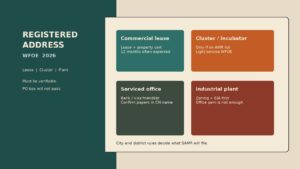
Every Wholly Foreign-Owned Enterprise in China needs a registered address before the market regulator will issue a business licence. That address appears on the licence, sets which SAMR office and tax bureau supervise the company, and is the place banks and inspectors expect to find when they knock. A cheap mailbox sold as a virtual office is still one of the most common reasons a 2026 filing stalls after the name check. This guide covers what China WFOE registered address requirements look like in practice: which premises SAMR will accept, when a cluster or incubator address is enough, when you need a real lease, the papers to prepare, and the downstream problems that show up at the bank, tax bureau, and work-permit desk. What a registered address is, and what it is not Under the PRC Company Law, a company must have a domicile. For a WFOE that means a commercial place of business that can receive official mail, support tax registration, and survive an on-site check. You register one principal address. Operating from a second site is often possible, but many cities require a filing or public disclosure of the actual workplace. It is not a PO box, a hotel room without a qualifying commercial licence, or a residential flat. A handful of cities allow limited home registration for tightly defined individual businesses. That exception almost never covers a foreign-invested limited company. The 2025 Company Registration Measures (SAMR Order No. 95, in force from 10 February 2025) still govern 2026 filings on two points: the address must be verifiable, and intermediaries who submit false address papers share liability with the applicant. Spot checks against empty-shell companies continue. Address types that usually pass Address type Typical proof Fits which WFOE Main caveat Leased commercial office Lease plus property ownership certificate; some districts want a filed lease Consulting, trading, most service companies Many bureaus want at least 12 months remaining on the lease Owned commercial unit Ownership certificate in the WFOE or shareholder name Any, if zoning matches the scope Changing later still needs a full SAMR amendment Government-listed cluster or incubator Hosting agreement plus the park's cluster-registration filing Light service or holding entities in cities that run the programme Must be on the local approved list, not a private shared desk Serviced office in a commercial building Operator lease or sub-lease the bureau accepts Companies that also need a bank site visit or work permits Confirm the operator can issue papers in the WFOE's Chinese name Industrial plant Industrial lease, zoning papers, often an environmental impact assessment Manufacturing WFOEs An office park does not replace a factory site Cluster registration (集中登记地) is the only form of so-called virtual office that many Shanghai and Shenzhen districts still accept for a WFOE. Beijing remains tighter in most districts. A private co-working desk with no AMR filing is not the same thing. Can the registered address differ from the operating address? Often yes, with a filing. Many early-stage consulting WFOEs register at an approved cluster address and work from a flexible workspace or from overseas. That split creates friction later: Banks in Shenzhen and other tier-one cities have tightened KYC. Several still send staff to the registered address before they open a basic RMB account. General VAT taxpayer status, invoice quota increases, and export tax refunds frequently trigger questions about the actual workplace. Food, medical device, warehousing, offline retail, and many import-export scopes expect the registered and operating sites to match, because inspectors visit the premises. Work-permit sponsorship in many cities needs a real office the labour bureau can inspect. If you expect any of those steps in the first year, budget for a genuine commercial lease instead of the cheapest hosting product. City and district differences that actually matter National law sets the principle. District AMR offices decide the file. Shanghai and Shenzhen still run relatively large cluster and incubator programmes, especially in free-trade and park zones. Beijing districts more often ask for dedicated space. Guangzhou and other provincial capitals sit in between and change the list of approved buildings without much notice. The city you pick also sets your

China WFOE Formation: A Step-by-Step Guide
China WFOE formation explained step by step: business scope, documents, SAMR filing, costs, and timelines. Plan your 2026 setup with confidence.
China WFOE Registered Address Rules and Virtual Office Risk in 2026
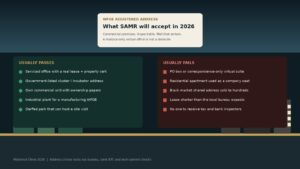
A China WFOE cannot be licensed without a registered domicile. That address appears on the business licence, sets which SAMR office and tax bureau supervise the company, and is the place banks and inspectors expect to find when they knock. A cheap mailbox sold as a “virtual office” is the most common reason a 2026 filing stalls after the name check. This guide separates what a registered address actually is from marketing language, what documents SAMR still asks for, where cluster or incubator seats work, and which virtual-office setups put the licence, bank account and work permits at risk. What a Registered Address Is Under Current Rules Under the PRC Company Law every company must maintain a domicile. For a wholly foreign-owned enterprise that domicile is a commercial premises the local Administration for Market Regulation can verify. Proof is usually a lease plus the landlord’s property-ownership certificate, or an equivalent use-right document issued by a government-listed park. The 2025 Company Registration Measures (SAMR Order No. 95, in force from 10 February 2025) tightened two points that still govern filings in 2026. The address must be verifiable. Intermediaries who submit false address papers share liability with the applicant. Spot checks against empty-shell companies, already common after 2023–2024 enforcement rounds, continue. Residential flats, hotel rooms without a qualifying commercial licence, post-office boxes and correspondence-only “virtual suites” are not a domicile. Some cities allow limited home registration for tightly defined individual businesses. That exception almost never covers a foreign-invested LLC. Address Types That Usually Pass Address type Typical proof Fits which WFOE Main caveat Leased commercial office Lease plus property certificate; some districts want a filed lease Consulting, trading, most service companies Many bureaus want at least 12 months remaining on the lease Owned commercial unit Ownership certificate in the WFOE or shareholder name Any, if zoning matches the scope Changing later still needs a full SAMR amendment Government-listed cluster or incubator Hosting agreement plus the park’s cluster-registration filing Light service or holding entities in cities that run the programme Must be on the local approved list, not a private shared desk Serviced office in a Grade A building Operator lease or sub-lease that the bureau accepts Companies that also need a bank site visit or work permits Confirm the operator can issue papers in the WFOE’s Chinese name Industrial plant Industrial lease, zoning papers, often an EIA Manufacturing WFOEs Office parks do not replace a factory site Cluster registration (集中登记地) is the only form of “virtual office” that many Shanghai and Shenzhen districts still accept for a WFOE. The park, not the tenant, holds the pre-approval with the local AMR. Beijing districts are tighter. Several still want evidence of actual workspace even inside a park. A serviced office is not the same product as a mailbox. If staff can sit there, mail is received, and the landlord can produce ownership papers, banks and visa offices treat it as a real seat. If the product is only a prestigious street line and a scanning app, treat it as correspondence, not a registered address. Virtual Office Risk in Practice Foreign founders usually meet the problem in one of four places, not at the first name-reservation screen. SAMR rejects the address pack because the property is residential, already overloaded, or missing from the cluster list. The licence issues, then the tax bureau visits and finds no one to receive notices. The company lands on the operating-anomaly list (经营异常名录). Banks freeze online banking. Fapiao quota applications stall. The corporate bank sends a clerk to photograph a nameplate. A shared cubicle with twenty other licences on the door is a common refusal point. Work-permit or residence-permit officers require an inspectable office. A cluster seat that cannot show a desk for the applicant fails that check even if SAMR accepted it months earlier. Cheap addresses sold online often reuse one suite number for hundreds of companies. Periodic AMR sweeps blacklist those buildings. A WFOE sitting on a blacklisted address can lose the licence. The legal representative can be restricted from holding that role again for a period set by the local bureau. Registered address and operating
