










How to Set Up a Wholly Foreign-Owned Enterprise in China
How do I set up a wholly foreign-owned enterprise in China? This guide covers WFOE documents, registered capital, permits, costs, and remote setup in 2026.

How to Set Up a Company in China: A 2026 Founder’s Guide
Ready to set up a company in China? This 2026 guide covers legal structures, documents, timelines, costs, and how to register remotely without traveling.
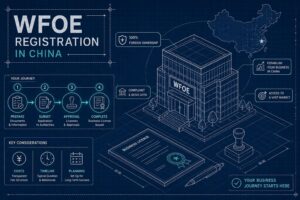
WFOE Registration in China: Steps, Costs & Timeline 2026
Plan your WFOE registration in China with confidence. This 2026 guide covers exact steps, required documents, realistic timelines, costs, and a compliance checklist.
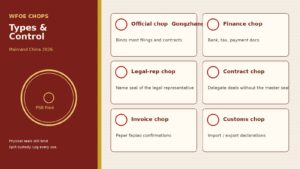
China WFOE Company Chops in 2026: Types, Custody and Control
A China WFOE is bound by its chops more often than by a wet-ink signature. Once the business licence is issued, an authorised Public Security Bureau engraver cuts the seals. Those stamps, not the passport of a director sitting overseas, are what banks, tax offices, landlords and counterparties treat as the company’s will. This 2026 guide sets out the chop types a typical wholly foreign-owned enterprise actually uses, which ones are mandatory, how custody should be split, what electronic seals change, and what to do when a seal is lost, held hostage or used without approval. Why Chops Still Matter After Digital Filing Under Chinese practice, a document stamped with a registered company chop is treated as an act of the company. Courts and counterparties look first at the seal impression, then at whether the user had apparent authority. A foreign parent’s board resolution that never reached a chop is weak evidence in a local dispute. Electronic seals now have the same legal effect as physical seals when they meet the Electronic Signature Law tests and the 2025 Electronic Seal Management Measures: exclusive control of the creation data, detectable alteration, and a retained audit trail. Government portals, e-fapiao platforms and many bank channels already use digital seals. Physical chops have not disappeared. SAMR change filings, many bank specimen cards, lease originals and customs packs still expect red ink on paper. Chops are carved after the licence. They must show the full registered Chinese name and are filed with the Public Security Bureau. The finance chop and legal-representative chop are also deposited as specimens with the company’s bank. Unregistered or “shadow” duplicates are a governance failure, not a shortcut. Chop Types a WFOE Actually Uses There is no statute that lists a fixed number of seals. In practice a new WFOE carves a short set and adds others only if the business needs them. Chop Chinese name Usual role Mandatory? Official company chop 公章 Contracts, government filings, letters, most corporate acts Yes Finance chop 财务专用章 Bank account work, payment instructions, tax and bookkeeping papers Yes Legal representative chop 法定代表人章 Stands in for the legal representative’s signature, especially at the bank Yes Invoice chop 发票专用章 Paper fapiao and some invoice confirmations Yes if paper invoices are still used Contract chop 合同专用章 Commercial contracts without releasing the official chop Optional but useful Customs chop 报关专用章 Import and export declarations Yes for trading or manufacturing with cross-border goods Official company chop. Round, red, full Chinese name. It can stand in for most other seals except customs and, in many cities, the invoice chop. That breadth is why it should never sit in the same drawer as the finance chop. Finance chop. Square or rectangular. Banks match it against the specimen card when the account is opened and when payment authority changes. Combining it with the official chop and an online-banking token in one person’s hands is how funds leave without a second pair of eyes. Legal representative chop. Square, carrying the legal representative’s Chinese name. It is destroyed and recarved when that person changes on the SAMR register. Keep it with the person named on the licence or with a trustee who reports to the shareholder, not with the general manager by default. Invoice chop. Still required on some paper confirmations. The legal invoice in 2026 is the electronic fapiao issued through the State Taxation Administration platform. Buyers verify the record in the tax system. Do not treat a red stamp on a PDF as proof that VAT was issued. Contract chop. Lets sales or operations bind ordinary commercial deals without access to the master seal. Write the delegation into internal rules: value caps, prohibited clauses, and a log. Customs chop. Needed once the WFOE files as a foreign-trade operator and clears goods. It is recorded with customs, not only with the PSB. Department or HR chops exist in larger companies. They do not replace the official chop on filings that SAMR, the tax bureau or a bank will reject without the master seal. How Chops Are Made and Registered Only a PSB-authorised engraver may cut the official set. The usual sequence
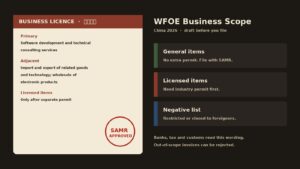
How to Choose a WFOE Business Scope in China in 2026
A WFOE business scope in China is not a marketing tagline. It is the list of activities printed on the business licence. Banks, the tax bureau, customs, and counterparties all read that list before they accept a contract, a fapiao, or a payment. Founders still treat the wording as boilerplate. Six months later they try to invoice for work the licence does not cover. The usual fix is a scope amendment, extra weeks of delay, and revenue that cannot be booked in the meantime. This guide explains how a WFOE business scope works in 2026, how it sits against the Foreign Investment Negative List, how to draft general items versus licensed items, and what it costs to change the wording after the licence is issued. What a WFOE business scope actually is The Chinese term is jingying fanwei (经营范围). SAMR reviews the draft against the national industry classification and the Business Scope Standards Catalogue, then prints the approved text on the licence. The same text is public on the National Enterprise Credit Information Publicity System. In practice the scope decides three things: What the company may legally sell and invoice Which post-licence filings are required (customs, food, telecom, medical devices, and similar permits) How tax officers classify VAT items and how banks review the purpose of inbound funds Operating outside the printed scope is not a grey area. It can block special VAT invoices, delay customs clearance, and, in serious cases, trigger administrative penalties. Negative List first, then the catalogue Before you write a single clause, check whether the activity is open to 100 percent foreign ownership. The Foreign Investment Access Negative List (2024 edition, still the national baseline through 2025–2026) splits activities into prohibited and restricted. Everything else is treated as permitted for a WFOE. The 1 November 2024 update removed the last nationwide manufacturing ownership caps. Restricted or closed space still includes parts of value-added telecom, domestic media and publishing, some education segments, selected financial services, and a small set of natural-resource activities. Pilot openings in Beijing, Shanghai, Guangzhou and Shenzhen can be wider than the national list. Confirm the city you will register in, not only the national document. A separate Market Access Negative List applies to all investors, foreign or domestic. Licensed items on that list need a permit before the activity is live, even if foreign ownership itself is allowed. General items versus licensed items SAMR wording now splits most scopes into two buckets. General business items do not need a pre-approval permit. Typical examples: management consulting, software development, information technology services, wholesale of ordinary goods, technology transfer. Licensed business items need a sector permit before you can operate them. Food operation, certain medical devices, value-added telecom, some education products, and hazardous chemicals fall here. The licence can list the item with a note that it applies only after the permit is granted. Listing the item does not replace the permit. Keep licensed items off the first draft unless you already know you will apply for the permit in year one. An unused licensed line can invite extra questions from the tax bureau and from banks. How WFOE types follow the scope Company Law does not create official “types” of WFOE. Local practice still groups companies by what the scope allows. Practical type Typical scope language Extra filings Usual setup feel Consulting / services Technical services, software, management consulting, R&D Usually none beyond tax and bank Lightest path Trading (FICE) Wholesale, retail, import and export of named goods Customs registration, often general VAT taxpayer Longer post-licence work Manufacturing Design, production, assembly, sale of self-made goods Environmental and workshop checks in many cities Longest path A service company that will also ship hardware should put import and export of related goods in the first draft. Adding trading later is possible, but customs and tax updates sit on top of the SAMR amendment. How to draft the wording Use the catalogue phrases, not a free-form English pitch. SAMR clerks match Chinese text to standard items. A clean 2026 draft usually has three layers: Primary activity: what you will invoice in the first year Adjacent activity:
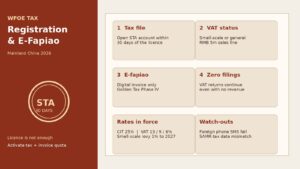
China WFOE Tax Registration and Fapiao Setup in 2026
A China business licence does not let a WFOE issue invoices or file tax. Tax registration, taxpayer status and e-fapiao access have to be switched on after the licence is issued. Until that happens, Chinese customers cannot treat a payment as a deductible purchase, and the company cannot complete a clean VAT or corporate income tax return. This guide covers what tax registration actually means in 2026, the 30-day deadline, how small-scale and general VAT taxpayer status differ under the VAT Law that took effect on 1 January 2026, how e-fapiao now works, and the filings that start even when revenue is still zero. What Tax Registration Means After the Business Licence The Unified Social Credit Code on the licence already functions as the taxpayer identification number. That does not finish the job. The company still has to open its file with the State Taxation Administration (STA) through the local tax bureau, activate the electronic tax bureau account, name a finance contact, choose VAT taxpayer status, and enable invoice issuance. Under the Administration Law on the Collection and Administration of Tax, a newly licensed enterprise should apply within 30 days of receiving the business licence. In practice many cities complete the basic tax file in one visit or through the e-tax portal once the licence data has synced from SAMR. The delay is usually the sync itself, not the form. Tax registration is separate from corporate bank account opening. Banks and the tax bureau both need the licence and chops, but they do not wait for each other. You can start the tax file while the legal representative is still booking the bank interview. Small-Scale Taxpayer or General VAT Taxpayer The VAT Law in force from 1 January 2026 defines a small-scale taxpayer as an enterprise whose annual VAT-taxable sales do not exceed RMB 5 million. Above that line, general-taxpayer registration is mandatory except in narrow non-enterprise cases. A new WFOE usually starts as a small-scale taxpayer unless it applies early for general status. The commercial choice matters more than the form. Small-scale taxpayer. VAT is calculated on a simplified levy. A temporary policy in force through 31 December 2027 reduces the payable rate on most taxable sales (other than certain real-estate items) from 3 percent to 1 percent, and monthly sales not exceeding RMB 100,000 (or quarterly sales not exceeding RMB 300,000) can stay below the VAT threshold. Input VAT on purchases cannot be credited. Many first-year service WFOEs stay here because it is simpler and cheaper while revenue is low. General taxpayer. Output VAT is charged at the statutory rates of 13 percent (most goods), 9 percent (certain transportation, construction and property-related items) or 6 percent (most modern services). Input VAT on qualifying purchases can be credited. Chinese enterprise buyers that want a special VAT fapiao for their own deduction almost always insist on a general-taxpayer supplier. Trading and manufacturing WFOEs that sell to other companies usually apply for general status in the first months, even if they are still under the RMB 5 million line, provided bookkeeping is complete. STA Announcement No. 2 of 2026 restated how general-taxpayer registration takes effect and abolished the old guidance period management from 1 January 2026. If you expect B2B buyers to demand special fapiao, apply once the books and bank account can support the file. Do not wait until a large contract is already signed. How E-Fapiao Works in 2026 Fully digital e-fapiao is now the legal invoice format. Paper tax-control disks and the old hardware UKey workflow have been retired in ordinary commercial use. Invoices are issued through the electronic tax bureau or an approved platform, numbered by the STA and matched in near real time under Golden Tax Phase IV. Two invoice types still matter: Special VAT fapiao — the buyer that is a general taxpayer can use it to claim input VAT. Ordinary VAT fapiao — sufficient for many B2C sales and for buyers that do not need an input credit. A small-scale taxpayer can issue ordinary fapiao and, in defined cases, special fapiao through the STA platform. The levy rate on those sales does
