









WFOE Bank Account Opening in China 2026: Accounts, Documents, and Timeline
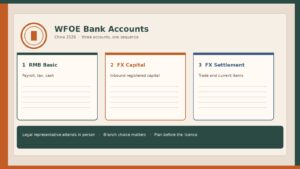
A China business licence does not move money. Until a Wholly Foreign-Owned Enterprise opens its corporate bank accounts, it cannot receive registered capital, pay tax or salaries, or settle with local suppliers. In 2026 that banking step is still the usual choke point after incorporation. This guide covers which accounts a WFOE actually needs, what banks ask for, why branches refuse files that look complete, and how long the work takes when the legal representative can attend in person. What a WFOE bank account is for Chinese banks treat a foreign-invested company as a new customer even when the shareholder already banks with the same group overseas. The file is a corporate KYC review plus a foreign-exchange registration, not a retail account application. Until the basic RMB account is live, the company is a certificate. Tax bureaus expect tax to leave that basic account. Staff expect payroll from it. Overseas shareholders expect a foreign-currency capital account before they remit registered capital under the contribution schedule in the articles of association. Company registration itself can be managed remotely. Banking generally cannot. Most mainland branches still require the legal representative to appear with a passport and the company chops. That is the gap many founders discover only after the licence arrives. For the earlier steps, see the overview of WFOE and company registration in China. Which accounts a WFOE needs in 2026 A working WFOE almost always needs more than one account. The labels differ slightly by bank, but the functions do not. Account Currency Main use Notes RMB basic deposit account RMB Daily operations, payroll, tax, cash withdrawal Only one basic account per company. Must be registered with the People’s Bank of China. RMB general account RMB Extra settlement at another bank or city Optional. Cannot withdraw cash. Useful if suppliers bank elsewhere. Foreign-currency capital account USD, EUR, HKD, and others Receive registered capital from the overseas shareholder Tied to the foreign-investment filing and SAFE records. Foreign-currency settlement account Foreign currency Current-account trade receipts and payments Needed if the company invoices or pays overseas counterparties in foreign currency. Open the RMB basic account first. The capital account follows once the bank can see the licence, chops, and foreign-investment filing. Settlement accounts are added when the business actually has current-account flows. Putting all three in the same bank saves a second KYC cycle. A Non-Resident Account held by the overseas parent is not a substitute. It cannot issue Chinese fapiao, run local payroll, or hold the WFOE’s registered capital. Who must attend and what banks check Banks apply enhanced due diligence to foreign-controlled companies. In practice they look at four things. First, the legal representative. Most branches still insist on an in-person interview. Video KYC exists in isolated pilots and should not be treated as the default. If the representative lives overseas, book the trip before the licence prints. Changing the representative later to avoid travel is a separate SAMR filing and can take weeks. Second, the registered address. Some branches send staff to look at the office. A thin virtual address that cannot host a visit is a common reason a file stalls. Address rules sit next to the licence, not inside the bank’s marketing brochure. Third, beneficial owners. Banks must identify the natural persons who ultimately control the WFOE. Multi-layer offshore holding companies without a clean UBO chart trigger extra review. Prepare the ownership chain to the individuals before the appointment. Fourth, expected flows. Officers ask where capital comes from, which currencies will move, and who the first counterparties are. Vague answers look like an empty shell. A one-page description of the first six months of activity is more useful than a generic business-plan template. Choice of legal representative therefore affects banking as much as it affects the licence. The role, residency, and travel availability are covered in more depth in a dedicated piece on WFOE legal representative requirements. Documents banks usually request Lists vary by city and by branch. The core pack is consistent enough to prepare in advance. Business licence original and copies (unified social credit code) Articles of association as filed with SAMR Foreign investment
How to Open a Corporate Bank Account in China for a WFOE in 2026
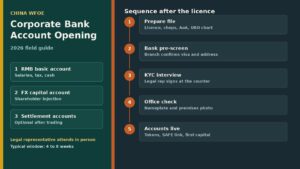
A China business licence is not enough to operate. Until the company has a corporate bank account, it cannot receive registered capital, pay tax, issue salaries, or settle with suppliers. For most foreign-invested enterprises, opening that account is now the longest and least predictable step in the whole setup. This guide explains which accounts a WFOE actually needs in 2026, what banks ask for, why the legal representative still has to appear in person, how long the process takes, and the mistakes that cause applications to stall. Which Bank Accounts a China WFOE Must Open A newly licensed WFOE normally needs two accounts on day one, and often a third once trading starts. RMB basic deposit account (基本存款账户). This is the company’s primary operating account under People’s Bank of China rules. It is the only account that can pay salaries, pay tax, and withdraw cash. A company may hold only one basic account. The bank that opens it is registered with the PBOC and later linked to the tax system. Foreign-currency capital account. This account receives registered capital from the overseas shareholder. It is opened at a bank that can handle SAFE (State Administration of Foreign Exchange) reporting. Capital must arrive from an account in the shareholder’s own name, in the currency stated in the Articles of Association. General RMB or settlement accounts. Extra RMB accounts and a foreign-currency current-account settlement account are optional but useful once the company starts invoicing customers or paying overseas suppliers. They cannot replace the basic account. Opening the basic account and the capital account at the same bank usually saves a second KYC round. How Long China Corporate Bank Account Opening Takes Plan on four to eight weeks after the business licence is issued. Document collection and a bank pre-screen take one to two weeks. The legal representative interview and compliance review take another two to four weeks. Online banking tokens and the SAFE link for the capital account add a further week or two. Domestic banks with an international desk in Shanghai, Shenzhen or Beijing sometimes finish faster when the file is complete. Foreign banks such as HSBC China or Standard Chartered China can be quicker for groups that already bank with them offshore, but their KYC is often stricter on ultimate beneficial owners. Bank fees themselves are modest, often zero to a few hundred US dollars. The real cost is travel time for the legal representative and any delay to capital injection. Documents Banks Ask For in 2026 Checklists differ by branch, but the core pack is consistent: Original business licence and several certified copies Articles of Association filed with SAMR, including the five-year capital contribution schedule Company chop, finance chop and legal representative chop, plus the bank’s specimen seal card Legal representative’s original passport and a valid visa or residence permit (a tourist L-visa is often refused) Shareholding chart through to natural-person ultimate beneficial owners Lease or property certificate for the registered address, plus the landlord’s title documents in many cities Board or shareholder resolution authorising the account A short description of expected counterparties, currencies and monthly volumes Overseas parent documents still need notarisation and apostille (or consular legalisation if the home country is not in the Hague Apostille Convention). Incomplete UBO charts and mismatched English names on passports are the two most common reasons a file is sent back. Why the Legal Representative Must Appear in Person Company registration can be handled remotely. Bank opening generally cannot. In 2026 almost every mainland bank requires the legal representative to sit in the branch, present the original passport, answer questions about the business model and source of funds, and sign the account forms. Powers of attorney and video calls are rarely accepted for the first basic account. A few foreign banks may allow video KYC when the group already has a relationship, but that should not be assumed when planning travel. Two practical workarounds exist if the overseas founder cannot fly: appoint a China-resident legal representative before incorporation, or choose a bank branch that will lock a date once the pre-screen is approved so the trip is a single appointment

China Company Setup for Foreigners in 2026: Entity Options, Process, Costs and Timeline
Setting up a company in China as a foreigner remains one of the most practical ways to access the domestic market, hire local staff, issue invoices, and operate with full legal standing. In 2026 the process is clearer than in previous years thanks to the Foreign Investment Law and the revised Company Law, yet several practical hurdles still catch first-time founders by surprise. This guide walks through the real decisions you face, the current entity options, the step-by-step registration flow, realistic timelines and costs, and the post-registration tasks that turn a business licence into a working company. Which Entity Structure Fits Your China Plans Foreign investors normally choose among five practical vehicles. The right choice depends on whether you need to generate revenue, hire employees, import goods, or simply explore the market first. Wholly Foreign-Owned Enterprise (WFOE) is the default for most operating businesses. It is a limited liability company owned 100 percent by foreign shareholders. A WFOE can trade, manufacture, provide services, open bank accounts, hire staff, and issue Chinese tax invoices (fapiao). No Chinese partner is required outside the Negative List sectors. Joint Venture (JV) is used when the business falls into a restricted sector on the Negative List or when a local partner brings essential licences, distribution networks or land rights. Setup is longer and governance more complex. Representative Office (RO) allows market research, liaison and quality control but cannot sign commercial contracts, issue invoices or generate revenue. It is cheaper and faster to establish yet limited in function. Branch Office is available mainly for foreign banks, insurance companies and certain specialised sectors. It is rarely used by ordinary trading or service companies. Employer of Record (EOR) lets you hire Chinese staff without forming an entity. Useful for testing the market with a small team, but you cannot issue local invoices or hold contracts in your own name. For the majority of service, trading and manufacturing projects outside restricted industries, a WFOE remains the most straightforward and controllable structure. Key Legal Changes Affecting China Company Setup in 2026 Two rules shape current practice. First, the 2020 Foreign Investment Law grants foreign investors national treatment in sectors not listed on the Negative List. The 2024 version of the Negative List reduced restricted items further, including the removal of remaining manufacturing restrictions. Second, the revised Company Law that took effect on 1 July 2024 requires shareholders of a limited liability company to contribute the full amount of subscribed registered capital within five years of establishment. There is still no statutory minimum capital for most industries, yet the five-year pay-in rule is strictly enforced. Articles of Association must state a clear capital contribution schedule. Document legalisation has also become simpler for investors from Hague Apostille Convention countries. A single apostille now replaces the old multi-step consular legalisation in many cases. Step-by-Step Process for Setting Up a WFOE The sequence is largely the same across major cities, although local Administration for Market Regulation (AMR / SAMR) offices differ slightly in processing speed and preferred documentation format. Confirm market access and define business scope. Check the latest Negative List. Draft a precise Chinese business scope that matches the activities you intend to perform. Scope wording is critical because banks, tax authorities and customs later rely on it. Choose city and registered address. Shanghai, Beijing, Shenzhen, Guangzhou and certain Free Trade Zones remain popular. Secure a lease that carries a valid property code; virtual addresses are accepted in many districts for service companies but not for manufacturing or trading that requires physical premises. Reserve the company name. Submit three to five Chinese name options in the format City + Unique Name + Industry + Limited Company. Approval usually takes one to three working days. Prepare incorporation documents. Articles of Association, shareholder identity documents or corporate certificates, bank reference letters and the lease. Corporate documents from the home country normally need notarisation and apostille (or consular legalisation if the home country is not an Apostille member). File with the local SAMR. Once documents are complete, the application for the business licence is submitted. In major cities the licence with the 18-digit Unified
China WFOE Annual Compliance and Tax Filing 2026
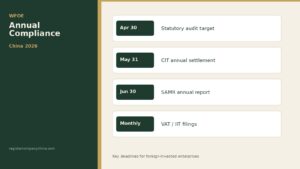
China WFOE Annual Compliance and Tax Filing 2026 A Wholly Foreign-Owned Enterprise does not finish its obligations when the business licence is issued. From the first full year of operation, the company sits inside a fixed compliance calendar that covers bookkeeping, tax returns, a statutory audit, corporate income tax settlement, and public annual reporting. Missing the main deadlines is expensive and visible. What annual compliance means for a WFOE Annual compliance is the set of recurring filings and reviews that keep the company in good standing with the tax bureau, the State Administration for Market Regulation, and, where relevant, foreign-exchange and customs systems. It includes monthly or quarterly VAT and surcharge filings, individual income tax withholding if there are employees, quarterly corporate income tax prepayments, a year-end statutory audit, the corporate income tax annual reconciliation, and the enterprise annual report published through the National Enterprise Credit Information Publicity System. Dormant companies are not exempt. A WFOE with no revenue still needs bookkeeping, nil tax filings where required, and the annual report. Treating inactivity as a pause is a common mistake and often ends with an abnormal-operations listing. The core 2026 deadline chain Most foreign finance teams work backward from three hard dates. Statutory audit target: end of April. A Chinese-registered CPA firm issues audited financial statements. Many tax bureaus will not accept the annual corporate income tax return without this report. Corporate income tax annual settlement: 31 May. This is the main tax deadline of the year. The company reconciles quarterly prepayments against final taxable profit, files the annual return, and pays any balance. Late payment attracts daily late fees. SAMR annual report and related foreign-investment reporting: 30 June. The company submits operating and shareholder information through the national publicity system. Failure can place the entity on the abnormal operations list, which affects banking, government procedures, and future changes. Alongside these annual items, VAT and individual income tax continue on a monthly or quarterly cycle, and corporate income tax is prepaid each quarter. Documents the tax and audit teams usually need Expect to prepare financial statements, bank reconciliations, fapiao and expense records, payroll and social insurance data if staff are on payroll, related-party transaction information where thresholds apply, and the signed audit report. R&D or preferential-rate claims need supporting project files; without them, deductions are often lost. What happens if you miss a deadline Late corporate income tax attracts daily late fees. Missed annual reporting can trigger listing on the abnormal operations registry, public credit impact, and friction with banks and regulators. Persistent non-compliance can complicate licence changes, profit repatriation, and eventual deregistration. Closing a WFOE already requires multi-year tax clearance; an unclean compliance history lengthens that process. Practical way to run the year Engage the CPA firm before year-end so fieldwork can start early in the new year. Keep bookkeeping current every month rather than reconstructing twelve months in April. Diary the 31 May and 30 June dates as non-negotiable. If the company is small or loss-making, file the annual tax return earlier in the window to leave room for bureau queries. Confirm local practice for audit timing and any city-level variations, especially for trading entities with customs obligations. China WFOE annual compliance and tax filing in 2026 is mostly calendar discipline. The rules are predictable. The cost of ignoring them is not. If your WFOE is approaching its first full compliance year, map the audit, May tax settlement, and June annual report together with ongoing monthly filings. That sequence is what keeps the company clear for banking, dividends, and future corporate changes.
WFOE Legal Representative Requirements in China 2026
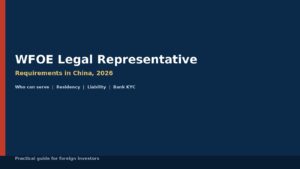
WFOE Legal Representative Requirements in China 2026 Every Wholly Foreign-Owned Enterprise needs one legal representative. The name sits on the business license, the person controls a personal chop, and Chinese banks, tax offices, and courts treat that individual as the company’s public face. Foreign founders still ask the same questions in 2026: does the legal representative have to be Chinese, live in China, or fly in for registration? This guide answers those points as SAMR offices and banks currently apply them. What the legal representative actually is Under the revised Company Law, the legal representative must be a natural person who is either a director carrying out company affairs or the general manager. A company cannot appoint another company. The role is printed on the business license and registered with the local Administration for Market Regulation. That person can sign contracts, instruct banks, and deal with regulators. Company actions taken in that capacity bind the WFOE. If the company later defaults on tax, labour, or court orders, enforcement tools such as consumption restrictions and exit bans can attach to the legal representative personally. That is why founders treat the appointment as a control decision, not a formality. Who can hold the role in 2026 Nationality is not a barrier. A foreign passport holder can serve. There is no statutory residency requirement and no rule that the person must hold a China work visa simply because of the title. Many WFOEs keep the founder overseas and run daily operations through a local general manager with a power of attorney. Disqualifications still apply. A candidate is blocked if they lack full civil capacity, have recent convictions for corruption, bribery, embezzlement or similar offences, are wanted by authorities, or are tied to unresolved liquidation or large unpaid debts. Local SAMR systems check identity against these lists at filing. The legal representative cannot also be the supervisor when a supervisor is appointed. The supervisor exists to watch the people who run the company. Small limited companies may, with unanimous shareholder consent, skip a standalone supervisor under the current law, but mixing the two seats when both exist is still rejected. Does the legal representative need to come to China? For SAMR registration itself, most cities now accept signed appointment papers, passport copies, and agent filings. Video identity checks appear in some districts. Founders routinely complete the licence without travelling. Bank account opening is the hard stop. Most mainland banks still require the legal representative to appear in person for KYC. A power of attorney rarely replaces that visit. Until the basic RMB account is live, the WFOE cannot receive capital or pay suppliers. Plan a short trip for banking even if registration is fully remote. Tax real-name verification after licensing is the other common in-person request. Some cities allow an authorised person to complete it; others want the legal representative. Confirm the local tax bureau rule before booking flights. Work visa and daily presence Holding the title does not automatically create a work relationship. If the legal representative lives abroad and only signs resolutions or visits on business trips, a Z visa is usually unnecessary. If that person will work and reside in China, the WFOE sponsors a work permit and residence permit like any other foreign employee. A WFOE can sponsor the legal representative and one other foreign manager early, even before large capital is injected. Extra foreign hires later often need a clearer payroll and capital story. Do not assume the title alone unlocks unlimited visas. Documents banks and SAMR expect Prepare a clear colour scan of a valid passport, a signed appointment letter, and a short resume. Foreign documents that support the parent company still need apostille after China joined the Apostille Convention. Chinese translations must come from a recognised translator. The articles of association should name the legal representative and describe how the role is filled or replaced. After the licence issues, carve the company chops, including the legal representative chop. In practice the chop, not a wet-ink signature, is what counterparties and banks accept. Changing the legal representative The seat can change. A successor should be appointed

What Is a WFOE in China?
What is a WFOE in China? Learn its legal structure, types, costs, setup steps, and how it compares to a JV or Rep Office. Start your China entry right.
